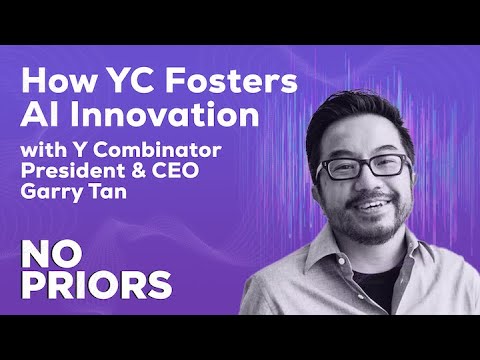
No Priors Ep 66 | With Y Combinator President and CEO Garry Tan
Elad Gil (host), Garry Tan (guest), Sarah Guo (host), Narrator, Narrator
In this episode of No Priors, featuring Elad Gil and Garry Tan, No Priors Ep 66 | With Y Combinator President and CEO Garry Tan explores garry Tan on YC, AI startup surge, and rebuilding San Francisco Garry Tan, President and CEO of Y Combinator, discusses YC’s evolution from a scrappy subculture to a defining institution for global startups, while arguing that its core philosophy—backing highly technical, clear-thinking founders—has stayed constant.
Garry Tan on YC, AI startup surge, and rebuilding San Francisco
Garry Tan, President and CEO of Y Combinator, discusses YC’s evolution from a scrappy subculture to a defining institution for global startups, while arguing that its core philosophy—backing highly technical, clear-thinking founders—has stayed constant.
He explains how AI is reshaping YC’s batches, with about 70% of companies now AI-related, and describes why he thinks “ChatGPT wrapper” is a misleading critique, likening LLMs to core primitives like databases or cloud, not mere features.
Tan outlines YC’s emphasis on first-hand customer insight, rapid shipping, and social pressure (like group office hours) as drivers of extreme early-stage growth, especially in the current AI wave where many startups achieve rapid revenue traction.
He also talks about his civic work in San Francisco, arguing for effective governance, strong public education (especially math), and more open, nuanced civic dialogue as essential to sustaining the city’s role as a global tech hub.
Key Takeaways
Highly technical founders who communicate clearly are YC’s enduring bet.
Regardless of hype cycles, YC prioritizes deeply technical people who can explain what they’re doing simply and who talk directly to customers, not just investors or other founders.
Get the full analysis with uListen AI
First-hand customer insight beats second- and third-hand ecosystem chatter.
Tan stresses that talking to users is “first-hand,” other founders are “second-hand,” and investors or media are “third- or fourth-hand,” so the best ideas come from direct engagement with a narrow, specific user segment.
Get the full analysis with uListen AI
AI ‘wrappers’ can be real businesses, like SaaS atop databases or cloud.
He rejects the idea that using an LLM API makes a startup trivial, comparing it to calling SaaS companies mere ‘MySQL wrappers’—the value is in workflow design, domain integration, and solving specific, painful problems.
Get the full analysis with uListen AI
Breaking work into precise, automatable steps is key to useful AI products.
Examples like Casetext show that mapping detailed “time and motion” of expert work (e. ...
Get the full analysis with uListen AI
AI is accelerating early revenue growth for young startups.
Recent YC batches saw average ARR jump from about $6M to over $30M in three months, which Tan attributes to AI’s ability to directly replace or augment expensive, repeatable knowledge work that companies already outsource or staff.
Get the full analysis with uListen AI
Too much capital can quietly kill discipline and necessary hard decisions.
Tan notes that companies which raise very large rounds can become structurally unable to cut 50–80% of staff when needed, drifting off course because the founders can’t make brutal but essential adjustments.
Get the full analysis with uListen AI
SF’s long-term vitality depends on effective public education and civic courage.
He argues that strong public math education and willingness to speak openly about policy tradeoffs are critical for giving diverse, non-wealthy kids access to tech opportunities and for maintaining San Francisco as a premier tech hub.
Get the full analysis with uListen AI
Notable Quotes
“YC started more like a punk club than an institution.”
— Garry Tan
“Talking to customers is first-hand; talking to investors is third-hand.”
— Garry Tan
“Calling AI products ‘ChatGPT wrappers’ is like calling SaaS ‘MySQL wrappers.’”
— Garry Tan
“If you can run fast for a long time, compounding takes care of the rest.”
— Garry Tan
“We need to save ambitious, optimistic people from investment banking and middle management.”
— Garry Tan
Questions Answered in This Episode
How should early-stage AI founders decide whether to build on existing models versus training their own foundation models, given the capital and talent requirements?
Garry Tan, President and CEO of Y Combinator, discusses YC’s evolution from a scrappy subculture to a defining institution for global startups, while arguing that its core philosophy—backing highly technical, clear-thinking founders—has stayed constant.
Get the full analysis with uListen AI
What concrete practices can non-YC founders adopt to recreate YC-style accountability and shipping culture in their own teams?
He explains how AI is reshaping YC’s batches, with about 70% of companies now AI-related, and describes why he thinks “ChatGPT wrapper” is a misleading critique, likening LLMs to core primitives like databases or cloud, not mere features.
Get the full analysis with uListen AI
Where does Tan think the next ‘Scale’ or ‘Stripe’ in the AI era is most likely to emerge—application layer, infra/tooling, or new foundation models?
Tan outlines YC’s emphasis on first-hand customer insight, rapid shipping, and social pressure (like group office hours) as drivers of extreme early-stage growth, especially in the current AI wave where many startups achieve rapid revenue traction.
Get the full analysis with uListen AI
How can San Francisco balance being a global tech hub with ensuring equitable access to quality public education and opportunity for non-elite communities?
He also talks about his civic work in San Francisco, arguing for effective governance, strong public education (especially math), and more open, nuanced civic dialogue as essential to sustaining the city’s role as a global tech hub.
Get the full analysis with uListen AI
What are the risks Tan sees in the current AI funding boom, and how can founders avoid being overcapitalized yet under-disciplined?
Get the full analysis with uListen AI
Transcript Preview
(instrumental music plays) So today on Underpriors, we're very lucky to have Garry Tan. Garry is currently the CEO... Is that- is that the right title?
Yeah. President and CEO-
The- the president and CEO of Y Combinator. Prior to that, he ran Initialized, a early stage venture fund. He started Posterous, which was acquired by Twitter, and has had a storied career working at a variety of Silicon Valley companies, including Palantir and others. Thank you so much for joining us today, Garry.
Thanks for having me. Well, this is gonna be our, uh, our first collabo e- episode. So part one on this podcast, part two, uh, over at the Garry Tan YouTube channel. So, thanks for having me. Thanks for doing the collab.
Super excited about it. Love to work with, like, a real creator. Um, okay, let's start with, like, you obviously need no introduction but people wanna know the story, like, how'd you go from being a founder to an investor at Y Combinator?
I think, uh, Paul Graham basically took a chance on me as a founder, and then later I got burnt out and, uh... Well, YC itself I like to think of as... You know, today people sort of look at it as this sort of institution, it's sort of the defining place where people wanna start their billion dollar companies. But I feel like in 2008 when I first found out- found out about it, it was a little bit more like, uh, you know, a punk club in the '90s in Seattle and, you know, sort of grunge was just getting started or something (laughs) . Like- like, these things are basically subcultures, and, uh, they sort of start off of the internet. And so one of the reasons why Y Combinator was so dominant and, you know, start- e- even had its chance to start was that, uh, Paul Graham's essays for, you know, sort of time immemorial, you know, from his experience creating Yahoo Stores, um, that he would write these essays that basically spoke to the experience of trying to start a company at that moment. So when you go around sort- sort of the legends of, uh, you know, YC, whether it's, you know, Patrick Collison at Stripe or, uh, my buddy Harj who I work with who co-founded a company with Patrick, um, you know, lots of people. Even me. I mean, I basically found out about starting a startup, uh, you know, from the news. Like, that suddenly, hey, there's this person who could sit in front of a computer, create software that could then touch a billion people, and was like, "Oh, it's, like, perfect mimesis." You're like, "Oh, I- I want that. How do I do it?" And then you go into Google and you type in, "Start a startup," and, uh, you find Paul Graham's essays (laughs) . And then increasingly they're finding this pod, and they're finding my YouTube channel, and they're finding the Y Combinator YouTube channel, and, uh, you know, I think all of that is sort of the direction we're going in. But that's how it started. It was like literally starting a company was a very strange thing. Like, when all of us came into tech that was, I- I think, more true. Today, I think it's something that a lot more people aspire to, and that's a really, really good thing, and that's sort of what we want.
Install uListen to search the full transcript and get AI-powered insights
Get Full TranscriptGet more from every podcast
AI summaries, searchable transcripts, and fact-checking. Free forever.
Add to Chrome