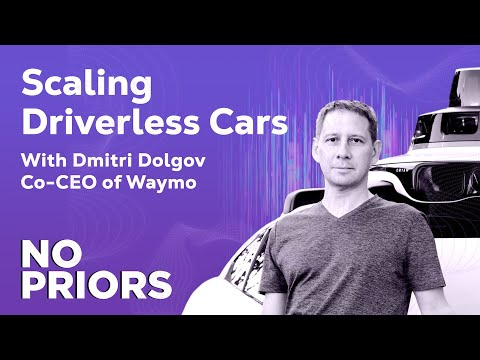
No Priors Ep. 87 | With Co-CEO of Waymo Dmitri Dolgov
Sarah Guo (host), Elad Gil (host), Dmitri Dolgov (guest), Sarah Guo (host), Sarah Guo (host)
In this episode of No Priors, featuring Sarah Guo and Elad Gil, No Priors Ep. 87 | With Co-CEO of Waymo Dmitri Dolgov explores waymo’s Co-CEO Explains Cracking Full Autonomy And Scaling Robo‑taxis Dmitri Dolgov, co-CEO of Waymo, traces the company’s evolution from Google’s 2009 Chauffeur project to today’s large-scale robo‑taxi service delivering over 100,000 paid rides per week.
Waymo’s Co-CEO Explains Cracking Full Autonomy And Scaling Robo‑taxis
Dmitri Dolgov, co-CEO of Waymo, traces the company’s evolution from Google’s 2009 Chauffeur project to today’s large-scale robo‑taxi service delivering over 100,000 paid rides per week.
He explains how successive “generations” of the Waymo Driver, driven largely by AI breakthroughs (ConvNets, transformers, larger models, VLMs) plus a robust simulation and evaluation stack, enabled a decisive jump to reliable full autonomy.
Waymo now claims safety performance significantly better than human drivers, and Dolgov stresses that building and *evaluating* the driver—along with a cautious, trust‑earning rollout—are as critical as the core AI itself.
Looking forward, Waymo’s primary near‑term business is ride hailing, but its generalized driver is intended to extend to deliveries, trucking, and other vehicle platforms in partnership with OEMs.
Key Takeaways
Full autonomy required a pivot away from driver assistance toward solving the entire driving task.
Waymo initially considered an advanced driver‑assist product but decided around 2013 that incremental assistance wouldn’t deliver the safety and impact they wanted; the company refocused on removing the human from the loop entirely.
Get the full analysis with uListen AI
AI architectural leaps plus a strong evaluation machine enabled the ‘nut‑cracking’ moment.
ConvNets (post‑AlexNet) gave an early boost but plateaued; transformers, larger models, more compute, and a rigorous data/simulation‑driven evaluation pipeline together produced the performance jump that made broad deployment viable.
Get the full analysis with uListen AI
Evaluating an autonomous driver is as hard and important as building it.
Waymo relies on hundreds of safety and performance metrics, large‑scale simulation (open‑loop and closed‑loop), and a formal readiness and safety framework; this system underpins their confidence in deployment decisions and safety claims.
Get the full analysis with uListen AI
Waymo’s autonomous service now empirically outperforms human drivers on safety.
Based on 22 million+ fully driverless miles, Waymo reports roughly 2x fewer low‑severity collisions and 6x fewer airbag‑deployment crashes than human benchmarks, and a Swiss Re study found 4x fewer damage claims and zero bodily injury claims in its dataset.
Get the full analysis with uListen AI
Scaling safely is constrained more by trust and process than raw technology.
Despite exponential mileage growth, Dolgov emphasizes gradual rollouts, transparency with regulators and communities, and the fragility of public trust as the primary gating factors to faster deployment, not just capital or engineering capacity.
Get the full analysis with uListen AI
Redundancy in sensing is currently necessary to meet a very high safety bar.
While in theory a camera‑only system can ‘drive,’ Waymo’s empirical tests show that removing LiDAR or radar degrades performance below their standards for full autonomy at scale; simplification is pursued carefully while maintaining required safety ‘nines.’
Get the full analysis with uListen AI
Ride hailing is the near‑term focus, but the Waymo Driver is designed to be generalizable.
Waymo aims to be a ‘driver’ company that partners with OEMs and ecosystem players; after ride hailing, the same core driver could power delivery, long‑haul trucking, and eventually personally owned autonomous vehicles.
Get the full analysis with uListen AI
Notable Quotes
“The complexity is in the long tail of the many, many nines.”
— Dmitri Dolgov
“It’s all about AI. Full stop.”
— Dmitri Dolgov
“We are starting to actually earn the right to talk about realizing the mission of making roads safer.”
— Dmitri Dolgov
“Trust is this thing that’s hard to earn, but very easy to lose.”
— Dmitri Dolgov
“We think of what we’re doing as building the driver. You put the driver in, but you still need the car.”
— Dmitri Dolgov
Questions Answered in This Episode
If the main bottleneck is public trust, what concrete steps could further accelerate societal comfort with fully driverless vehicles?
Dmitri Dolgov, co-CEO of Waymo, traces the company’s evolution from Google’s 2009 Chauffeur project to today’s large-scale robo‑taxi service delivering over 100,000 paid rides per week.
Get the full analysis with uListen AI
How might future AI breakthroughs—beyond transformers and current VLMs—change Waymo’s sensor requirements or safety margins?
He explains how successive “generations” of the Waymo Driver, driven largely by AI breakthroughs (ConvNets, transformers, larger models, VLMs) plus a robust simulation and evaluation stack, enabled a decisive jump to reliable full autonomy.
Get the full analysis with uListen AI
At what point would Waymo feel comfortable significantly simplifying the sensor suite without compromising its current safety advantage over humans?
Waymo now claims safety performance significantly better than human drivers, and Dolgov stresses that building and *evaluating* the driver—along with a cautious, trust‑earning rollout—are as critical as the core AI itself.
Get the full analysis with uListen AI
How will the economics of robo‑taxis compare to private car ownership once Waymo reaches much larger scale in multiple cities?
Looking forward, Waymo’s primary near‑term business is ride hailing, but its generalized driver is intended to extend to deliveries, trucking, and other vehicle platforms in partnership with OEMs.
Get the full analysis with uListen AI
What governance or regulatory frameworks would best balance innovation, competition, and safety in a world where AI, not humans, is doing most of the driving?
Get the full analysis with uListen AI
Transcript Preview
(music plays) Hi, listeners. Welcome to No Priors. Today, we're hanging out with Dmitry Dolgov, co-CEO of Waymo. Waymo started as the Chauffeur Project within Google back in 2009, and eventually spun off as its own company. Now it provides over 100,000 paid rides each week across San Francisco, LA, Austin, and Phoenix. I love taking Waymos, and I'm regularly campaigning for better South Bay coverage. We're excited to dig into all things robo-taxis, self-driving, what it takes to deploy this technology on a mass scale, and what's next for Waymo.
Hi, Dmitry. Thank you so much for joining us today.
Thank you for having me.
Yeah. Uh, maybe we can start off with just a little bit of a history of, um, self-driving at Google, how you got involved, and how things have evolved over time.
I've been do- doing this for, you know, quite a few years. I think, uh, about 18 now. I got started in, uh, around 2006. Uh, this was the time of the DARPA Grand Challenges. Um, this was when, you know, DARPA organized, uh, a few competitions, uh, that they called the Grand Challenge in robotics, uh, uh, for the, uh, with the purpose of advancing research in autonomous vehicles, right? So the first competition they had was the first Grand Challenge. This was, uh, the challenge there was to create a car that could drive autonomously in a desert. I just completed this deck and why I'm gonna, you know, drive for about 100 miles. Uh, nobody succeeded, but, you know, there was a lot of great progress that was made, and then they repeated the challenge, and a few teams succeeded. So on the heels of that, they created another challenge th- called the DARPA Urban Challenge, uh, where the setup was, uh, kind of a mock, uh, city that was supposed to imitate, you know, what driving on public roads is like. And that's the one, uh, that, uh, I was involved in. I was on Stanford's team. This was kind of my, you know, uh, moment where it clicked for me.
Mm-hmm.
I saw the, you know, the future and the benefits, and I've never looked back. That's what I've been doing ever since. Uh, and then, uh, we started this project at Google in 2009. Uh, it was just me and a small group of us, uh, and then that grew into what now is Waymo, uh, when we started the company, uh, in the very beginning of 2017.
All right. Yeah, it seems like a lot of the, um, lineage or history of this field all traces back to a handful of labs. You know, it's like Sebastian Thrun's lab at Stanford and a few others, and it seems like the founders of a lot of the companies that ended up eventually existing in this ecosystem all came out of the same sort of cohort of people, which I always think is fascinating to think about in terms of lineages.
Install uListen to search the full transcript and get AI-powered insights
Get Full TranscriptGet more from every podcast
AI summaries, searchable transcripts, and fact-checking. Free forever.
Add to Chrome