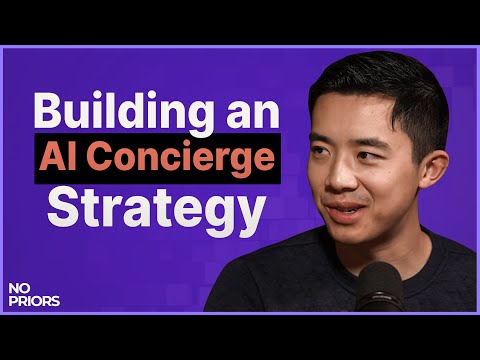
No Priors Ep. 132 | With Decagon CEO and Co-Founder Jesse Zhang
Elad Gil (host), Jesse Zhang (guest), Sarah Guo (host)
In this episode of No Priors, featuring Elad Gil and Jesse Zhang, No Priors Ep. 132 | With Decagon CEO and Co-Founder Jesse Zhang explores decagon’s AI Concierge Is Quietly Reinventing Enterprise Customer Conversations Globally Decagon CEO and co-founder Jesse Zhang explains how the company builds AI customer service agents that handle high-volume, complex conversations for major enterprises like banks, airlines, and telcos. The agents integrate into existing systems and replace mundane human labor while improving both efficiency and customer satisfaction, often cutting contact center costs by 60–70%. Zhang discusses how second-time founding, commercial discipline, and an intense in-office culture helped Decagon reach large enterprises quickly and scale past 200 employees. He also explores pricing models, defensibility versus foundation model providers, and a future where consumer and enterprise agents talk directly to each other to get things done.
Decagon’s AI Concierge Is Quietly Reinventing Enterprise Customer Conversations Globally
Decagon CEO and co-founder Jesse Zhang explains how the company builds AI customer service agents that handle high-volume, complex conversations for major enterprises like banks, airlines, and telcos. The agents integrate into existing systems and replace mundane human labor while improving both efficiency and customer satisfaction, often cutting contact center costs by 60–70%. Zhang discusses how second-time founding, commercial discipline, and an intense in-office culture helped Decagon reach large enterprises quickly and scale past 200 employees. He also explores pricing models, defensibility versus foundation model providers, and a future where consumer and enterprise agents talk directly to each other to get things done.
Key Takeaways
AI agents can dramatically reduce contact center costs while improving satisfaction.
Decagon’s enterprise deployments have shown 60–70% reductions in contact center spend, while maintaining or improving customer satisfaction scores, making the ROI case straightforward for large organizations.
Get the full analysis with uListen AI
Success in AI enterprise adoption is increasingly top-down and board-driven.
Unlike prior tech waves that started with single teams experimenting, AI adoption is now framed as company-wide “AI transformation,” with C-suites prioritizing customer service as low-hanging fruit.
Get the full analysis with uListen AI
A productized, non-technical-friendly platform is a key differentiator in enterprise AI.
Decagon explicitly designs its system so business users, not just engineers, can configure, iterate, and analyze AI agents—contrasting with legacy SaaS that required heavy technical implementation and maintenance.
Get the full analysis with uListen AI
Early-stage AI startups benefit from intense, in-office, execution-focused cultures.
Zhang argues that most leading AI companies are heavily in-office because colocation radically accelerates iteration speed, especially before the company reaches larger scale where remote can be more workable.
Get the full analysis with uListen AI
Founders must deliberately shift from short-term deals to long-term product and org design.
Once initial product-market fit is found, continuing to optimize only for near-term customer wins leads to future bottlenecks; investing in core product capabilities and thoughtful org structure prevents later breakdowns.
Get the full analysis with uListen AI
The right pricing metric for agents is the business outcome, not usage minutiae.
For customer service, pricing per resolved conversation aligns with how enterprises already model cost per contact and avoids per-minute incentives that would encourage unhelpfully long interactions.
Get the full analysis with uListen AI
AI agents will evolve from reactive support to full-funnel “concierge” experiences.
Zhang envisions agents that handle everything from pre-purchase questions to proactive outreach and upsell, and eventually interacting with users’ personal agents—effectively making conversational agents the primary UI to brands.
Get the full analysis with uListen AI
Notable Quotes
“You can kind of think of us as a conversational UI for the brand.”
— Jesse Zhang
“We’ve done case studies now where folks have been able to cut [contact center spend] down by 60–70%.”
— Jesse Zhang
“One of the things that LLMs unlock is that you can really empower the non-technical business users.”
— Jesse Zhang
“If you join a pre-PMF team and you never actually get to see the commercials in action, you’re not really learning much.”
— Jesse Zhang
“Eventually you want this to be a unified concierge experience… it becomes the go-to way that [customers] interact.”
— Jesse Zhang
Questions Answered in This Episode
How will enterprises manage governance, auditing, and compliance as AI agents take over a majority of customer conversations?
Decagon CEO and co-founder Jesse Zhang explains how the company builds AI customer service agents that handle high-volume, complex conversations for major enterprises like banks, airlines, and telcos. ...
Get the full analysis with uListen AI
What specific product or org mistakes from his first startup most shaped how Jesse designed Decagon’s commercial strategy?
Get the full analysis with uListen AI
How could foundation model providers like OpenAI or Anthropic most realistically threaten or complement Decagon’s position over the next five years?
Get the full analysis with uListen AI
What are the hardest edge cases in customer service that Decagon’s AI still struggles to handle without human intervention?
Get the full analysis with uListen AI
How might widespread agent-to-agent interactions change the economics and design of consumer products and services beyond customer support?
Get the full analysis with uListen AI
Transcript Preview
(music plays) Today, we're lucky to have with us on No Priors Jesse Zhang. Jesse is the co-founder and CEO of Decagon, which provides customer service and other related AI for all sorts of different enterprises, including banks, telecom providers, airlines, and of course, many of the biggest and most important tech companies. Jesse prior started Loki, which was acquired by Niantic, and we're very excited to have him join us today on No Priors. Jesse, thanks for joining us today on No Priors.
Thanks for having me.
Can you tell us a little bit about Decagon and why you started the company, how you started it, how you all got going?
Yeah, of course. So Decagon, for those who are not really familiar with us, we're an AI customer service agent. And so you can kind of think of us, you know, if we're working with a large bank or airline, or just people that have large contact volume, the AI's job is to, you know, have a very engaging and personalized conversation with the user and resolve it and, you know, s- save the- the company a bunch of money and, you know, ideally drive more revenue in the future 'cause folks are more engaged. And as we, as we've grown, it's kind of becoming more and more of a... You gotta think of like a conversational UI for the brand, where it's- it's how every user can interact with it. And we often use the term, like, concierge to describe this, but, um, that's what we do.
And you're working right now with some big banks, or some of the world's biggest banks. You're working with airlines, telcos. Like, you've actually gotten to very big customers very quickly. How did- how did you go about doing that, or how did it happen?
Yeah, so I mean, uh, as you know, we started out mostly with the, like, digital native companies. A lot of startups do that. And digital natives, of course, are much more willing to try out startups. They can move faster. They can get a lot of-
So that'd be like late-stage tech companies and things like that, yeah.
Yeah, like, uh, like Ripley and Notion, folks like them. They were, like, great partners, and they also just helped us iterate on the product a lot. So that's where we started. As we've gone on, I think just naturally, we were kind of pulled that market just 'cause of the demand. And as you might imagine, those- that's where most the large contact volumes are. So it just happened a lot faster than we thought, and I would say a lot of these enterprise also moved a lot faster than we would have expected. Um, so that's- that's why we ended up there.
Mm-hmm. And that's one of the underappreciated things about AI traction, is a lot of companies are willing to try things in a way they weren't willing to before because it's such a big technology shift. And so all these markets are kinda open now that weren't before, or that would be much harder to do.
Install uListen to search the full transcript and get AI-powered insights
Get Full TranscriptGet more from every podcast
AI summaries, searchable transcripts, and fact-checking. Free forever.
Add to Chrome