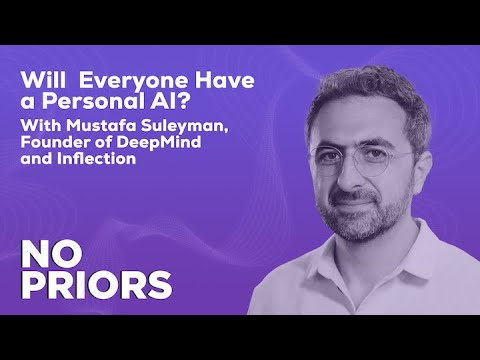
No Priors Ep. 16 | With Mustafa Suleyman, Founder of DeepMind and Inflection
Narrator, Mustafa Suleyman (guest), Sarah Guo (host), Elad Gil (host), Sarah Guo (host)
In this episode of No Priors, featuring Narrator and Mustafa Suleyman, No Priors Ep. 16 | With Mustafa Suleyman, Founder of DeepMind and Inflection explores mustafa Suleyman on Personal AI, Governance, and the Coming Wave Mustafa Suleyman traces his path from youth counseling and conflict-resolution work to co-founding DeepMind and now Inflection AI, explaining how systems-level impact and framing conversations led him toward AI.
Mustafa Suleyman on Personal AI, Governance, and the Coming Wave
Mustafa Suleyman traces his path from youth counseling and conflict-resolution work to co-founding DeepMind and now Inflection AI, explaining how systems-level impact and framing conversations led him toward AI.
He recounts DeepMind’s thesis around general intelligence, transfer learning, and landmark achievements like AlphaGo and AlphaFold, while reflecting on how definitions of intelligence and model architectures have evolved.
Suleyman explains why Inflection’s first product, Pi, is built around empathetic conversation and personal alignment rather than pure information retrieval, arguing that conversational AI will replace today’s search- and SEO-dominated interfaces.
He discusses the risks of echo chambers and the need for democratic oversight of powerful recommendation/AI systems, outlines Inflection’s culture and technical approach to scaling models, and previews his book on AI, synthetic biology, and geopolitics.
Key Takeaways
Impact at scale requires shifting from one-to-one services to systems-level levers.
Suleyman moved from direct counseling and facilitation into AI because he concluded that traditional governance and human processes could not keep pace with global challenges or technological change.
Get the full analysis with uListen AI
Generality is not the only or best definition of intelligence in AI systems.
He argues that the crucial capability is intelligent routing of attention and computation to the right tools or expert models in context, rather than a single monolithic model that does everything.
Get the full analysis with uListen AI
Conversational AI will supplant search-style interfaces as the primary way we compute.
Today’s web is distorted by SEO and ad incentives; Suleyman believes natural-language dialogue with AI that summarizes, personalizes, and iteratively refines answers will become the dominant interface.
Get the full analysis with uListen AI
Personal AIs aligned to individuals will coexist with countless brand, business, and institutional AIs.
He envisions an ecosystem of hundreds of millions or billions of agents—your personal AI talking to other entities’ AIs on your behalf—rather than a world dominated by just a few mega-assistants.
Get the full analysis with uListen AI
Echo chambers are the default trajectory unless AI platforms accept curatorial responsibility.
Drawing on the social media experience, he insists that recommendation and AI systems are inherently political, require transparent curation, and must be made accountable to democratic oversight bodies.
Get the full analysis with uListen AI
Model progress is driven by compounding exponentials in compute, data, and efficiency.
Compute for frontier models has grown by ~10x per year, data has exploded, and architectural advances (e. ...
Get the full analysis with uListen AI
User interaction data and long-term memory will be key differentiators for personal AIs.
Pi’s early users already volunteer rich personal information; Suleyman sees capturing, organizing, and using this safely as essential to building a “second mind” that truly reflects and serves the user.
Get the full analysis with uListen AI
Notable Quotes
“Learning to speak other people's social languages is actually an acquired skill, and you really can do it with a little bit of attention to detail and some patience and care.”
— Mustafa Suleyman
“Conversation is the future interface, and Google is already a conversation—it’s just an appallingly painful one.”
— Mustafa Suleyman
“We’ve learnt to speak Google. That’s just a weird lexicon that we’ve co-developed with Google over 20 years. Now that has to stop.”
— Mustafa Suleyman
“There are going to be hundreds of millions of AIs or billions of AIs, and they’ll be aligned to individuals.”
— Mustafa Suleyman
“The platforms were never neutral. That was the big lie.”
— Mustafa Suleyman
Questions Answered in This Episode
How can we practically design AI “routers” that choose among tools and models while remaining transparent and auditable?
Mustafa Suleyman traces his path from youth counseling and conflict-resolution work to co-founding DeepMind and now Inflection AI, explaining how systems-level impact and framing conversations led him toward AI.
Get the full analysis with uListen AI
What governance structures or institutions does Suleyman think are realistically capable of overseeing powerful AI platforms in the next decade?
He recounts DeepMind’s thesis around general intelligence, transfer learning, and landmark achievements like AlphaGo and AlphaFold, while reflecting on how definitions of intelligence and model architectures have evolved.
Get the full analysis with uListen AI
How can personal AIs avoid reinforcing users’ biases while still feeling aligned, supportive, and nonjudgmental?
Suleyman explains why Inflection’s first product, Pi, is built around empathetic conversation and personal alignment rather than pure information retrieval, arguing that conversational AI will replace today’s search- and SEO-dominated interfaces.
Get the full analysis with uListen AI
In a world of billions of AIs, how will economic value and attribution flow back to original human creators and publishers?
He discusses the risks of echo chambers and the need for democratic oversight of powerful recommendation/AI systems, outlines Inflection’s culture and technical approach to scaling models, and previews his book on AI, synthetic biology, and geopolitics.
Get the full analysis with uListen AI
What lessons from AlphaFold’s success in scientific discovery can be generalized to tackle other complex global problems using AI?
Get the full analysis with uListen AI
Transcript Preview
(instrumental music plays) Today on No Priors, we're speaking with Mustafa Suleyman, co-founder of DeepMind, the pioneering AI lab acquired by Google in 2014 for $650 million, and now co-founder and CEO of Inflection, along with Reid Hoffman and Karine Simonyan. Inflection just launched their first public product, Pi, last week. Mustafa, welcome to No Priors. Thanks so much for joining us.
Thanks for having me. I'm super excited to be here.
Yeah. We're- we're very excited to have you today. I think one thing that'd be great to maybe start with is just a little bit of your personal story, because I think you have a really unique background. You're very well-known obviously for, um, DeepMind and your pioneering work in the AI world. But I think before all that, you worked on a Muslim youth helpline, you started a partnership and consultancy that was focused on conflict resolution to navigate social problems. I'd just love to hear a little bit more about the early days of things that you did before, uh, DeepMind, and then maybe we could talk a little about DeepMind and- and, sort of, more recent stuff as well.
Yeah, sure. I mean, the truth is, I- I was very much a, kind of, change-the-world kid growing up. Like, um, a big believer in grand visions, doing good, having a huge impact in the world. And that was always, kind of, what drove me. Um, so when I... I grew up in London and went to Oxford, um, but at the end of the second year of my philosophy degree, I was, kind of, getting a bit frustrated with the, sort of, theoretical, you know, nature of it all. It was full of hypothetical moral quandaries. And, um, so a friend that I met, um, at Oxford was starting a telephone counseling service, a- a, kind of, helpline, and it really appealed to me. It was a non-judgmental, non-directional, secular support service for young British Muslims, and this was, like, about six months after the 9/11 attacks, and so there was quite a lot of, like, rising Islamophobia and the government was talking a lot about anti-terrorism and, you know, in general, I think that, like, sort of, migrant communities were feeling the pressure and, um, this was a support service that was staffed entirely by us, by young people. I was 19 at the time. And, yeah, I spent, uh, almost three years working pretty much full time on- on that. And it was an incredible experience, because it was basically my first startup and, you know, fundraising was the name of the game, except the numbers were much, much smaller than they are these days. Uh, and, you know, the surf- the service was staffed by almost 100 volunteer young people, which was just amazing 'cause we felt like we can actually do something, you know? It was quite liberating and energizing to actually give this a shot. And, you know, I was very much inspired by the kind of human rights principles. It was deliberately not religious, even though it used some of the kind of culturally sensitive language that help people feel heard and understood. Um, so yeah, it's had a- a very formative impact on my- my outlook.
Install uListen to search the full transcript and get AI-powered insights
Get Full TranscriptGet more from every podcast
AI summaries, searchable transcripts, and fact-checking. Free forever.
Add to Chrome