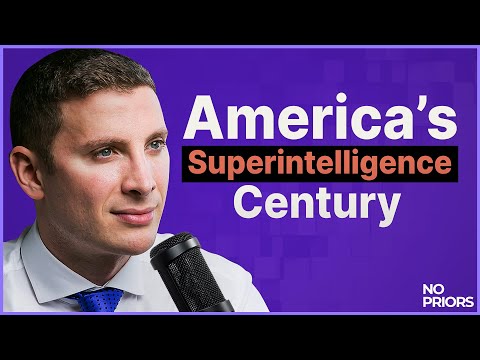
No Priors Ep. 129 | With U.S. Under Secretary of State (E) Designate Jacob Helberg
Sarah Guo (host), Jacob Helberg (guest), Sarah Guo (host), Elad Gil (host), Narrator
In this episode of No Priors, featuring Sarah Guo and Jacob Helberg, No Priors Ep. 129 | With U.S. Under Secretary of State (E) Designate Jacob Helberg explores superintelligence, Supply Chains, and Nuclear: Rebuilding American Economic Power Jacob Helberg, U.S. Under Secretary of State (E) designate, outlines a vision of America shifting from a consumption-heavy, services-led economy toward a high-investment, reindustrializing nation powered by AI and abundant energy.
Superintelligence, Supply Chains, and Nuclear: Rebuilding American Economic Power
Jacob Helberg, U.S. Under Secretary of State (E) designate, outlines a vision of America shifting from a consumption-heavy, services-led economy toward a high-investment, reindustrializing nation powered by AI and abundant energy.
He argues that securing supply chains—especially critical minerals, semiconductors, and component manufacturing—and reducing dependence on China is now core to U.S. national security and economic strategy.
Helberg sees AI as a major productivity engine that can erase low-cost labor advantages, trigger a “second Great Divergence,” and enable advanced economies to re-shore manufacturing at scale.
A central pillar of his agenda is rapidly expanding energy supply, particularly through nuclear, and leveraging capital and energy partnerships with the Middle East to support data centers, manufacturing, and long-term growth.
Key Takeaways
Securing critical supply chains is now a front-line national security priority.
With 90% of critical mineral refining in China and heavy dependence on Taiwanese semiconductors, Helberg argues the U. ...
Get the full analysis with uListen AI
AI-driven productivity can overturn the ‘service-economy destiny’ narrative.
He contends that agentic AI will give workers “superpowers,” making high-wage economies competitive again in manufacturing by eroding low-cost labor advantages in developing countries.
Get the full analysis with uListen AI
Targeted industrial policy and offtake agreements can rebuild key industries.
The DoD–MP Materials rare earth magnet deal (anchor buyer plus price floor) is presented as a repeatable blueprint to counter Chinese price manipulation and make Western refining and component manufacturing viable again.
Get the full analysis with uListen AI
Nuclear power is essential to achieving energy abundance for the AI era.
Given flat U. ...
Get the full analysis with uListen AI
Reducing regulatory and permitting friction is as important as new capital.
Helberg stresses that compressing project timelines (e. ...
Get the full analysis with uListen AI
Global AI competition will be fought over full-stack “intelligence exports.”
He expects the U. ...
Get the full analysis with uListen AI
The U.S. administration is positioning itself as aggressively pro‑builder.
Helberg frames current policy—permitting reform, tax incentives, openness to foreign investment from trusted partners—as “shock therapy” to make America the best destination for capital and to catalyze large-scale building.
Get the full analysis with uListen AI
Notable Quotes
“We have one of the best innovation ecosystems in the world, but that innovation ecosystem is sitting on top of a supply chain system that is very exposed.”
— Jacob Helberg
“AI will, far from replacing humans altogether, actually give workers superpowers and massively increase productivity.”
— Jacob Helberg
“The defining feature of this century is not the rise of China; it’s really the rise of super intelligence.”
— Jacob Helberg
“The one thing France got right in the last 45 years is that it gets 75% of its total energy supply from nuclear.”
— Jacob Helberg
“This is a pro‑builder administration… the policies have really amounted to shock therapy to help facilitate building in America as much as possible.”
— Jacob Helberg
Questions Answered in This Episode
How quickly can the U.S. practically reduce its dependence on Chinese refining and Taiwanese semiconductor manufacturing without destabilizing global markets?
Jacob Helberg, U. ...
Get the full analysis with uListen AI
What specific policy levers would most effectively accelerate nuclear deployment in the U.S. while maintaining safety and public trust?
He argues that securing supply chains—especially critical minerals, semiconductors, and component manufacturing—and reducing dependence on China is now core to U. ...
Get the full analysis with uListen AI
If AI triggers a “second Great Divergence,” how should developing countries that currently rely on cheap labor reposition their economic strategies?
Helberg sees AI as a major productivity engine that can erase low-cost labor advantages, trigger a “second Great Divergence,” and enable advanced economies to re-shore manufacturing at scale.
Get the full analysis with uListen AI
How can the U.S. promote an open, secure AI stack abroad that competes effectively with Chinese offerings without over-regulating domestic innovators?
A central pillar of his agenda is rapidly expanding energy supply, particularly through nuclear, and leveraging capital and energy partnerships with the Middle East to support data centers, manufacturing, and long-term growth.
Get the full analysis with uListen AI
What governance and security frameworks are needed to make large-scale energy and compute partnerships with Middle Eastern countries both attractive and safe?
Get the full analysis with uListen AI
Transcript Preview
(digital music) Hi, listeners. Welcome back to No Priors. Today, Elad and I are here with Jacob Helberg, the under secretary of state designate for economic growth, energy, and the environment, co-founder of the Hill and Valley Forum, connecting Silicon Valley to policymakers in D.C., and author of the book The Wires of War: Technology and the Global Struggle for Power. We talk about what America needs to change about its global supply chain, why nuclear is the key to energy abundance, the return of American manufacturing, and super intelligence as a means for productivity and economic growth. Jacob, thanks so much for being here.
Thanks for having me.
So, very exciting, uh, in terms of your new role as under secretary for, um, economic growth, energy, and the environment. Uh, can you start by just, like, telling us a little bit about what your initial agenda is or what you're excited about?
A few of the topics that I discussed in my opening statement in my senate confirmation are, (clears throat) um, focused on securing our supply chains. Our economy is extremely over-reliant on a supply chain system that's very brittle. We have 90% reliance on, uh, uh, critical minerals that are refined in China, on semiconductors that are manufactured in Taiwan. Um, we have one of the best innovation ecosystems in the world but that innovation ecosystem is sitting on top of a supply chain system that is very exposed to ge- potential geopolitical disruptions. And so helping move the needle to, uh, forge new partnerships with other countries to secure that is, is indispensable, uh, as well as supporting ongoing efforts by the administration to re-shore as much as we can right here in the US would really go a long way to help give our builders the tools that they need to do what they do best, which is build products people love that are disruptive and that help grow the American economy.
What, what are some of those things that you think are most important to re-shore? And I, I think you also have sort of a broader purview of the anatomy of the US economy changing and mutating, and could you actually give us the big picture, and then kind of the specifics in terms of how you think things are shifting, and then what do you think is most important to kind of bring back?
Yeah, totally. So one of the fascinating things about the, this current era and, and decade that we're in is, um, we're actually really seeing the juxtaposition between the macroeconomic effects of the policies implemented by the Trump administration, uh, juxtaposed with, um, an incredibly powerful technological shifts, especially in artificial intelligence. And what I mean by that is President Trump came in and (clears throat) instated a blitzkrieg of policy reforms, uh, fast-tracking data center permits. Uh, on day one, he rolled out an EO to unleash American energy, to facilitate and support, um, the production, uh, to surge production capacity for energy sources like oil, oil, gas, and nuclear, um, as well as clean, beautiful coal, as he says. Um, and, and so the, the net effect of all of these different policies, uh, combined with incredibly fast-paced progress in artificial intelligence is actually, um, changing, uh, the makeup of our economy. And we're, we're starting to see that in the data because for a long time, the American economy was primarily a consumption-driven economy. We have, you know, at different points in time for the last few decades been between 70 and 80% consumption driven. Over two-thirds of our economy have been entirely driven by services, um, and about 10% has been manufacturing, and we're starting to see those numbers move. And, um, the manufacturing makeup of our economy as a share of GDP has remained, as of now, um, roughly the same, but that's a lagging indicator. The more interesting one is we're seeing massive capex investment, as you guys know, um, that has really picked up in a statistically significant way. Um, it's, it's over 2% of GDP right now, and it's probably gonna double by next year. Part of that is, um, the result of tax incentives. Part of that is just making it easier to, um, to get permitting, because as you guys know, a lot of this stuff boils down to how do you compress the window be- when you wanna make a capex investment, um, (clears throat) you know, the business people make a decision about whether or not it's gonna take seven years or five years to actually get something up and running, and compressing that window as much as possible actually, uh, really moves the needle.
Install uListen to search the full transcript and get AI-powered insights
Get Full TranscriptGet more from every podcast
AI summaries, searchable transcripts, and fact-checking. Free forever.
Add to Chrome