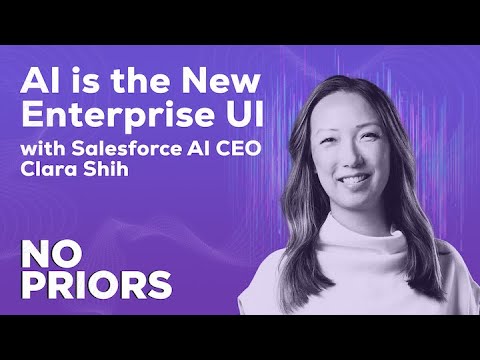
No Priors Ep. 43 | With Clara Shih, CEO of Salesforce AI
Elad Gil (host), Clara Shih (guest), Sarah Guo (host)
In this episode of No Priors, featuring Elad Gil and Clara Shih, No Priors Ep. 43 | With Clara Shih, CEO of Salesforce AI explores salesforce AI CEO Clara Shih on Data, Copilots, and Enterprise Adoption Clara Shih, CEO of Salesforce AI, explains how Salesforce evolved from early NLP and transformer models into a broad generative AI platform spanning every Salesforce cloud.
Salesforce AI CEO Clara Shih on Data, Copilots, and Enterprise Adoption
Clara Shih, CEO of Salesforce AI, explains how Salesforce evolved from early NLP and transformer models into a broad generative AI platform spanning every Salesforce cloud.
Salesforce is pursuing an open architecture that combines in-house and third‑party models, wrapped in a unified Copilot and Copilot Studio platform for prompts, actions, and bring‑your‑own‑models.
Enterprise adoption of generative AI is still early—"second or third inning"—with leaders already deploying production use cases while most are focused on getting their data organized and connected.
Shih anticipates AI will fundamentally change enterprise UX and software development, shifting from hard‑coded flows to goal‑oriented agents, while business models must balance AI compute costs with clear, measurable ROI.
Key Takeaways
Enterprise AI platforms must support a mix of internal, external, and customer‑owned models.
Salesforce uses its own models, enables customers to fine‑tune their own via Data Cloud, and integrates with Anthropic, Cohere, OpenAI, Google Vertex, and others so different customers can choose or delegate model selection based on their needs.
Get the full analysis with uListen AI
A unified copilot and agent platform is key to scaling AI across products.
Einstein Copilot and Copilot Studio (Prompt Builder, Action Builder, Einstein Studio) provide shared infrastructure for prompts, actions, and models, so every Salesforce cloud can quickly layer AI into workflows while reusing common services and trust controls.
Get the full analysis with uListen AI
Data readiness is the main bottleneck to broad enterprise AI adoption.
Most enterprises have fragmented data across multiple lakes and systems; Shih notes that Salesforce Data Cloud and zero‑ETL integrations with BigQuery, Databricks, and Snowflake are growing fast because companies must unify structured and unstructured data to power training and RAG.
Get the full analysis with uListen AI
Start with narrow, high‑value customer service use cases rather than boiling the ocean.
Many enterprises are successfully deploying generative AI first in support: unifying knowledge bases, using vector search and RAG, and giving agents reply suggestions grounded in articles and case history, which shortens handle time and improves customer experience.
Get the full analysis with uListen AI
AI will increasingly replace rigid UX flows with dynamic, goal‑driven experiences.
Shih describes prototypes like “Generative Canvas,” where the system dynamically assembles UI components and visualizations as users converse with an AI copilot, shifting product work from hard‑coding flows to specifying goals and constraints.
Get the full analysis with uListen AI
Business models for AI must clearly link higher compute costs to measurable ROI.
Because AI has real COGS, pricing needs to be simple enough for customers to understand without token calculators, while demonstrating outcomes such as lower support handle time and higher sales conversion to justify spend.
Get the full analysis with uListen AI
There is substantial white space for startups across models, tooling, and applications.
Shih sees opportunity in domain‑specific models (e. ...
Get the full analysis with uListen AI
Notable Quotes
“AI is the new UI, or maybe Slack is the new UI for AI.”
— Clara Shih
“It’s early—probably the second or third inning—for enterprise adoption of generative AI.”
— Clara Shih
“Most companies, especially in the enterprise, as you know, their data is just all over the place, and so that’s kind of like step one.”
— Clara Shih
“The job of the software engineer and product manager and designer is gonna shift from prescribing the how to describing the why and the what and the goal.”
— Clara Shih
“Salesforce, like, we’re doing a lot, but we can’t do everything.”
— Clara Shih
Questions Answered in This Episode
How should an enterprise prioritize and scope its very first generative AI use case to balance impact with risk?
Clara Shih, CEO of Salesforce AI, explains how Salesforce evolved from early NLP and transformer models into a broad generative AI platform spanning every Salesforce cloud.
Get the full analysis with uListen AI
What governance and trust-layer mechanisms are most effective to keep enterprise data safe when using third‑party models?
Salesforce is pursuing an open architecture that combines in-house and third‑party models, wrapped in a unified Copilot and Copilot Studio platform for prompts, actions, and bring‑your‑own‑models.
Get the full analysis with uListen AI
How will the role descriptions and skill sets of product managers and software engineers change as agents take over more of the ‘how’ in software?
Enterprise adoption of generative AI is still early—"second or third inning"—with leaders already deploying production use cases while most are focused on getting their data organized and connected.
Get the full analysis with uListen AI
What are the trade‑offs between building domain‑specific internal models versus relying on general‑purpose external models for key workflows?
Shih anticipates AI will fundamentally change enterprise UX and software development, shifting from hard‑coded flows to goal‑oriented agents, while business models must balance AI compute costs with clear, measurable ROI.
Get the full analysis with uListen AI
For startups, where is the most defensible opportunity layer—foundational models, tooling, or domain‑specific applications—in a world of large platforms like Salesforce?
Get the full analysis with uListen AI
Transcript Preview
(instrumental music) . Today on No Priors, we have an entrepreneur and executive Clara Shih. Clara is currently CEO of Salesforce AI, and before that was the CEO of Salesforce Service Cloud and of Hearsay Social, a company she's co-founder of, as well as she was a board member at Starbucks. Clara currently leads artificial intelligence efforts across Salesforce, including AI Copilot and agent platform, model development, go-to-market, growth, adoption, partnerships, ecosystems, and secure responsible AI. It's so much stuff, I got tired just t- going through all of it, so she must be exhausted. Um, today on No Priors, we talk with Clara about Salesforce's forays into generative AI and the future evolution of AI in the enterprise. So thank you so much for joining us today, Clara.
Sure. Thanks for having me. I'm a big fan.
So I was hoping to just start off with, um, how you ended up taking on the CEO role for Salesforce AI. I know before that you were working o- on, um, Service Cloud, and then we had sort of this big wave of innovation happen in term of generative AI, and Salesforce has been quite fast to adapt to it. So I was just hoping to learn a little bit more about how your role evolved and the c- the kinds of areas that you focus on today.
Yeah. I mean, if you go back to Hearsay days, and, uh, Elad, you'll, you might know this, Hearsay had and continues to have NLP to mine the messages that, that come through. And Hearsay mines it for both lead generation opportunities as well as t- to detect compliance infractions. So that was like really when, you know, just from an empirical standpoint, I got closer to, to AI and ML. And this is like all, you know, pre-large language models. And then when I joined Service Cloud, it's like almost three years ago, when you think about the customer service world, and there's a lot of AI, there's been chatbots for many years, and we were using very early, you know, pre-GPT types of transformer models to do that. And just as we started playing around with, with, with our own models and we saw OpenAI models and the ecosystems models get better and better, it just became obvious that this would be a core part of Service Cloud going forward. So I'd say probably, you know, a year and a half ago is when, you know, in the Service Cloud world, my engineering leader, Jayesh, and I, we really started to, to double down on these experiments, more prototypes. We were working with a c- a couple customers, um, including Juk- Gucci to develop very early prototypes of what now has become Service GPT, and we were just learning and, and iterating and figuring things out as we, as we went. Well, then, of course, fast-forward to last year, ChatGPT, um, is launched, and now every customer is super interested in AI. And, and across Salesforce, you know, I think there wa- there was a sudden, you know, wake-up moment to say, "How do we apply large language models to every cloud?" And so I think we were in a position of saying, "Hey, here's what we've learned working with Gucci, working with, uh, these other prototype customers, and let's start to think about how this applies to sales and marketing and commerce and Slack. And by the way, instead of each of us building this separately, how do we create a common platform and shared services for everything from model fine-tuning to prompt builder to the trust layer and the gateway so that we can all go really fast and also empower our ecosystem to do so?" So that was formalized into a separate role and this new, new role that I, I took on about six or seven months ago.
Install uListen to search the full transcript and get AI-powered insights
Get Full TranscriptGet more from every podcast
AI summaries, searchable transcripts, and fact-checking. Free forever.
Add to Chrome