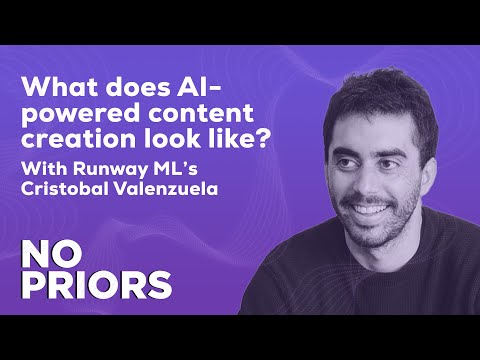
No Priors Ep. 2 | With Runway ML’s Cristobal Valenzuela
Sarah Guo (host), Cristóbal Valenzuela (guest), Elad Gil (host), Narrator
In this episode of No Priors, featuring Sarah Guo and Cristóbal Valenzuela, No Priors Ep. 2 | With Runway ML’s Cristobal Valenzuela explores runway ML Fuses Art and AI To Reinvent Creative Video Tools Cristóbal Valenzuela, co-founder and CEO of Runway, describes how his multidisciplinary background in economics, business, design, and media arts led to building an applied AI research company focused on creative tools, especially for video.
Runway ML Fuses Art and AI To Reinvent Creative Video Tools
Cristóbal Valenzuela, co-founder and CEO of Runway, describes how his multidisciplinary background in economics, business, design, and media arts led to building an applied AI research company focused on creative tools, especially for video.
Runway evolved from an early ‘model app store’ for ML into a vertically integrated stack: in‑house research, infrastructure, and 35+ AI-powered tools that augment professional creators rather than replace them.
He emphasizes product-first thinking in an extremely fast-moving research field, arguing that models alone are not products and that real value comes from usable abstractions tightly informed by how artists and filmmakers actually work.
The conversation situates AI art within a longer history of technological shifts in art (e.g., paint tubes, photography, cinema) and predicts today’s ‘AI paint-tube moment’ will eventually look like a natural evolution in artistic practice.
Key Takeaways
Treat models as components, not products.
Valenzuela stresses that a research model is just one ingredient; turning it into a viable product requires deployment infrastructure, UX, unit economics, and deep understanding of real workflows.
Get the full analysis with uListen AI
Embed domain experts and researchers in the same product loop.
Runway pairs PhD-level ML researchers with veteran video editors and VFX artists, allowing product decisions to be shaped simultaneously by what’s technically feasible and what professionals actually need.
Get the full analysis with uListen AI
Look for partially automatable tasks with high pain and low safety risk.
Runway targets tedious, time-consuming creative tasks like rotoscoping where 70–90% automation is already hugely valuable, unlike domains (e. ...
Get the full analysis with uListen AI
Use user behavior to infer the real problem, not the requested feature.
They noticed users misusing static image segmentation models on video via hacked FFmpeg pipelines, which revealed a deeper need and led to building an interactive, video-native Greenscreen tool.
Get the full analysis with uListen AI
Prioritize control and expressiveness over pure ‘wow’ in generative tools.
Runway’s long-term goal is not just impressive outputs but tools that let creators reliably steer and refine results, mirroring how artists think across video, audio, text, and motion simultaneously.
Get the full analysis with uListen AI
Sequence infrastructure and research bets for the long term, not hype cycles.
Given rapid architectural shifts (CNNs, GANs, transformers, diffusion), they emphasize saying no to attractive but misaligned requests and owning their stack so they can pivot quickly as breakthroughs occur.
Get the full analysis with uListen AI
Frame AI art as a new ‘paint tube’ moment, not an aberration.
By comparing AI tools to the invention of paint tubes and the rise of photography and cinema, Valenzuela argues today’s debates will likely be seen as another transitional phase in how artists use technology.
Get the full analysis with uListen AI
Notable Quotes
“Models on their own are not products.”
— Cristóbal Valenzuela
“Customers are really good at telling you what their problems are; they’re really bad at verbalizing solutions.”
— Cristóbal Valenzuela
“Our goal is not to build autonomous systems that don’t engage with humans. It’s to help humans with great ideas get there really quickly.”
— Cristóbal Valenzuela
“You shouldn’t dismiss toys. Toys are very interesting to learn a lot.”
— Cristóbal Valenzuela
“We’re still in the paint-tube moment of AI art.”
— Cristóbal Valenzuela
Questions Answered in This Episode
How might Runway’s tools change the economics and staffing structure of film, VFX, and advertising production over the next decade?
Cristóbal Valenzuela, co-founder and CEO of Runway, describes how his multidisciplinary background in economics, business, design, and media arts led to building an applied AI research company focused on creative tools, especially for video.
Get the full analysis with uListen AI
What concrete steps can research-heavy AI startups take to avoid getting stuck in ‘cool demo’ mode and move quickly toward real product-market fit?
Runway evolved from an early ‘model app store’ for ML into a vertically integrated stack: in‑house research, infrastructure, and 35+ AI-powered tools that augment professional creators rather than replace them.
Get the full analysis with uListen AI
As AI tools become more controllable, how will notions of authorship and artistic credit evolve when human and model contributions are tightly intertwined?
He emphasizes product-first thinking in an extremely fast-moving research field, arguing that models alone are not products and that real value comes from usable abstractions tightly informed by how artists and filmmakers actually work.
Get the full analysis with uListen AI
What are the most promising multimodal interactions (text, video, audio, motion) that Runway has not yet productized, and what’s blocking them today?
The conversation situates AI art within a longer history of technological shifts in art (e. ...
Get the full analysis with uListen AI
How should art schools and design programs adapt their curricula to prepare creators for a world where AI is a standard part of the creative toolkit?
Get the full analysis with uListen AI
Transcript Preview
(music plays) Chris, welcome to the podcast.
Thank you for having me here. I'm super excited to chat with you.
So, can we start all the way back? I think you are the only person I know with degrees in economics, business, design, and then also went to art school. How did, how'd that happen, and then how'd you stick an interest in ML in there that became very real at some point?
Yeah, that's an interesting question. I've always been very curious about just things in general, and so I've been trying to, like, uh, find ways of channeling that curiosity. I'm originally from Chile, and, um, I studied in Chile a combination of, like, business and econ, and then went into design, and it was a very particular design kind of like program. I spent a lot of time with physical computing, which is like working with hardware, with, like, um, electronics, mostly applied to design and, like, art. And while I was doing that, I was also consulting, so for a moment I ha- I thought I had, like, two lives. Uh, I was, like, doing art, uh, on the one end, with, like, Arduinos and electronics, and on the other side I was, like, consulting for these banks, which was very, like, different. But I love it. I think it's, it's, it's perspectives and worldviews that are very opposite at the same time you gain from being at both. And around that time, I just spent, like, three, four years doing that in Chile and started, like, teaching myself software engineering, like programming. That was just driven by curiosity. Uh, again, just, like, exploring or experimenting, which I think has... I would consider a constant, like, characteristic of how we think about what I wanna do and what I wanna, like, learn. And it also has been combating in the company itself, in, in Runway. Long story short, I, I kind of, like, fell in love or was experimenting with, um, early computer vision models in 2016, '15, and then went into a rabbit hole. S- apply and got a scholarship at NYU, and then spent, like, two years in, in art school. ITP, uh, that's the name of the program. It's a very unique program. Happy to go deeper into (laughs) , into that particular program b- because for me it was very fundamental kind of, like, piece in, uh, in my career of, like, understanding how to bridge business, design, art, and, and, and technology in a cohesive way. But yeah, I, I think just curiosity, I think, drives me a lot.
Amazing. And, uh, now you have one life that combines those.
(laughs)
But in the art side, how should I picture Arduino electronic art?
Media arts probably is the best, uh, way of, uh, describing it. (laughs) I think I was just interested in the wild y- the, the kind of, like, experimental side of technologies. How do you take, like, this, this hardware, these systems, these networks, and, and build interactive experiences? So I had the chance of presenting at a few festivals, uh, with, with, actually with one of my co-founders. There we were at, at Ars Electronica, which is this large, like, um, electronic arts festival and media arts. I think for me, media arts is a way of, like, expressing a worldview, um, using technology like any other form of art. Like, you just kind of like experimenting and, like, reflecting and, and, and expressing a worldview using a piece of, like, a tool. And in this case, like, it happens to be that we like to express it via, like, computers and software, and writing software is a form or an art- of art, and write- making hardware is also s- form of art. One thing I've, I remember early on in my career when I was dabbling between, like, art and, and business, I met this very famous Chilean artist that, he's a photographer, and he was just, like, mentoring me, and, like, we were chatting, and he, he was speaking to me, and he was like, "How do you think about doing these kind of, like, installations?" And like, "I was exposing it at a museum there, like National Art Museum in, in Chile." And I told him, like, "It's, it's a wonderful new world. Like, I've never been exposed to this world." And I remember the answer, it struck with me forever, which was like, "Chris, this is the same world. We all live in the same world, right? It's the same, right? We just build, like, silos and, like, arbitrary definitions of what is what." And it, it just really stuck with me. I think he just said it like he wasn't really thinking about it, but it, I really, like, stuck with that. And, and I think that's, that's how I like to look of the world. Like, it's, it's just the same world. You can apply different points of views and perspective on that. We build arbitrary, like, definitions of, like, "This is, this is art, and that- that's, that's, like, design, and that's econ, and that's business." But I think true creativity and curiosity comes from just, like, looking at it as a whole, and taking things that weren't supposed to be part of one thing and then adapting them. And sometimes it's hard, because you need to, like, learn things that you've never done before, and it's uncomfortable, and it's perhaps you feel like, uh, an imposter. Like, you haven't, you shouldn't be doing this. I've learned not to care, to be honest. (laughs) I just, like, just drive by curiosity, like, you'll figure something out, and I really like that.
Install uListen to search the full transcript and get AI-powered insights
Get Full TranscriptGet more from every podcast
AI summaries, searchable transcripts, and fact-checking. Free forever.
Add to Chrome