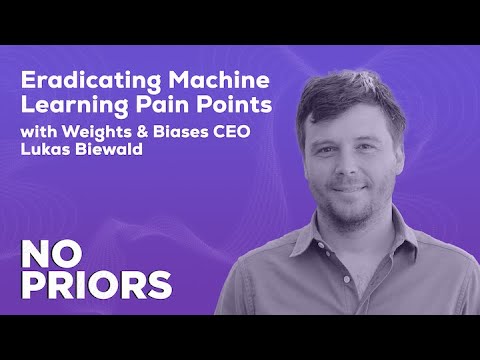
No Priors Ep. 26 | With Weights & Biases CEO Lukas Biewald
Elad Gil (host), Lukas Biewald (guest), Sarah Guo (host), Sarah Guo (host), Elad Gil (host), Narrator
In this episode of No Priors, featuring Elad Gil and Lukas Biewald, No Priors Ep. 26 | With Weights & Biases CEO Lukas Biewald explores lukas Biewald on building ML tooling, data, and the LLM shift Lukas Biewald, founder of Figure Eight and Weights & Biases (W&B), traces his path from early, often-frustrating academic ML work to building two companies around data labeling and ML tooling. He explains how Figure Eight struggled for years in a tiny ML market, then caught the self‑driving wave just as Scale AI out-executed them, ultimately freeing him to start W&B. W&B focuses on simple, developer-first experimentation and MLOps tools, and is now pivoting aggressively to support LLM workflows with its Prompts product as Biewald sees GPT adoption as an existential shift. Throughout, he emphasizes data quality, long-term product thinking, deep customer contact, and the emerging but still-embryonic real-world adoption of LLMs, especially in verticals like pharma and agriculture.
Lukas Biewald on building ML tooling, data, and the LLM shift
Lukas Biewald, founder of Figure Eight and Weights & Biases (W&B), traces his path from early, often-frustrating academic ML work to building two companies around data labeling and ML tooling. He explains how Figure Eight struggled for years in a tiny ML market, then caught the self‑driving wave just as Scale AI out-executed them, ultimately freeing him to start W&B. W&B focuses on simple, developer-first experimentation and MLOps tools, and is now pivoting aggressively to support LLM workflows with its Prompts product as Biewald sees GPT adoption as an existential shift. Throughout, he emphasizes data quality, long-term product thinking, deep customer contact, and the emerging but still-embryonic real-world adoption of LLMs, especially in verticals like pharma and agriculture.
Key Takeaways
Data quality and collection often matter more than model choice.
Biewald’s experience at Yahoo showed identical ranking models performed very differently across countries purely due to training data rigor, inspiring Figure Eight to put ML practitioners closer to the labeling process.
Get the full analysis with uListen AI
ML markets evolve in discontinuous waves, not smooth growth.
Figure Eight endured nearly eight stagnant years because there simply weren’t enough serious ML customers until self-driving cars emerged, illustrating how timing and new application waves dramatically reset the opportunity landscape.
Get the full analysis with uListen AI
ML tooling must be designed for researchers and developers, not DevOps abstractions.
Biewald argues that tools like Git LFS, Docker, and Kubernetes are too complex or ill-suited for many ML practitioners, who need simple, ergonomic ways to handle experiments, data versioning, and reproducibility within their workflows.
Get the full analysis with uListen AI
LLMs are an existential shift for many traditional ML workflows and tools.
Tasks like sentiment analysis and document structuring can now be handled directly by GPT-style APIs, pushing W&B to rapidly build LLMOps features (Prompts) even before revenue data reflects the change, based on observed customer behavior.
Get the full analysis with uListen AI
Enterprise LLM adoption is still very early despite the hype.
Biewald notes that only a small number of companies have LLMs truly in production; most are still prototyping, and long enterprise planning cycles mean the real tooling market size is currently modest relative to the buzz.
Get the full analysis with uListen AI
Pharma and other ‘quiet’ verticals are investing heavily in ML.
Weights & Biases sees large, under-discussed ML buildouts in pharma (drug simulation and testing), agriculture (precision spraying, yield optimization), gaming, and fintech, suggesting ML is becoming core infrastructure across the economy.
Get the full analysis with uListen AI
Founder success in AI hinges on obsessive customer contact and product honesty.
Biewald stresses how hard it actually is to get real customer meetings and how vital it is to use them to test whether you’re making something people genuinely want, even if it means hearing uncomfortable feedback.
Get the full analysis with uListen AI
Notable Quotes
“I just really wanted to work on something that people cared about.”
— Lukas Biewald
“I kind of realized, you know, I am actually getting out of date myself.”
— Lukas Biewald
“This is actually our kind of first real existential threat, I think.”
— Lukas Biewald, on LLMs impacting W&B’s core business
“Very, very few people have LLMs in production… it’s just an insanely saturated tools market with very few people getting things out.”
— Lukas Biewald
“Everybody knows [you should] make something people want, but no one cares about it enough.”
— Lukas Biewald
Questions Answered in This Episode
How will W&B’s LLMOps tooling need to evolve as enterprises finally move from LLM prototypes to large-scale production deployments?
Lukas Biewald, founder of Figure Eight and Weights & Biases (W&B), traces his path from early, often-frustrating academic ML work to building two companies around data labeling and ML tooling. ...
Get the full analysis with uListen AI
What specific product or design choices did Scale AI make that Biewald believes allowed them to ‘eat Figure Eight’s lunch’ in self-driving, and what would he do differently now?
Get the full analysis with uListen AI
How might changes in OpenAI’s business model (e.g., broader fine-tuning of GPT-4) affect the balance between proprietary APIs and self-hosted open-source models?
Get the full analysis with uListen AI
What kinds of telemetry and user behavior data have most shaped the evolution of W&B’s closed-source UI and workflows?
Get the full analysis with uListen AI
In pharma and agriculture, what are the most promising near-term ML use cases Biewald expects to see actually clear regulatory and operational hurdles in the next 3–5 years?
Get the full analysis with uListen AI
Transcript Preview
(music plays) We've talked to many practitioners who are pushing the state of the art. This week on the podcast, we're exploring the dominant ML developer tool, Weights & Biases. Elad and I are sitting down with CEO and co-founder, Lukas Biewald. He has a knack for creating companies that support pain points in ML development. His first company, Figure Eight, addressed the problem of data collection for model training, and his second company, Weights & Biases, has created an experimentation platform that supports AI practitioners at companies including NVIDIA, OpenAI, Microsoft, and many more. Lukas, thanks for doing this. Welcome to No Priors.
Thank you. Great to be here.
Lukas, you studied at Stanford, where I assume you discovered your interest in machine learning, and under one of our previous No Priors guests, Daphne Koller. Can you talk about when you started working in AI and learning from Daphne?
Yeah, totally. A- as a kid, I was obsessed with playing games, and I got really into Go, and I was super into the idea of- or thinking about how would computers win at these games. And so, I actually sent Daphne an email, maybe as a freshman, being like, "Hey, can I, can I work with you? Like, I'm really interested in games. I wanna learn how to, like, beat Go." And, and Daphne wrote me actually a pretty polite email being like, "That's not what I do." (laughs) "Go away." A few years later, I, I took her course, and I was actually, I studied math at Stanford, and I have to say, Daphne cared about a thousand times more about teaching than even the best professor in the math department. And so, it was really just eye-opening. Like, I just loved how much she actually cared about teaching, and it got me really excited about the AI that was working there. And I went on to be a research assistant for her, and the funny thing at that time was, like, nothing really worked. Like, it was just before kind of, you know, Google was thought to be really, like, PageRank at the time was the thing that was making them work, and I think later, you know, it became clear that machine learning was a big, a big part of that. But really, when I was doing ML, it was, like, searching for applications that were working, and Daphne was actually really obsessed at the time with a thing called Bayes' Nets, which you don't hear about too much anymore, 'cause I don't think they ever really, um, you know, worked for many applications. I hope I'm not offending anyone, but that's my, my understanding. I actually think, you know, the, the thing that I really took away from Daphne that, that really lasted with me was, um, I mean, she's just one of the smartest people I've ever encountered, and she had this incredible clarity of thought and an intolerance for sloppy thinking that, that's just like really served me well. And I think that's so sort of separate from machine learning. You'd, you'd see like other professors would come and give like guest talks and, you know, they would say something that's kind of lazy, and like, we'd all just be sitting there just like waiting for Daphne to like eviscerate (laughs) them. And I think her, her personality has, has mellowed a little bit o- o- over time, but I, I kind of miss... I just miss that sort of like aggressive clear thinking, um, and I, I really admire it.
Install uListen to search the full transcript and get AI-powered insights
Get Full TranscriptGet more from every podcast
AI summaries, searchable transcripts, and fact-checking. Free forever.
Add to Chrome