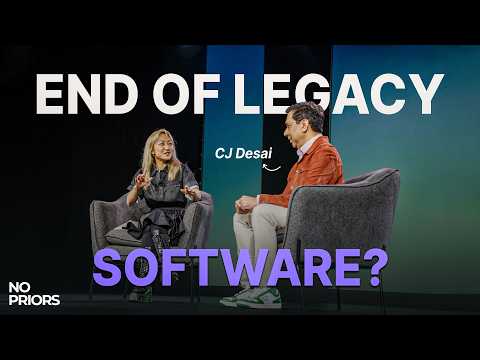
No Priors Live: Building Durable Software in the AI Age with MongoDB President & CEO CJ Desai
CJ Desai (guest), Sarah Guo (host)
In this episode of No Priors, featuring CJ Desai and Sarah Guo, No Priors Live: Building Durable Software in the AI Age with MongoDB President & CEO CJ Desai explores mongoDB’s CJ Desai on platforms, AI shifts, and durable moats Desai argues that the AI era has put “the future of software” under scrutiny from both investors and customers, but that fears of software’s “terminal value being zero” are overblown.
MongoDB’s CJ Desai on platforms, AI shifts, and durable moats
Desai argues that the AI era has put “the future of software” under scrutiny from both investors and customers, but that fears of software’s “terminal value being zero” are overblown.
He frames durability around two constants in the stack—LLMs and the data layer—while everything else evolves, making speed of learning and execution the decisive advantage during transitions.
A central thesis is that platforms, not point products, create defensibility because customers build integrations, governance, and multiple workflows around them—making switching materially harder.
He explains why MongoDB is positioned for messy, high-velocity AI-era data needs, shares what Fortune 500s are actually adopting (coding assistants > office copilots), and emphasizes customer intimacy and intellectual honesty over “AI-washing.”
Key Takeaways
In the AI age, durability comes from mastering transitions faster than peers.
Desai repeatedly returns to “speed matters”: building quickly, learning on the shift, and pivoting before customers/investors doubt your future. ...
Get the full analysis with uListen AI
Platforms are the scarce asset class in software; products are replaceable.
A wedge can get you in, but it’s also easy to swap out unless customers adopt multiple capabilities that work together. ...
Get the full analysis with uListen AI
Enterprise stickiness is created by integrations, compliance work, and embedded workflows—not features alone.
His banking example (300 apps on MongoDB out of 9,000 total) highlights how governance, security reviews, and integrations create “fabric-level” dependency. ...
Get the full analysis with uListen AI
“Vibe coding” increases app creation speed, but doesn’t solve enterprise go-to-market and regulatory barriers.
Even if an app can be generated quickly, Desai argues that winning large banks/healthcare/public sector requires multi-cloud, on-prem/air-gapped options, resiliency, audits, and credibility—constraints that slow “on-demand app” disruption.
Get the full analysis with uListen AI
Incumbents can win if AI strengthens their moat and shows up as revenue acceleration.
His test is blunt: innovate faster with AI and “sell more. ...
Get the full analysis with uListen AI
The stack’s near-term constants are LLMs and the data layer; application value shifts to AI-enabled use cases.
Desai expects LLM frameworks/agentic tooling to persist and believes data storage/retrieval is non-optional. ...
Get the full analysis with uListen AI
Fortune 500 AI value today is uneven: coding assistants are breaking through; office copilots often underwhelm.
He reports weak ROI sentiment on productivity copilots, but “very positive feedback” on coding assistance improving velocity and security. ...
Get the full analysis with uListen AI
Systems of record can be replaced—but only with dramatic, provable value and disruption in price/performance.
Contrary to the common “layer-on” narrative, Desai says leaders will engage replacement conversations if it’s cheaper, faster, better, and aligned to outcomes-based value. ...
Get the full analysis with uListen AI
Customer intimacy is a strategic weapon for product leaders during transitions.
Desai describes speaking to ~10 customers/week and credits early mentorship for teaching that great product decisions require constant customer contact. ...
Get the full analysis with uListen AI
Intellectual honesty beats ‘AI branding’—and protects long-term credibility.
He notes MongoDB publicly pushed back on attributing results to AI (“Absolutely not… it’s our core”), warning that optimizing narratives for the market can send companies into the wrong operating cycle.
Get the full analysis with uListen AI
Notable Quotes
““Platforms are sticky, products are not.””
— CJ Desai
““Tools are for fools.””
— CJ Desai (attributed to Frank Slootman)
““We talk to regulators a lot more than we speak to our customers and vendors.””
— CJ Desai (relaying bank perspective)
““Not leaning in is not an option.””
— CJ Desai
““If you say you’re innovating more, but you’re not selling more, then you have potentially issues.””
— CJ Desai
Questions Answered in This Episode
You define a platform as “N ≥ 2” products used together—what are MongoDB’s clearest “multi-product” adoption paths that turn a single use case into platform-level stickiness?
Desai argues that the AI era has put “the future of software” under scrutiny from both investors and customers, but that fears of software’s “terminal value being zero” are overblown.
Get the full analysis with uListen AI
In the bank example (300 of 9,000 apps), what are the biggest technical and organizational blockers that prevent expanding from 300 to 3,000?
He frames durability around two constants in the stack—LLMs and the data layer—while everything else evolves, making speed of learning and execution the decisive advantage during transitions.
Get the full analysis with uListen AI
You argue “vibe coding” won’t easily penetrate regulated enterprises—what specific certifications, controls, or deployment requirements most often kill these deals in practice?
A central thesis is that platforms, not point products, create defensibility because customers build integrations, governance, and multiple workflows around them—making switching materially harder.
Get the full analysis with uListen AI
When you say LLMs and the data layer are constants, where do you expect the most volatility: orchestration/agents, observability, security, or the application layer—and why?
He explains why MongoDB is positioned for messy, high-velocity AI-era data needs, shares what Fortune 500s are actually adopting (coding assistants > office copilots), and emphasizes customer intimacy and intellectual honesty over “AI-washing.”
Get the full analysis with uListen AI
You described office productivity copilots as disappointing but coding assistants as a breakthrough—what distinguishes successful AI deployments (data readiness, workflow fit, incentives, governance)?
Get the full analysis with uListen AI
Transcript Preview
Since twenty twenty-two, the future of software is in question. This is from the investor community, but also customers. It is a very pivotal moment on the software stack, and then you look at the software stack, and you say: "Okay, what is the one thing that will always be there?" How many companies today that are there that are more than ten billion in just pure-play software revenue? It's single digits. Why is that? The software industry has been around for a long time, created by many, many smart people like yourselves. Why is it only single-digit companies are more than ten billion in revenue? Because-
Platforms are rare.
Platforms are rare. Speed matters. When technology transitions happen, are you building as fast as you can? And then are you learning on that technology shift, whether it's the internet age or AI age or mobile, are you pivoting fast? It's just that you have to stay ahead of that game. If you fall behind that game, investors or customers will always ask you that question: What is the future of your company?
Welcome to the very first live recording of the No Priors podcast, with host Sarah Guo and MongoDB President and CEO, CJ Desai.
Hey, everyone. I am so happy to be here with you guys and my, uh, longtime friend, CJ. I know you guys have had a great day of announcements and, and learnings here at the conference, but I, I'm really excited personally to have the opportunity to zoom out with CJ to talk about, uh, the future of software, um, what's happening in SaaS and, and where the value is going to be. These are important questions to me in my, you know, day job as a, as a venture investor. Um, so CJ, you have worked with these platform enterprise software and infrastructure companies, uh, became CEO of MongoDB recently. Uh, I feel like the one question that we were just talking about, that every investor asks you, and then everybody in the technology ecosystem has at the back of their mind, is: What is the value of software when you can generate a bunch of software? And, and so I'd, I'd love to just get your thoughts on this.
It's a very spicy question to start with. I like it.
I'm making sure everybody's awake.
Yeah.
Yeah.
Uh, first, thank you for doing No Priors live for the first time. It's maiden, and we have a really good crowd here, so, uh, it's always exciting. You know, when you think about technology transition, software, whether you look at internet age or mainframe, all the way till AI, you have to really think through what is the moat here, right? Whichever applications you create... You know, SaaS applications got created, uh, late nineties, right? Late nineties. I think Salesforce had their twenty-five years anniversary recently, and so SaaS has been around for at least twenty-five years, uh, from a transition perspective. And now with AI, the question is, just in general, what is the future of software? What's the stack, and do you really have a moat as a company or not? There are folks, Sarah, who will say: "Hey, my moat is I have a great customer relationship," or, "My channel is amazing, and that's my moat, as I disrupt myself within." Um, but from my standpoint, speed matters, right? Speed matters. So when technology transitions happen, are you building as fast as you can? And then are you learning on that technology shift, whether it's the internet age or AI age or mobile back in, uh, early 2010, when Meta made the pivot towards, uh, mobile? Are you pivoting fast? And if you pivot fast to leverage the technology, whatever the platform shifts are happening, I think it is fine. It's just that you have to stay ahead of that game. If you fall behind that game, investors or customers will always ask you that question: What is the future of your company? And that is something you have to be on the leading edge. Not every bet will work, but from my standpoint, the... Just going on the extreme, terminal value being zero for some of the software, they are overblown. Uh, and, you know, uh, we'll figure this out together.
Install uListen to search the full transcript and get AI-powered insights
Get Full TranscriptGet more from every podcast
AI summaries, searchable transcripts, and fact-checking. Free forever.
Add to Chrome