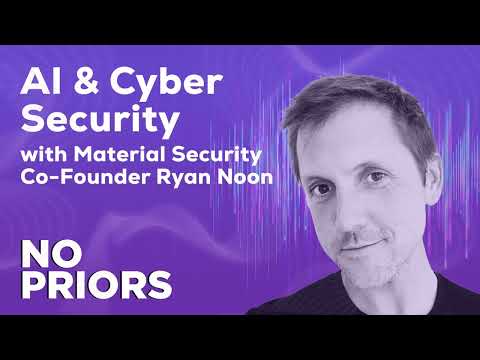
No Priors Ep. 38 | With Material Security Co-Founder Ryan Noon
Elad Gil (host), Ryan Noon (guest), Narrator
In this episode of No Priors, featuring Elad Gil and Ryan Noon, No Priors Ep. 38 | With Material Security Co-Founder Ryan Noon explores aI Supercharges Cybersecurity: Material Security’s Ryan Noon On Defense Ryan Noon, co-founder and chairman of Material Security, explains how the company protects cloud email (Google Workspace, Office 365) by assuming accounts will be compromised and limiting the damage through “defense in depth.”
AI Supercharges Cybersecurity: Material Security’s Ryan Noon On Defense
Ryan Noon, co-founder and chairman of Material Security, explains how the company protects cloud email (Google Workspace, Office 365) by assuming accounts will be compromised and limiting the damage through “defense in depth.”
He describes how generative AI, especially LLMs, has become a powerful tool for security operations, from interpreting messy signals to reading code and analyzing logs, while also amplifying attackers’ capabilities.
Noon argues that AI represents a step-function shift—like moving from bronze to iron weapons—creating an arms race in which intelligence itself becomes commoditized and nations, companies, and attackers all must adapt.
He also discusses the structure of the cybersecurity market, the dominance and acquisition patterns of incumbents, and offers candid advice to founders on markets, teams, and avoiding overcomplicated “shovel-selling” in AI.
Key Takeaways
Design security assuming attackers will eventually get in.
Material’s philosophy is “defense in depth”: treat account compromise as inevitable, then constrain what attackers can access (e. ...
Get the full analysis with uListen AI
Use off-the-shelf LLMs before over-investing in custom models.
Noon argues that even baseline models like GPT‑3. ...
Get the full analysis with uListen AI
LLMs excel at noisy, text-heavy security tasks.
From parsing raw email headers to reading code and scanning for sensitive data leaks, LLMs act like a cheap, partial security analyst that can filter signals, explain patterns, and handle previously hard automation problems.
Get the full analysis with uListen AI
AI amplifies attackers by lowering skill and scale barriers.
Even simple uses—like grammar-correcting phishing emails or automating social engineering at scale—materially increase threat effectiveness, letting “one jerk with a for loop” do what used to require a roomful of attackers.
Get the full analysis with uListen AI
Open, liberal societies are structurally more exposed online.
Because Western systems are open, deeply networked, and largely privatized, they adopt digital tech quickly but leave a broad “soft underbelly” in cyberspace, unlike authoritarian regimes that can tightly control platforms and information flows.
Get the full analysis with uListen AI
Cybersecurity markets reward distribution power over pure innovation.
Large incumbents (Cisco, Palo Alto, hyperscalers) often prefer acquiring proven startups over inventing from scratch, using their sales machines and bundles to scale solutions in a market where buyers can’t easily judge effectiveness.
Get the full analysis with uListen AI
Founders should prioritize big, simple markets over complex niches.
Noon advises new founders—especially in AI—to pick large, obvious problems and straightforward products that everyone clearly needs, rather than chasing tiny Gartner-defined niches or overly intricate “shovel-selling” tools.
Get the full analysis with uListen AI
Notable Quotes
“We used to call the company seat belts for email.”
— Ryan Noon
“It turns out if you feed precisely one internet to precisely a million GPUs, it picks up a thing or two about cybersecurity.”
— Ryan Noon
“You know that you have like 90% of a human that you can use for like a penny and a half, right? Start there.”
— Ryan Noon
“Intelligence is now a commodity that we can arms race.”
— Ryan Noon
“Play the game on easy if you possibly can.”
— Ryan Noon
Questions Answered in This Episode
How should security teams practically integrate LLMs into their existing SOC workflows without overhauling everything at once?
Ryan Noon, co-founder and chairman of Material Security, explains how the company protects cloud email (Google Workspace, Office 365) by assuming accounts will be compromised and limiting the damage through “defense in depth.”
Get the full analysis with uListen AI
What new classes of security products become possible if we fully assume that intelligence at “90% of a human” is cheap and ubiquitous?
He describes how generative AI, especially LLMs, has become a powerful tool for security operations, from interpreting messy signals to reading code and analyzing logs, while also amplifying attackers’ capabilities.
Get the full analysis with uListen AI
How can open societies mitigate their inherent cyber exposure without sacrificing the openness that drives innovation and free expression?
Noon argues that AI represents a step-function shift—like moving from bronze to iron weapons—creating an arms race in which intelligence itself becomes commoditized and nations, companies, and attackers all must adapt.
Get the full analysis with uListen AI
Given the acquisition-heavy nature of cybersecurity, what strategies can startups employ if they aim to remain independent and build large standalone companies?
He also discusses the structure of the cybersecurity market, the dominance and acquisition patterns of incumbents, and offers candid advice to founders on markets, teams, and avoiding overcomplicated “shovel-selling” in AI.
Get the full analysis with uListen AI
Where is the real line between overhyped AI “shovel-selling” and genuinely transformative AI-native security products?
Get the full analysis with uListen AI
Transcript Preview
So this week I'm joined by Ryan Noone. He's the co-founder and chairman of Material Security, the cyber security company making cloud-based email a safe place for sensitive data. He previously started Parastructure, which was acquired by Dropbox, where he was an engineering manager prior to starting Material Security. Ryan, welcome to No Priors.
Hey. It's g- it's great to be here, man. Always lovely to talk to you.
Ah, yeah, it's always fun to chat with you. Um, so one of the reasons I was excited to be chatting with you today is, I feel like you have such a great perspective on, uh, both the broader security industry, various tech topics, et cetera, but also specifically how this all starts to tie into AI. And I know that at Material you were, um, a very fast adopter actually of, um, AI-related technologies as the first sort of APIs really came out, and you started playing around with them quite early and doing interesting things with them. Do you wanna first talk a little bit about how you started Material, and then maybe we can touch on how you started getting involved with the AI side of it?
Yeah, sure. Um, so we started Material, I guess, 2016, 2017 or so. Uh, I had left Dropbox and, um, you know, was living in Europe, and fell in love with, uh, all the election hacking that happened year, um, you know, that year was pretty nasty (laughs) . Like, every random Gmail account kept getting, like, dumped on the internet. So, I, I had an idea for, like, you know, how to protect a Gmail account, you know, just an ordinary personal one in, like, a fairly novel way. Uh, I coded it. It shockingly worked, the Gmail API let you do it. I brought it back home and, and showed it to some friends, and, uh, we realized this is actually a special case of a broader way of thinking. Now, seven years later, it's a, you know, whatever cyber security unicorn thing, and we get to work with the coolest companies, you know, in the world by far, and the stuff that you get to do at- at this scale is just mind-blowing. It's (laughs) , it's wild to think just where it started and- and- and where it's come.
And what- what are the main products that Material focuses on? Just for the- the audience, so they have a better sense.
Yeah, so, um, the- the broad thesis is basically we've all kind of got these Google and Microsoft accounts. Um, you know, email is- is sort of where we started, but, you know, since then we've kind of, uh, just went deeper and deeper and deeper into sort of everything that you can use, uh, you know, a Gmail account or a Microsoft account for. Uh, the bread and butter of the business is selling, you know, to- to companies, you know, mid-size and up, uh, with these kind of, these big Google Workspace and Office 365 deployments. Uh, the product has a bunch of different modules that are all kind of based around the- the main things people worry about. Um, the- the kind of, the first big product that you mentioned, you know, in the intro was, people have years and years of sensitive information sitting in these accounts. If somebody, you know, gets into your Google account, they're just gonna download all of your email, uh, and go through it later, and your whole life is in there. It's even worse, you know, in- in a corporate environment. And so that product, what it can do actually is, uh, it finds, you know, sensitive stuff that's just sitting around, kind of just sitting in your inbox, uh, in your archive, whatever, and then it can basically redact it and then replace it with a clean copy so that if somebody gets in and downloads the whole thing, they don't get anything good. Uh, but then if you happen to need it, like I- I- I like having all this information at my fingertips, you can just press a button and you have an extra face ID or a touch ID or, you know, more advanced policies and- and- and work, but just something that's easy for you but hard for the attacker. So we started there, and then we expanded into anti-phishing. You know, people can send you tricky emails and get you to do things and steal money from you. Uh, we expanded into account takeover protection which is, you know, more of the things that people do, uh, after they compromise the account, and you know, I try to reset all your other accounts and steal your bank account and all of that. Just, the- the operative concept is defense in depth, which is just, you know, like, just assume that the bad guy got in, like, what do they want, you know? Like, they got over the wall, there should be another wall and a machine gun. You know, it's like history has all these fairly basic lessons about resiliency (laughs) that, uh, never really always get applied the right way when it comes to computers. So...
Install uListen to search the full transcript and get AI-powered insights
Get Full TranscriptGet more from every podcast
AI summaries, searchable transcripts, and fact-checking. Free forever.
Add to Chrome