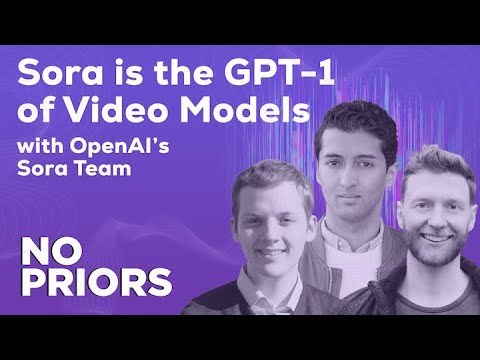
No Priors Ep.61 | OpenAI's Sora Leaders Aditya Ramesh, Tim Brooks and Bill Peebles
Sarah Guo (host), Tim Brooks (guest), Bill Peebles (guest), Aditya Ramesh (guest), Elad Gil (host)
In this episode of No Priors, featuring Sarah Guo and Tim Brooks, No Priors Ep.61 | OpenAI's Sora Leaders Aditya Ramesh, Tim Brooks and Bill Peebles explores openAI’s Sora: Building a World-Simulating Video Engine for AGI The episode features Sora leads Aditya Ramesh, Tim Brooks, and Bill Peebles discussing OpenAI’s new text-to-video model and its role on the path to AGI.
OpenAI’s Sora: Building a World-Simulating Video Engine for AGI
The episode features Sora leads Aditya Ramesh, Tim Brooks, and Bill Peebles discussing OpenAI’s new text-to-video model and its role on the path to AGI.
They frame Sora not just as a generative video tool, but as an early world simulator that learns physics, 3D structure, and human/animal behavior directly from raw video.
The team explains the core technical ideas—diffusion transformers and spacetime patches—chosen to make minute‑long HD, multi‑aspect‑ratio video scalable in the same way GPT is for text.
They also cover potential applications (creative tools, education, robotics, avatars), current limitations (cost, speed, object interactions, safety), and why they see Sora as the “GPT‑1 moment” for visual models.
Key Takeaways
Treat video models as world simulators, not just media generators.
By learning to predict future frames from raw video, Sora implicitly acquires knowledge of 3D structure, physics, and social interactions—similar to how humans mentally simulate scenarios—making it a plausible building block for AGI.
Get the full analysis with uListen AI
Architectural choices were made for long‑term scalability, not quick wins.
Instead of extending image models, the team designed Sora from scratch around diffusion transformers and spacetime patches, optimized from day one for minute‑long HD video, diverse aspect ratios, and broad data coverage.
Get the full analysis with uListen AI
Scaling laws appear to hold for video much like for language.
Using GPT‑style transformers on video tokens, they observe that more compute and data systematically improve quality, suggesting a clear path to stronger physical reasoning, longer sequences, and richer interactions as resources increase.
Get the full analysis with uListen AI
Tokenizing video as latent spacetime patches unlocks generality.
Representing videos as 3D cubes in latent space lets a single model handle different resolutions, durations, orientations, and even still images, analogous to how text tokens let LLMs train on diverse textual formats.
Get the full analysis with uListen AI
Creative empowerment and new media forms may be the first big wins.
Early artist tests show Sora lowering barriers to high‑quality visual storytelling and hint at entirely new interaction paradigms (e. ...
Get the full analysis with uListen AI
Safety, cost, and latency are gating broader public deployment.
OpenAI is limiting access to artists and red teamers while it addresses misuse risks (deepfakes, misinformation, sensitive content) and works to make generation cheaper and faster enough for mainstream use.
Get the full analysis with uListen AI
Current models still struggle with fine‑grained, persistent object interactions.
While Sora can maintain some state (e. ...
Get the full analysis with uListen AI
Notable Quotes
“We really believe models like Sora are on the critical pathway to AGI.”
— Aditya Ramesh
“This is the GPT‑1 of this new paradigm of visual models.”
— Tim Brooks
“This is really the first generative model of visual content that has breadth in a way that language models have breadth.”
— Bill Peebles
“The best way to learn intelligence in a scalable manner is to just predict data.”
— Tim Brooks
“It understands 3D… we didn’t explicitly bake 3D information into it whatsoever, we just trained it on video data and it learned about 3D because 3D exists in those videos.”
— Tim Brooks
Questions Answered in This Episode
How far can pure next‑frame prediction in video take us toward general reasoning, and where will it hit conceptual limits?
The episode features Sora leads Aditya Ramesh, Tim Brooks, and Bill Peebles discussing OpenAI’s new text-to-video model and its role on the path to AGI.
Get the full analysis with uListen AI
What new creative or interactive formats do the Sora team anticipate emerging that don’t resemble today’s films, games, or social videos?
They frame Sora not just as a generative video tool, but as an early world simulator that learns physics, 3D structure, and human/animal behavior directly from raw video.
Get the full analysis with uListen AI
How should responsibility for deepfake and misinformation risks be shared among model providers, platforms, and end‑users?
The team explains the core technical ideas—diffusion transformers and spacetime patches—chosen to make minute‑long HD, multi‑aspect‑ratio video scalable in the same way GPT is for text.
Get the full analysis with uListen AI
In what concrete ways will Sora‑like world models feed into robotics and embodied agents over the next few years?
They also cover potential applications (creative tools, education, robotics, avatars), current limitations (cost, speed, object interactions, safety), and why they see Sora as the “GPT‑1 moment” for visual models.
Get the full analysis with uListen AI
What types of personalization—style, aesthetic, long‑term memory—do they envision adding to Sora, and how will they balance that with privacy and safety constraints?
Get the full analysis with uListen AI
Transcript Preview
(instrumental music plays) Hi, listeners. Welcome to another episode of No Priors. Today, we're excited to be talking to the team behind OpenAI's Sora, which is a new generative video model that can take a text prompt and return a clip that is high definition, visually coherent, and up to a minute long. Sora also raised the question of whether these large video models are world simulators and applied the scalable transformers architecture to the video domain. We're here with the team behind it, Aditya Ramesh, Tim Brooks, and Bill Peebles. Welcome to No Priors, guys.
Thanks so much for having us.
Thanks.
To start off, why don't we just ask each of you to introduce yourselves so our listeners know, uh, who we're talking to. Aditya, mind starting us off?
Sure. I'm Aditya, I lead the Sora team together with Tim and Bill.
Hi, I'm Tim. I also lead the Sora team.
I'm Bill, also lead the Sora team.
Simple enough. Um, maybe we can just start with, you know, the OpenAI mission is AGI, right? Um, greater intelligence. Is text-to-video, like, on path to that mission? How'd you end up working on this?
Yeah, we absolutely believe models like Sora are really on the critical pathway to AGI. We think one sample that illustrates this kind of nicely is a scene with a bunch of people walking through Tokyo during the winter. And in that scene, there's so much complexity. So you have a camera which is flying through the scene. There's lots of people which are interacting with one another. They're talking, they're holding hands. There are people selling items at nearby stalls. And we really think this sample illustrates how Sora is on a pathway towards being able to model extremely complex environments and worlds, uh, all within the weights of a neural network. And looking forward, you know, in order to generate truly realistic video, you have to have learned some model of how people work, how they interact with others, how they think ultimately, and not only people, also animals and really any kind of object you want to model. And so looking forward as we continue to scale up models like Sora, we think we're going to be able to build these, like, world simulators where essentially, you know, anybody can interact with them. I, as a human, can have my own simulator running and I can go and, like, give a human in, in that simulator work to go do, and they can come back with it after they're done. And we think this is a pathway to AGI which is just going to happen as we scale up Sora in the future.
It's been said that we're still far away despite massive demand for a consumer product. Like, what, uh, is, is that on the roadmap? What do you have to work on before you, you have broader access to Sora? Tim, you wanna talk about it?
Install uListen to search the full transcript and get AI-powered insights
Get Full TranscriptGet more from every podcast
AI summaries, searchable transcripts, and fact-checking. Free forever.
Add to Chrome