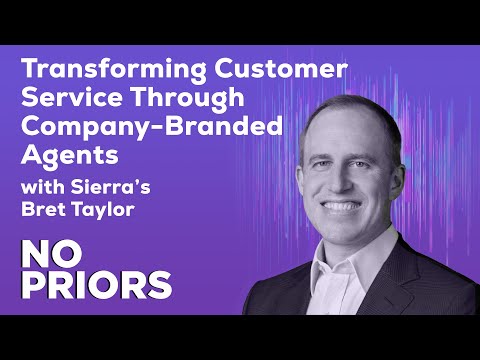
No Priors Ep. 82 | With CEO of Sierra Bret Taylor
Sarah Guo (host), Elad Gil (host), Bret Taylor (guest), Sarah Guo (host), Elad Gil (host), Sarah Guo (host), Sarah Guo (host)
In this episode of No Priors, featuring Sarah Guo and Elad Gil, No Priors Ep. 82 | With CEO of Sierra Bret Taylor explores bret Taylor Maps The Future Of AI Agents For Business Bret Taylor explains how AI ‘agents’ are evolving from academic concepts into practical systems that reason and act autonomously across three main categories: personal, persona-based, and company agents.
Bret Taylor Maps The Future Of AI Agents For Business
Bret Taylor explains how AI ‘agents’ are evolving from academic concepts into practical systems that reason and act autonomously across three main categories: personal, persona-based, and company agents.
He focuses on Sierra’s vision of branded company agents that handle end‑to‑end customer interactions—far beyond simple Q&A—by combining LLMs with process orchestration, integrations, and strict guardrails.
Taylor argues the AI stack will mirror the cloud era: a few large foundation‑model providers, a tools layer, and many solution companies that own specific high‑value workflows with outcome-based pricing.
He anticipates conversational, multimodal interfaces reshaping customer experience and device usage, potentially reducing screen time as agents take on more work and interactions on our behalf.
Key Takeaways
Narrow, well-scoped agents work best with today’s AI capabilities.
Persona-based and company agents succeed when they tackle a specific job with clear processes and system integrations, turning hard research problems into engineering problems with measurable benchmarks.
Get the full analysis with uListen AI
Customer-facing agents must do things, not just answer questions.
Real customer interactions involve actions like upgrades, returns, claims, and policy changes, requiring agents that integrate with many systems of record and execute complex workflows—not just RAG-based knowledge lookup.
Get the full analysis with uListen AI
Effective agents combine goals, guardrails, and controlled creativity.
Businesses must specify what outcomes they want, where the AI is allowed to improvise, and where it must strictly follow rules, so agents retain the magic of LLM creativity without hallucinating or violating policy and brand.
Get the full analysis with uListen AI
AI market structure will mirror cloud: few model providers, many solutions.
Taylor expects a small set of capital-intensive foundation-model builders, a tools layer (e. ...
Get the full analysis with uListen AI
Outcome-based pricing aligns AI vendors with customer value.
Charging for jobs done (e. ...
Get the full analysis with uListen AI
Conversational agents are becoming core brand experiences.
Company agents need distinct tone, personality, and safety constraints that reflect brand values, potentially adapting dynamically to user language and sentiment while staying within strict supervisory guardrails.
Get the full analysis with uListen AI
Conversational interfaces may reduce screen time and change devices.
As voice, chat, and multimodal agents become effective, interactions may shift from tapping screens to speaking with agents via phones, earbuds, cars, or ambient devices, letting software act in the background while people stay present in the real world.
Get the full analysis with uListen AI
Notable Quotes
“Most software systems for the past two decades have been rules engines that execute really quickly… and now we're moving to a world of goals and guardrails.”
— Bret Taylor
“If you think about all of the interactions you've had with brands that you care about, what percentage of those conversations were asking questions? Probably none of them. It's all about taking action.”
— Bret Taylor
“If every time there's a new release of an AI model somehow it decreases your value, it probably indicates you're not actually a solution.”
— Bret Taylor
“I think the best AI companies are aligning their business model with their customers' business models, charging for the outcome… it's very meaningfully different than paying for tokens.”
— Bret Taylor
“I'm hopeful in this world of AI, agents will become a meaningful part of our experience… and by doing that, it enables us to not have to do those things and be present in the world that we live.”
— Bret Taylor
Questions Answered in This Episode
How should a company decide which workflows are ready to be owned by an AI agent versus remaining human-led for now?
Bret Taylor explains how AI ‘agents’ are evolving from academic concepts into practical systems that reason and act autonomously across three main categories: personal, persona-based, and company agents.
Get the full analysis with uListen AI
What concrete methods best balance agent creativity with strict compliance and safety constraints in regulated industries?
He focuses on Sierra’s vision of branded company agents that handle end‑to‑end customer interactions—far beyond simple Q&A—by combining LLMs with process orchestration, integrations, and strict guardrails.
Get the full analysis with uListen AI
How will widespread use of company agents change the structure and skills of customer support and customer experience teams over the next five years?
Taylor argues the AI stack will mirror the cloud era: a few large foundation‑model providers, a tools layer, and many solution companies that own specific high‑value workflows with outcome-based pricing.
Get the full analysis with uListen AI
In a world of outcome-based pricing, how should enterprises measure and govern the value and risks of AI agents across departments?
He anticipates conversational, multimodal interfaces reshaping customer experience and device usage, potentially reducing screen time as agents take on more work and interactions on our behalf.
Get the full analysis with uListen AI
If conversational interfaces reduce screen time, what new kinds of products or experiences become possible that are infeasible in today’s app-centric world?
Get the full analysis with uListen AI
Transcript Preview
(instrumental music) . Hi, listeners. Welcome back to No Priors. Today, we have Bret Taylor, whose legendary career spans from creating Google Maps to serving as the CTO of Facebook and co-CEO of Salesforce, founding two companies along the way, as well as chairing the board of Twitter and now OpenAI. He and Clay Bavor have started Ciara, which is creating company agents for the next generation of customer experience. I'm thrilled to have such an amazing technologist and leader at all scales with us today, and longtime friend. Welcome, Bret.
Well, thanks so much for joining us today, Bret.
My pleasure. Thanks for having me.
Let's get right into it. Um, do agents work today?
How do you define agents or do you want me to define agent?
You define agent. You're the expert.
Agents means something different in academia than I think they mean in industry right now. Um, I think both definitions are important. Just starting with idea is sort of the classic academic definition is a, an agentic system is one where software can reason and take action autonomously, and it comes from the word agency. And as a consequence of such a broad academic definition, I think it becomes sort of the proverbial inkblot test for people using the word. In industry right now, there's probably three categories of agent that I think are or are on the cusp of working. The first, I think, which a lot of people online talk a lot about is personal agents, and I think that's probably the earliest of the three categories that I see but- but maybe one of the more exciting ones. You know, and this is the agent that will triage your inbox, schedule a vacation, um, help you prep for a meeting, manage your calendar, all of that. And the reason why I think that's earliest, I think it's really interesting to make some demos, but I think the human-computer interaction and even how the agents interact with all the systems we depend on as people is quite complex. You can think of sort of the surface area of both reasoning and systems integrations as almost infinite. And so as a consequence, I think it probably, a prerequisite for a great personal agent probably demands more technology than is currently available though there's lots of interesting startups in this space, and you could imagine some interesting companies carving out meaningful niche use cases that expands as the technology improves. The second category of agent, and I think this one does exist in some categories, is what I call persona-based agents. So they're agents that do a job, a very specific job. Um, you know, there's companies like Harvey that, you know, serve a legal function. Um, there's all the coding agents, and I think there's some fairly effective ones right now that serve the job of a, uh, computer programmer. Um, I think this is really exciting because I think when you narrow, I call those cases narrow but deep. If you're just trying to-
Install uListen to search the full transcript and get AI-powered insights
Get Full TranscriptGet more from every podcast
AI summaries, searchable transcripts, and fact-checking. Free forever.
Add to Chrome