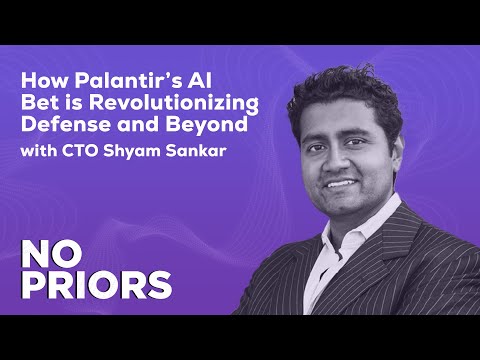
No Priors Ep. 25 | With Palantir's CTO Shyam Sankar
Sarah Guo (host), Shyam Sankar (guest), Elad Gil (host), Elad Gil (host)
In this episode of No Priors, featuring Sarah Guo and Shyam Sankar, No Priors Ep. 25 | With Palantir's CTO Shyam Sankar explores palantir CTO on AIP, Ontologies, and AI’s Operational Future Palantir CTO Shyam Sankar traces his path from early employee to architect of the company’s forward‑deployed engineering model and core platforms Gotham, Foundry, and Apollo.
Palantir CTO on AIP, Ontologies, and AI’s Operational Future
Palantir CTO Shyam Sankar traces his path from early employee to architect of the company’s forward‑deployed engineering model and core platforms Gotham, Foundry, and Apollo.
He explains how Palantir’s new AIP platform brings large language models into secure, private environments and couples them with ontologies—structured representations of an enterprise—to build reliable, high‑impact AI copilots.
Sankar argues that the real value in AI will accrue at the application and integration layer, not in the underlying models, and that 'chat' interfaces are too limiting compared to AI that directly manipulates application state.
Concrete examples span defense, manufacturing, and healthcare, illustrating how AI can shift workflows from surfacing alerts to proposing executable actions while maintaining human oversight and trust.
Key Takeaways
Treat AI as a stochastic system, not deterministic code.
Sankar emphasizes that LLMs are 'stochastic genies'—powerful but probabilistic—so engineers must invest in evals, telemetry, and health checks rather than relying on traditional, spec-driven unit tests.
Get the full analysis with uListen AI
Ground LLMs in a rich ontology to make them useful and safe.
Palantir’s long-standing work on ontologies and digital twins gives LLMs compressed, semantically meaningful context about an enterprise, enabling more reliable, domain-specific tools and workflows without modifying the base models.
Get the full analysis with uListen AI
Shift from chatbots to AI that directly manipulates application state.
Instead of returning text answers, Palantir aims for prompts or intents that produce JSON/DSL changes to underlying applications (e. ...
Get the full analysis with uListen AI
Focus AI on workflows where upside is high and errors are no-ops.
Early high‑value use cases are those where correct AI output creates large gains, but incorrect output can be safely ignored or reviewed—such as suggested courses of action, claims triage, or operational recommendations with human approval gates.
Get the full analysis with uListen AI
Use ensembles and multiple models to build trust and robustness.
Palantir and its customers often compare outputs from several 'mad genius' models, especially when those outputs are structured, which allows statistical reasoning, consensus-building, and safer deployment in high-consequence environments.
Get the full analysis with uListen AI
Human–AI teaming works best via state machines and narrow authorities.
Rather than free-roaming 'agents' that plan arbitrarily, Sankar advocates agents that control specific state transitions within explicit enterprise state machines, mirroring existing human roles and easing change management.
Get the full analysis with uListen AI
AI will erode integration moats and empower customers over their systems.
By using LLMs to understand and orchestrate APIs and complex systems (e. ...
Get the full analysis with uListen AI
Notable Quotes
“It’s a stochastic genie… it’s neither human thought nor traditional computer science.”
— Shyam Sankar
“Prompts are for developers. Chat is a massively limiting interface.”
— Shyam Sankar
“An LLM is not gonna know anything about orbital simulation or weaponeering… but with the right tool, it’s gonna do that quite excellently.”
— Shyam Sankar
“We had accidentally spent the last 20 years really thinking hard about dynamic ontologies… and the LLMs were just waiting for something like ontology.”
— Shyam Sankar
“Instead of surfacing alerts, we want to surface solutions.”
— Shyam Sankar
Questions Answered in This Episode
How can organizations without an existing ontology or digital twin practically get to the point where LLMs are truly useful, not just gimmicky chatbots?
Palantir CTO Shyam Sankar traces his path from early employee to architect of the company’s forward‑deployed engineering model and core platforms Gotham, Foundry, and Apollo.
Get the full analysis with uListen AI
What specific metrics and eval frameworks does Palantir use to decide an LLM-backed copilot is trustworthy enough for production in high-stakes environments?
He explains how Palantir’s new AIP platform brings large language models into secure, private environments and couples them with ontologies—structured representations of an enterprise—to build reliable, high‑impact AI copilots.
Get the full analysis with uListen AI
How might the rise of LLM-based integration change the power balance between large enterprise software vendors and their customers over the next decade?
Sankar argues that the real value in AI will accrue at the application and integration layer, not in the underlying models, and that 'chat' interfaces are too limiting compared to AI that directly manipulates application state.
Get the full analysis with uListen AI
Where is the line between acceptable AI-driven automation and decisions that must remain fully human, particularly in defense and healthcare contexts?
Concrete examples span defense, manufacturing, and healthcare, illustrating how AI can shift workflows from surfacing alerts to proposing executable actions while maintaining human oversight and trust.
Get the full analysis with uListen AI
What does it mean in concrete product terms for Palantir to 'aim for the entire market share of AI,' and how do they plan to compete with both hyperscalers and pure model providers?
Get the full analysis with uListen AI
Transcript Preview
(instrumental music) . Palantir has built a data-driven application platform over the past two decades that is used by governments, militaries, and some of the world's largest companies for analytics and operational decisions. Palantir recently announced a new platform, AIP, as part of a push to invest in AI. This week on the podcast, Sara and I talk to Palantir's CTO, Shyam Sankar. He was the company's first business hire, and has led the company for nearly two decades previously as the COO. Shyam, welcome to No Priors.
Thanks for having me. Great to be here, Sara and Elad.
So, I think you have a very unique background. I believe you grew up in Nigeria and then moved to the United States. You got interested in computers reasonably early. It'd be great to just hear your personal story and your background.
Y- yeah. I, uh, spent the first three years of my life really in Nigeria. My f- my father had, uh, built the first pharmaceutical manufacturing facility on, on the, on the continent. Uh, until then, all the drugs were really imported. Um, and we fled Nigeria during some violence, and really resettled in the US as, as kind of like refugees. So I, a, a great deal of gratitude, understanding the counterfactual reality of, like, you know, h- how the world could have ended up there. And so I grew up in Florida. Uh, I think relevant to the current age, I grew up in a time where when the space shuttles would launch, we would all file out into, uh, the recess courtyard to actually just watch it. You know? And that seemed...
Cool.
... quite normal. And it also seemed really normal that on Saturday morning at like 6:00 AM you'd be woken up to double sonic booms every now and then. Uh, and so I'm, I'm eagerly awaiting the return of, of the space age that, that commercial space and new space have been bringing back to us here. Uh, but I made my way out to Silicon Valley in, uh, in 2003, and started getting involved with startups. I, my, the first company I worked at was Xoom with an X, uh, that was founded by Kevin Hartz, uh, and it was an international money transfer company. And then after three years at Xoom, I started at Palantir as the 13th employee. Uh, really the first person on the business side, and, and have had the most fantastic ride ever since. But never been more excited about what we're doing than, than what we're doing right now with, with AIP and the opportunities that are in front of us.
How did you originally find Palantir? 'Cause it, you know, it was a very secretive company very early on. It was sort of a very small community in technology in Silicon Valley that actually heard of it. So I was, I was just sort of curious, like, how you connected with the company and got involved?
Install uListen to search the full transcript and get AI-powered insights
Get Full TranscriptGet more from every podcast
AI summaries, searchable transcripts, and fact-checking. Free forever.
Add to Chrome