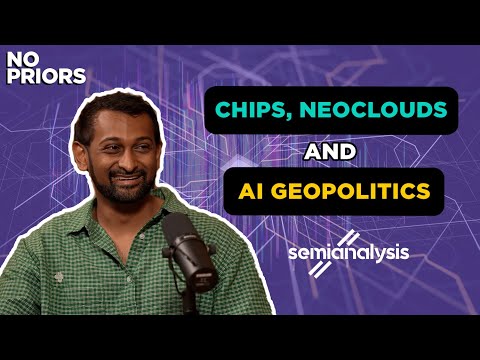
No Priors Ep. 127 | With SemiAnalysis Founder and CEO Dylan Patel
Sarah Guo (host), Dylan Patel (guest), Narrator
In this episode of No Priors, featuring Sarah Guo and Dylan Patel, No Priors Ep. 127 | With SemiAnalysis Founder and CEO Dylan Patel explores aI Chips, Open Source Models, And Data Centers Reshaping Global Power SemiAnalysis founder Dylan Patel discusses how OpenAI’s new open source model and its highly optimized inference stack will raise the commodity bar for closed APIs, especially in code and reasoning workloads. He explains why infrastructure and orchestration, not just model-level optimizations, will increasingly differentiate inference providers and neo-clouds as GPU supply, networking, data centers, power, and labor all become multi-bottlenecks.
AI Chips, Open Source Models, And Data Centers Reshaping Global Power
SemiAnalysis founder Dylan Patel discusses how OpenAI’s new open source model and its highly optimized inference stack will raise the commodity bar for closed APIs, especially in code and reasoning workloads. He explains why infrastructure and orchestration, not just model-level optimizations, will increasingly differentiate inference providers and neo-clouds as GPU supply, networking, data centers, power, and labor all become multi-bottlenecks.
Patel argues that challenging NVIDIA requires mastering a three‑headed dragon of hardware, networking, and software co-design amid rapidly evolving model architectures, making hyperscaler chips (TPU, Trainium, AMD GPUs) more plausible competitors than most startups. He also dives into the macro impact of AI build‑out on GDP, the severe constraints in power and data‑center labor, and how creative infra execution (e.g., xAI, CoreWeave) is now a core competitive edge.
Finally, the conversation turns to geopolitics: why the US wants the world running on American AI stacks, the delicate balance of exporting GPUs to China while slowing its domestic chip ecosystem, and how AI systems may become the next global vector for values and propaganda. The episode closes with a lighter note on poker as a proxy for entrepreneurial edge and why that changed Patel’s view of Cognition’s prospects.
Key Takeaways
OpenAI’s open source model will compress API margins and accelerate adoption.
By releasing not just weights but also highly optimized custom kernels, OpenAI gives everyone a near-best-in-class inference stack on day one, raising the commodity baseline and pressuring API providers who charge high margins for non-frontier models.
Get the full analysis with uListen AI
Infrastructure and orchestration will matter more than single-node optimizations.
As model- and kernel-level tricks spread via open source, the hardest differentiation shifts to distributed systems: caching between turns, tool-use orchestration across hundreds of GPUs, and reliable, high-utilization clusters at scale.
Get the full analysis with uListen AI
Most neo-clouds will consolidate, go ‘real-estate returns,’ or die.
A few players like CoreWeave, Crusoe, and Together differentiate with utilization, software, and scale, but many GPU renters lack basic capabilities, struggle with debt and low utilization, and will either move up into software/APIs, down into pure infra, or go bankrupt.
Get the full analysis with uListen AI
Competing with NVIDIA demands more than a better chip—it requires ecosystem and timing.
NVIDIA’s lead in hardware execution, networking, and 20+ years of software and model co-design means a startup’s architectural ‘win’ must be huge and perfectly timed to future workloads; otherwise small process, memory, networking, and supply-chain disadvantages erase the gains.
Get the full analysis with uListen AI
AI build‑out is propping up macro growth while hitting multi‑factor bottlenecks.
Massive CAPEX in GPUs, data centers, and power is driving US GDP and raising electrician wages, but constraints now span packaging (CoWoS, HBM), optics, substations, generators, grid reliability, real estate, and skilled labor—varying by company and region.
Get the full analysis with uListen AI
US policy aims to keep America at the top of the AI value stack globally.
The emerging strategy is to sell as high in the stack as possible—services, tokens, infra, then chips—while slowing China’s domestic capability via export controls, yet not cutting them off entirely to avoid retaliation over critical inputs like rare earths.
Get the full analysis with uListen AI
AI systems will export values as much as capabilities.
Just as Hollywood once projected a positive image of America, future global users will internalize the worldviews embedded in models like Claude or Chinese LLMs, making it strategically important which country’s models become the default interfaces.
Get the full analysis with uListen AI
Notable Quotes
“NVIDIA charges a lot of money because they’re the best. If there was something better, people would use it, but there isn’t.”
— Dylan Patel
“You either have to go really, really big, or you need to move into the software layer, or you just make commercial real estate returns, or you go bankrupt. These are the paths for all neo-clouds.”
— Dylan Patel
“There’s actually no software that the cloud can provide to deserve the margins that Amazon and Google’s clouds have today if you’re just an infrastructure provider.”
— Dylan Patel
“Hardware–software co-design is the thing that matters. You can’t just look at one in isolation.”
— Dylan Patel
“In this next age, do you want the world to run on Chinese models with Chinese values, or American models with American values?”
— Dylan Patel
Questions Answered in This Episode
How far can open source model quality and optimized kernels go in eroding the business models of today’s closed API providers?
SemiAnalysis founder Dylan Patel discusses how OpenAI’s new open source model and its highly optimized inference stack will raise the commodity bar for closed APIs, especially in code and reasoning workloads. ...
Get the full analysis with uListen AI
What concrete software abstractions or services should clouds and neo-clouds build to truly earn premium margins in AI infrastructure?
Patel argues that challenging NVIDIA requires mastering a three‑headed dragon of hardware, networking, and software co-design amid rapidly evolving model architectures, making hyperscaler chips (TPU, Trainium, AMD GPUs) more plausible competitors than most startups. ...
Get the full analysis with uListen AI
Given the rapid evolution of model architectures, what kind of hardware design bets—if any—are still rational for new AI chip startups?
Finally, the conversation turns to geopolitics: why the US wants the world running on American AI stacks, the delicate balance of exporting GPUs to China while slowing its domestic chip ecosystem, and how AI systems may become the next global vector for values and propaganda. ...
Get the full analysis with uListen AI
How should policymakers balance slowing China’s AI progress with the economic risks of retaliation and the global dependence on Chinese supply chains?
Get the full analysis with uListen AI
What societal and psychological effects might emerge if AI ‘companions’ become people’s primary daily social interaction, and who should be accountable for managing those risks?
Get the full analysis with uListen AI
Transcript Preview
(instrumental music) . Hi, listeners. Welcome back to No Priors. Today, I'm here with Dylan Patel, the chief analyst at SemiAnalysis, a leading source for anyone interested in chips and AI infrastructure. We talk about open source models, the bottlenecks to building a data center the size of Manhattan, geopolitics, and poker as a tell for entrepreneurship. Welcome, Dylan. Dylan, thank you so much for being here.
Thank you for having me.
I've been really looking forward to this conversation. Um, you're such a deep thinker about this space. And then also, it's very odd, you clearly have the Samsung watch.
Yeah. I- I got the Blink-
The folding phone.
... I got the Blink, I got the-
And the laptop.
... the Fold. Yeah, yeah.
Tell me more.
So part of the sto- origin story is that I was moderating forums when I was a child, and my dad's first Android phone was the Droid, right?
Okay, yes.
And for some reason, I was obsessed with, like, messing with it, like rooting it, like under-clocking it, improving the battery life, all these things, because when we were on a road trip, there's nothing to do besides, like, mess around on this phone. So I posted so much about Android that I became a moderator of slash r/Android on Reddit, and- and like many other subreddits related to hardware and NVIDIA, and Intel, and all this stuff. But because of that, I've just always had Android. Now, I've had work iPhones before, but I just really love Android, and then it's like, if you're gonna like technology, I'm not like someone who pushes it, but like get the best stuff. So I have like the Ultra Samsung watch, which I think looks cool, and the- the folding phone, right? It's fun. It's obviously different and weird. No- no iMessage is- is a travesty.
What does it dominate at? What is it better at?
Um-
Besides the openness of, like, the hackability.
I don't even hack that much stuff anymore, right? It's like, what do you use your phone for? I think- I think the main thing is, like, you can have, like, Slack and an email up on two different parts of your phone. I think that's probably the main thing. Or like, you can actually use, like, a spreadsheet on a folding phone. You cannot use a spreadsheet on a regular phone.
Okay.
And that's not even an Android thing.
Yeah.
Like, Apple's folding phone next year will be able to do that just fine, and I'll have no argument then.
Yeah.
But I just like it, you know? People- people have their preferences. People are creatures of habit.
You got to look at the GPU purchasing forecast-
Yes.
... on a sheet, on your phone, I think.
Yes, I do. I do. No. Like, it's like someone's telling you numbers. You're like, "Wait, this is, like, slightly different than my number," right? Like...
Install uListen to search the full transcript and get AI-powered insights
Get Full TranscriptGet more from every podcast
AI summaries, searchable transcripts, and fact-checking. Free forever.
Add to Chrome