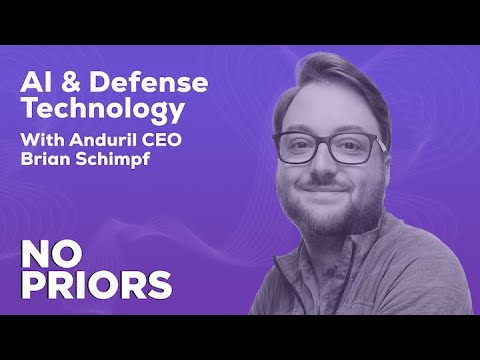
No Priors Ep. 19 | With Anduril CEO Brian Schimpf
Elad Gil (host), Brian Schimpf (guest), Sarah Guo (host)
In this episode of No Priors, featuring Elad Gil and Brian Schimpf, No Priors Ep. 19 | With Anduril CEO Brian Schimpf explores aI-Driven Defense: Anduril’s Bid To Reinvent Modern Military Capability Anduril CEO Brian Schimpf explains how the company is using software-first, AI-enabled systems—like autonomous drones, sensor networks, and large underwater vehicles—to transform defense from a few exquisite, manned platforms into many low-cost, intelligent ones.
AI-Driven Defense: Anduril’s Bid To Reinvent Modern Military Capability
Anduril CEO Brian Schimpf explains how the company is using software-first, AI-enabled systems—like autonomous drones, sensor networks, and large underwater vehicles—to transform defense from a few exquisite, manned platforms into many low-cost, intelligent ones.
He details why modern warfare, illustrated by Ukraine, now favors distributed, autonomous systems and how Anduril’s Lattice platform turns multi-sensor data into battlefield awareness and counter-drone capabilities.
Schimpf discusses practical limits on autonomy (humans remain accountable for lethal decisions), where LLMs and AI fit into defense, and how Anduril rapidly achieved large programs of record within the Pentagon’s slow, complex procurement system.
The conversation closes on strategic gaps in the Pacific, the need to arm allies for deterrence, the tech industry’s renewed engagement with defense after Ukraine, and the importance of clear ethical conviction when building weapons technology.
Key Takeaways
Software-first, low-cost systems will dominate future defense architectures.
Traditional, manned platforms like carriers and fighter jets are too expensive and vulnerable; militaries increasingly need large numbers of cheaper, autonomous systems orchestrated by powerful software to achieve mass and resilience.
Get the full analysis with uListen AI
Owning both hardware and software is crucial to selling real capabilities to the DOD.
The Pentagon buys capabilities, not point products—meaning sensors, platforms, networking, autonomy, support, and integration must come as a coherent package, which pushes companies like Anduril to vertically integrate.
Get the full analysis with uListen AI
Modern battlefields are transparent, favoring dispersed units and autonomy at the edge.
Commercial satellites and pervasive sensing make it hard to hide large formations or fixed infrastructure, pushing warfare toward smaller, distributed units relying on local autonomous systems for sensing and strike.
Get the full analysis with uListen AI
Defense autonomy must be predictable, bounded, and keep humans accountable for force.
U. ...
Get the full analysis with uListen AI
LLMs are promising for synthesis and intent translation, but reliability is a barrier.
Large language models can help digest vast text corpora and convert human mission intent into machine-executable plans, yet hallucinations and non-determinism must be tightly controlled, usually with humans in the loop.
Get the full analysis with uListen AI
Winning large programs of record requires deep understanding of Pentagon processes.
Success isn’t just great tech; it demands early lobbying, budget-cycle fluency, building logistics and training capacity, and making it easy and low-risk for DOD buyers to bet on a new vendor at scale.
Get the full analysis with uListen AI
Deterrence now hinges on long-range reach and empowering allies, not just U.S. power projection.
In the Indo-Pacific, the U. ...
Get the full analysis with uListen AI
Notable Quotes
“The way defense buys, at the end of the day, is they wanna buy a capability.”
— Brian Schimpf
“We’re not gonna out-build China. That’s not an option on these large, very expensive platforms.”
— Brian Schimpf
“The US is not going to adopt systems that have autonomous robots going out and making sort of lethal decisions.”
— Brian Schimpf
“What seemed to be only doable on a 20-year, multi-billion-dollar investment is now doable in years.”
— Brian Schimpf
“Leadership and conviction matters. We’ve been clear: we work on weapons. We believe that’s important and we are not shy about that.”
— Brian Schimpf
Questions Answered in This Episode
How should policymakers draw firm ethical and legal boundaries around autonomous weapons while still enabling rapid innovation?
Anduril CEO Brian Schimpf explains how the company is using software-first, AI-enabled systems—like autonomous drones, sensor networks, and large underwater vehicles—to transform defense from a few exquisite, manned platforms into many low-cost, intelligent ones.
Get the full analysis with uListen AI
What concrete changes in procurement and budgeting would most accelerate adoption of software-first defense systems across the DOD?
He details why modern warfare, illustrated by Ukraine, now favors distributed, autonomous systems and how Anduril’s Lattice platform turns multi-sensor data into battlefield awareness and counter-drone capabilities.
Get the full analysis with uListen AI
How can LLMs and other generative models be engineered to meet the reliability and non-hallucination standards required for operational military use?
Schimpf discusses practical limits on autonomy (humans remain accountable for lethal decisions), where LLMs and AI fit into defense, and how Anduril rapidly achieved large programs of record within the Pentagon’s slow, complex procurement system.
Get the full analysis with uListen AI
In a world of cheap drones and proliferated satellites, what realistic strategies exist to restore any element of surprise or concealment on the battlefield?
The conversation closes on strategic gaps in the Pacific, the need to arm allies for deterrence, the tech industry’s renewed engagement with defense after Ukraine, and the importance of clear ethical conviction when building weapons technology.
Get the full analysis with uListen AI
How can the U.S. balance giving allies powerful defensive tools without enabling escalation or unintended offensive uses against adversaries’ homelands?
Get the full analysis with uListen AI
Transcript Preview
Welcome to No Priors. Today, we're speaking with Brian Schimpf, the co-founder and CEO of Anduril, a next generation defense technology company. Anduril made early use of AI in its creation of low-cost drones, sensor networks, machine vision, and other systems. We're excited to explore what AI means for the future of defense. Brian, it's great to have you on the show.
Hey, thank you very much for having me on.
Well, I- I would love to start with your personal story and background, how you got interested in technology, how you got interested in defense tech. I know you worked on a variety of robotics and other things. It'd just be great to hear about your... You know, what led you to, to start this great company.
Absolutely. So I've been someone who's been coding since I was 12. Um, you know, loved doing it forever. You know, if I could just have spare time, I'd actually just be coding. I love it. It's great. Um, in college, I ended up working on self-driving cars when that was just getting started, so I worked on DARPA Grand Challenge, Urban Challenge. Um, we had, you know, kind of a small but mighty team at Cornell that was mostly undergrads, just a handful of us, and it was a pretty amazing time to see how fast robotics technology could progress. It went from literally nothing working in, like, you know, what was it, 2004, to multiple teams being able to drive through cities in 2007. So, just the pace at this technology can move was, was really impressive to see. Uh, after that, I went out to Silicon Valley. I joined Palantir. I started out as, like, a forward-deployed engineer, so I was working with customers all the time. And that's where I ended up working a lot with the government and national security space, and the thing that was really amazing to me was the degree to which people in that space really cared about the mission, what they were doing and the sense of purpose that they had around the problems they were trying to solve and how important they were, and that's just an incredibly motivating aspect of working in this area. Um, combined with it being some of the most technically challenging and hard problems that you can get your hands on, it's- it's a really interesting and unique space to work on. Uh, at Palantir, I ended up, uh, running product and engineering towards the end, built some really cool products, uh, particularly in the data space, around how do you do analytics, how do you make this stuff work at scale, and how do you build modern software in an intelligent way while also doing this in the government space? So I got a lot of experience there. Uh, and then ended up founding Anduril with some really good friends, uh, inclusive of, uh, Trey Stevens, Matt Grimm. Uh, we had met up with Palmer Luckey who, you know, started Oculus. A totally interesting guy, like, incredible character, like, an incredible human, and he was incredibly passionate about the defense space as well. And so, you know, when he was getting out of Facebook or, you know, as he would insist I say, when he was fired from Facebook, we decided it was time to do this. Uh, so we got together and started Anduril around 2017.
Install uListen to search the full transcript and get AI-powered insights
Get Full TranscriptGet more from every podcast
AI summaries, searchable transcripts, and fact-checking. Free forever.
Add to Chrome