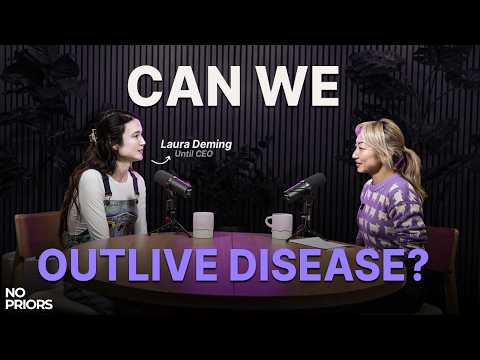
Why Cryopreservation is No Longer Science Fiction | with Until Co-founder and CEO Laura Deming
Laura Deming (guest), Sarah Guo (host)
In this episode of No Priors, featuring Laura Deming and Sarah Guo, Why Cryopreservation is No Longer Science Fiction | with Until Co-founder and CEO Laura Deming explores reversible cryopreservation roadmap: from transplant organs to human hibernation Until is developing reversible cryopreservation—cooling living systems enough to halt damage and “restart” them—by first targeting single-organ preservation for transplants.
Reversible cryopreservation roadmap: from transplant organs to human hibernation
Until is developing reversible cryopreservation—cooling living systems enough to halt damage and “restart” them—by first targeting single-organ preservation for transplants.
Deming argues the core scientific problem is not whether cryopreservation can work (it already does for embryos and some tissues), but whether it can scale to large, vascularized organs and eventually whole bodies.
Key technical challenges center on avoiding ice formation (which physically damages tissue), controlling cooling/rewarming rates, and balancing cryoprotectant toxicity against engineering improvements.
The long-term vision is a new form of critical care: “an ambulance to the future” that could pause a dying patient’s biological clock until a therapy or trial becomes available, with the brain remaining the biggest unknown for whole-body reversibility.
Key Takeaways
Cryopreservation is already proven—scaling is the frontier.
Embryos have been cryopreserved for decades and later developed successfully, and prior academic work suggests kidneys can be cryopreserved and regain function. ...
Get the full analysis with uListen AI
Avoiding ice is the central technical constraint.
Ice formation expands water and can rupture membranes and tissue structure. ...
Get the full analysis with uListen AI
Ice formation is probabilistic, which creates an engineering opening.
Because nucleation is stochastic, controlling time-at-temperature and thermal gradients can reduce the probability of ice formation. ...
Get the full analysis with uListen AI
Engineering progress can reduce biological risk (especially toxicity).
Faster, more uniform cooling and rewarming can allow lower concentrations of cryoprotective agents, which are often toxic at effective doses. ...
Get the full analysis with uListen AI
The near-term “product” is transplant logistics, not sci-fi hibernation.
Organs currently expire quickly, forcing last-minute flights, rushed matching, and “house arrest” for patients near transplant centers. ...
Get the full analysis with uListen AI
Whole-body reversibility hinges on brain fidelity and tolerance.
Deming identifies the brain as the largest unknown: what injuries or molecular-level perturbations are acceptable while still preserving identity and function. ...
Get the full analysis with uListen AI
The field has been under-resourced partly due to perception and stigma.
Cryopreservation is described as difficult to discuss rationally—either attracting uncritical enthusiasm or being dismissed as science fiction—reducing mainstream academic and funding participation. ...
Get the full analysis with uListen AI
Notable Quotes
“Our long-term goal is reversible whole body cryopreservation for medical hibernation. But in the near term, what we work on is reversibly cryopreserving single human organs…”
— Laura Deming
“Single years can make the difference between a patient dying of terminal illness and living long enough to make the critical cure… What if you had an ambulance to the future?”
— Laura Deming
“Making time not a variable changes the whole paradigm.”
— Laura Deming (quoting a transplant surgeon)
“The main question is not, ‘Is this possible to do at all?’ It’s, ‘Is it possible to scale up?’”
— Laura Deming
“If you could instantaneously cool and rewarm, then you wouldn’t have to put any CPA in… but that’s not something… feasible for a large system.”
— Laura Deming
Questions Answered in This Episode
When you say there’s a temperature “below which ice formation stops happening,” what exact regime are you targeting (e.g., vitrification temperature range), and what evidence defines that cutoff in organs?
Until is developing reversible cryopreservation—cooling living systems enough to halt damage and “restart” them—by first targeting single-organ preservation for transplants.
Get the full analysis with uListen AI
What are the measurable success criteria for a cryopreserved organ—immediate viability, histology, perfusion metrics, or long-term functional recovery after transplant?
Deming argues the core scientific problem is not whether cryopreservation can work (it already does for embryos and some tissues), but whether it can scale to large, vascularized organs and eventually whole bodies.
Get the full analysis with uListen AI
Which organ do you expect to commercialize first (kidney, liver, heart), and what makes it the best “first product” from a thermal and vascular standpoint?
Key technical challenges center on avoiding ice formation (which physically damages tissue), controlling cooling/rewarming rates, and balancing cryoprotectant toxicity against engineering improvements.
Get the full analysis with uListen AI
What’s the hardest engineering bottleneck today: achieving uniform rewarming, preventing thermal gradients/cracking, or perfusing cryoprotectants evenly through vasculature?
The long-term vision is a new form of critical care: “an ambulance to the future” that could pause a dying patient’s biological clock until a therapy or trial becomes available, with the brain remaining the biggest unknown for whole-body reversibility.
Get the full analysis with uListen AI
How do you quantify and mitigate cryoprotectant toxicity—are you optimizing compounds, dosing protocols, or relying primarily on faster cooling/rewarming to lower concentrations?
Get the full analysis with uListen AI
Transcript Preview
What if you could take someone who is on their deathbed and find some way to hibernate them until the sort of critical cure for their disease comes online?
The ability to freeze time for humans. I didn't actually think that was something you could go work on, so apparently it is.
Our long-term goal is reversible whole body cryopreservation for medical hibernation. But in the near term, what we work on is reversibly cryopreserving single human organs to help transplant patients get organs more efficiently. Making time not a variable changes the whole paradigm. One thing I love about the field of cryopreservation is I think, like, the problem speaks for itself. Water expands when it forms ice. That's just hard for your tissue to take [chuckles] without substantial damage. And the cool thing is that there's sort of a temperature below which ice formation stops happening. So basically, if you can traverse and you can get below that without ice formation, then you're good. We already reversibly cryopreserve tissue, including human tissue, all the time, and we do it for very long time periods. There are kids who were literally cryopreserved for thirty years as tiny embryos, and so the main question is not, "Is this possible to do at all?" It's, "Is it possible to scale up?"
Given that's true, why don't you think it's been worked on?
Um. [upbeat music]
Hi, listeners. Welcome back to No Priors. Today, I'm really excited to be here with Laura Deming, previously the founder of the Longevity Fund, and now the co-founder and CEO of Until. We're going to talk about how Until is progressing the frontier of reversible cryopreservation, or freezing living things and waking them back up, beginning with human organs, progressing to small animals, and hopefully making progress on the whole body. It sounds like science fiction, but we'll talk about some of the scientific challenges, where we are today, and the implications if this is possible. Thanks so much. Welcome, Laura. Laura, thanks so much for doing this.
Yeah, thanks for having me.
I've been so looking forward to this since our Pantheon Watch sessions. We're talking about upload and the nature of consciousness, but one thing that you don't know is that my, like, very long ago wished-for technologies that I wanted to exist were telepathy and, like, upload, and the ability to, to, to freeze time for humans. I didn't actually think that was something you could go work on, so apparently it is.
[chuckles]
How do you end up working on that or being interested in longevity at all?
There... There's two different questions. So yeah, I come from a longevity background, but in my mind, like, um, reversible cryopreservation is, is applicable a bit outside of that as well. I don't know. I mean, I, I think I'm really obsessed with areas that feel like they should be worked on but aren't. Um, and, you know, when I was a kid, I think naively just growing up, that seemed really obvious for longevity. Um, and it's really surprising to realize that, you know, it's not the case that most people, like, are working on that explicitly as a goal, and in fact, that, like, it's, it's kind of... Like, I think longevity and aging kind of occupy this weird realm, where because they're not, like, explicitly diseases in a way that's fully socially recognized yet, they're not seen as valid to work on. But, like, that's not really for, I, I think, technical reasons on some level. It's, it's more for, like, classification reasons because, like, you know, uh, you, you can extend the lifespan of like, uh, sort of many different organisms using technology. Um, and, and how much you can do that in humans, we have no idea, and, you know, it could be very small technology. But sort of, like, I think longevity is interesting because it feels like an area where there's a social blind spot around something, and I find those very interesting.
Install uListen to search the full transcript and get AI-powered insights
Get Full TranscriptGet more from every podcast
AI summaries, searchable transcripts, and fact-checking. Free forever.
Add to Chrome