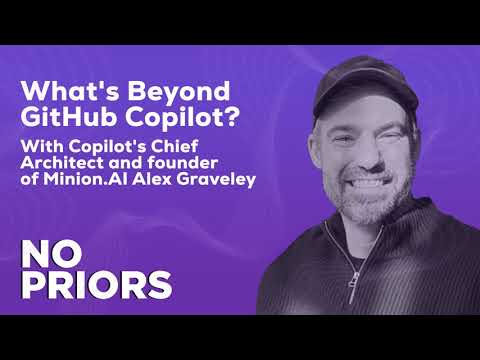
No Priors Ep. 10 | With Copilot's Chief Architect and founder of Minion.AI Alex Graveley
Sarah Guo (host), Alex Graveley (guest), Elad Gil (host), Narrator, Sarah Guo (host), Elad Gil (host), Sarah Guo (host), Elad Gil (host), Sarah Guo (host)
In this episode of No Priors, featuring Sarah Guo and Alex Graveley, No Priors Ep. 10 | With Copilot's Chief Architect and founder of Minion.AI Alex Graveley explores from Linux Hacker To Copilot Architect: Building The Age Of Agents Alex Graveley traces his path from teenage Linux and open source contributor to building Hackpad, Dropbox Paper, and ultimately serving as chief architect of GitHub Copilot.
From Linux Hacker To Copilot Architect: Building The Age Of Agents
Alex Graveley traces his path from teenage Linux and open source contributor to building Hackpad, Dropbox Paper, and ultimately serving as chief architect of GitHub Copilot.
He explains lessons from ops-heavy ‘assistant’ startups like Magic, early crypto work, and the messy human behaviors that make automation hard, especially before modern language models.
Graveley details Copilot’s origin with a weak early code model, the experimentation that led to the ghost-text UX, and the ruthless focus on speed that drove massive adoption and retention.
He closes by discussing his new startup Minion, the coming era of AI agents that act for users in the real world, and the societal challenges around identity, abuse, and building the right talent and intuition for this new wave.
Key Takeaways
Open source and real user problems can seed impactful products.
Hackpad emerged from a Burning Man warehouse struggling to coordinate projects; by forking Etherpad and solving a real organizational need, it grew into a YC company and ultimately an acquisition, showing how niche coordination problems can become mainstream tools.
Get the full analysis with uListen AI
Ops-heavy ‘assistant’ startups exposed the limits of pre-LLM automation.
Magic and similar services relied on human operators, revealing how messy, context-dependent, and unpredictable human requests are in text form—and why earlier ML approaches (like basic seq2seq) couldn’t yet handle the variability of real-world tasks.
Get the full analysis with uListen AI
AI abuse and human bad actors are nearer-term threats than runaway AGI.
Graveley expects years of discomfort as AIs are weaponized for fraud, scams, and social engineering, arguing that policy, identity systems, and enforcement need to catch up to mitigate harm rather than focusing solely on AI itself going rogue.
Get the full analysis with uListen AI
Product success with AI hinges on UX and extreme latency optimization.
Copilot only took off after shifting from clunky UIs to Gmail-style ghost text and optimizing multi-line completions; data showed every extra 10 ms of latency reduced completions by about 1%, and regions far from Texas under-used the product until additional GPU regions were deployed.
Get the full analysis with uListen AI
Weak early models can still be viable if they scale and are framed right.
The initial code model from OpenAI solved under 10% of test cases, yet systematic evaluation, better prompting, more data (including version histories and diffs), and improved UX pushed success rates above 60% on in-the-wild tests, enabling a mass-market product.
Get the full analysis with uListen AI
Inference cost trajectories can transform business models and accessibility.
Copilot’s initial cost estimates were around $30 per user per month, but better deployment and optimizations brought this closer to $10 or less, turning what looked like an enterprise-only tool into a mass subscription product developers would personally pay for.
Get the full analysis with uListen AI
Future AI value will come from agents that take actions, not just answer.
With Minion, Graveley aims to extend the ‘Copilot’ concept to daily life—agents that book travel, manage schedules, do taxes, and handle digital chores—by combining LLMs with structured task decomposition, real-world feedback signals, and new behavioral datasets (like clickstreams).
Get the full analysis with uListen AI
Notable Quotes
“The honest answer is, I think we're gonna go through a many-year period of extreme discomfort, where AIs pretend to be things, or confuse people, or extract money from your grandparents.”
— Alex Graveley
“I'm not really scared about AIs killing us... I'm more worried about bad people using new technology to hurt us.”
— Alex Graveley
“It turns out code is pretty special, right? You can run it. So if an AI generates some code and it runs, you know something about that code that you wouldn't know necessarily with text.”
— Alex Graveley
“Our retention rate was 50%. Months later it was still above 50% by weekly cohort, which is insane.”
— Alex Graveley
“The goal, right, is straight out of sci‑fi: you wanna make a thing where you say, 'Hey, computer, file my taxes,' and it does the right thing.”
— Alex Graveley
Questions Answered in This Episode
What specific safeguards and identity systems does Graveley believe are most urgent to build to prevent AI-driven financial and social scams?
Alex Graveley traces his path from teenage Linux and open source contributor to building Hackpad, Dropbox Paper, and ultimately serving as chief architect of GitHub Copilot.
Get the full analysis with uListen AI
How might the ‘code is special because you can run it’ insight translate into reliable evaluation frameworks for non-code AI agents operating in the real world?
He explains lessons from ops-heavy ‘assistant’ startups like Magic, early crypto work, and the messy human behaviors that make automation hard, especially before modern language models.
Get the full analysis with uListen AI
What kinds of new datasets—such as user interaction logs or web actions—does Minion intend to leverage, and how will they be collected ethically?
Graveley details Copilot’s origin with a weak early code model, the experimentation that led to the ghost-text UX, and the ruthless focus on speed that drove massive adoption and retention.
Get the full analysis with uListen AI
How should developers and product teams cultivate the intuition and experimentation mindset Graveley says is needed to build effective AI products?
He closes by discussing his new startup Minion, the coming era of AI agents that act for users in the real world, and the societal challenges around identity, abuse, and building the right talent and intuition for this new wave.
Get the full analysis with uListen AI
In a world where agents can handle most routine coding and life tasks, what new skills and roles will become most valuable for humans?
Get the full analysis with uListen AI
Transcript Preview
So let's start with some background to how did you end up working in tech for AI?
Tech was earlier. I started, you know, really young and, uh, I got really into Linux when I was 14 or so. And, um, yeah, it was right around the time when the web was, like, a new thing, and you had to work to kind of get on the web. And then Linux is... I just sort of found it. It, um, popped into my life, and I really liked the... I read the GPL really early at 15, and it struck me. And, uh, just the idea of helping in the open and making it freely available, so other people could learn from things like I was learning from things seemed great. So I went and spent many years just working on open source stuff. And I don't know, I guess I didn't realize there was like... There was kind of a... There was, like, legacy technology, right? Like Windows was popular at that time. So people ran their, you know, data centers on Windows and networks on Windows and... Um, this Linux thing was, like, very strange and people didn't really know what it was. I spent many hours compiling kernels and, uh, hacking on stuff and, uh... Yeah.
And what was the thought process behind starting, like, Hackpad?
Oh, Hackpad. Uh, yeah. So I had just finished like four or five years at VMware, and, uh, I wanted to get into startups. I knew- I knew that. And then, uh... So I left VMware and I started working on an, an education startup like many of us do. Uh, I don't know if you know this, but like many, many founders start with like the idea of an education startup.
It's like a rite of passage. Yeah.
It's like a rite of passage. Yeah. So I spent, I don't know, nine months working on- on- on- on that.
Most of us have done either that or consumer social at the time.
Sure. Yeah. And, uh, it's... Uh, it turns out education's very hard. Um, yeah. You nod your heads knowingly. Yeah. And, uh, so after nine months I was like, "All right, this isn't going anywhere. Uh, I- I know... I don't know if there's a value prop here." I mean, that's... That was the value, is that I learned that, like, you have to make something that is both achievable and that people want to pay for or spend their time on. So, yeah, then I was just kind of fishing around. Um, I was living in like a- a warehouse in San Francisco with a bunch of Burning Man people, and, uh, we were having trouble organizing burning... Large-scale Burning Man projects. And so, uh, I forked Etherpad and started hacking on it. Uh, recruited a friend to... In the community to start working on it with me. And yeah, just grew from there. We had... Um, you know, before we did YC we had most... Many of the large Burning Man camps using it to organize their- their builds.
Install uListen to search the full transcript and get AI-powered insights
Get Full TranscriptGet more from every podcast
AI summaries, searchable transcripts, and fact-checking. Free forever.
Add to Chrome