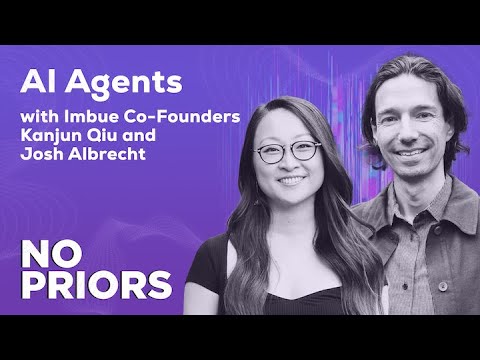
No Priors Ep. 41 | With Imbue Co-Founders Kanjun Qiu and Josh Albrecht
Sarah Guo (host), Kanjun Qiu (guest), Josh Albrecht (guest), Elad Gil (host)
In this episode of No Priors, featuring Sarah Guo and Kanjun Qiu, No Priors Ep. 41 | With Imbue Co-Founders Kanjun Qiu and Josh Albrecht explores imbue Envisions Reliable Reasoning Agents To Transform Everyday Computer Use Imbue co-founders Kanjun Qiu and Josh Albrecht discuss their mission to build AI agents that can reason, act autonomously, and write robust code, moving beyond today’s chatbots and token-prediction LLMs.
Imbue Envisions Reliable Reasoning Agents To Transform Everyday Computer Use
Imbue co-founders Kanjun Qiu and Josh Albrecht discuss their mission to build AI agents that can reason, act autonomously, and write robust code, moving beyond today’s chatbots and token-prediction LLMs.
They argue that current computers require constant micromanagement and that the next revolution is agents that understand goals, plan, and reliably execute tasks on users’ behalf.
A core focus is reasoning and reliability: building architectures, evaluation methods, and tooling that transform fragile agent loops into production-ready systems, with coding agents as a primary proving ground.
They foresee a future where everyone effectively becomes a “software engineer” through natural-language programming of agents, leading to more, better, and highly customized software built with heavy compute but relatively small teams.
Key Takeaways
Treat agent reliability as a first-class engineering problem.
Imbue frames current agent limitations primarily as reliability issues—getting the system to consistently choose good plans, know when it’s uncertain, and correct its own errors—rather than expecting a single massive model to magically solve everything.
Get the full analysis with uListen AI
Use real, high-frequency workflows to drive research (“serious use”).
They deliberately build agents for tasks they themselves need daily (coding, internal operations, recruiting), which exposes failure modes, forces better tooling, and incrementally pushes reliability from ~60% toward production-grade performance.
Get the full analysis with uListen AI
Combine general agents with specialized sub-agents and smaller models.
Agent workflows can mix large general-purpose models for planning with specialized, smaller, cheaper models or sub-agents for repeated subtasks, achieving both cost efficiency and strong performance.
Get the full analysis with uListen AI
Leverage code as both a reasoning medium and an evaluation goldmine.
Coding tasks provide objective signals (tests passing, type checks, style constraints) and allow a smooth spectrum between fuzzy language-based reasoning and concrete hard-coded logic, making them ideal for building and measuring reasoning agents.
Get the full analysis with uListen AI
Continuously decompose evaluation into granular, measurable criteria.
Rather than only asking “is the output correct? ...
Get the full analysis with uListen AI
Invest in data and training efficiency, not just raw model size.
Even with enough GPUs to train frontier-scale models, Imbue emphasizes better data curation, training stability, and hyperparameter optimization to get more capability from fewer resources instead of simply chasing the largest models.
Get the full analysis with uListen AI
Use agents to build and improve the next generation of agents.
They already employ internal “agentic” infrastructure (e. ...
Get the full analysis with uListen AI
Notable Quotes
“Our computers today need to be micromanaged. Nothing really happens unless I'm in front of it turning all these little knobs.”
— Kanjun Qiu
“The real promise of AI is if we can get systems that can actually act on our behalf and accomplish goals.”
— Josh Albrecht
“Writing agents today feels like writing code in assembly.”
— Kanjun Qiu
“If you want something to actually execute the general algorithm for addition, you need a thing that works in a different way than a pure language model.”
— Josh Albrecht
“In the future everyone will be a software engineer, and so everyone will need dev tools.”
— Kanjun Qiu
Questions Answered in This Episode
How far can current LLM-based systems be pushed before fundamentally new agent architectures are required for robust real-world autonomy?
Imbue co-founders Kanjun Qiu and Josh Albrecht discuss their mission to build AI agents that can reason, act autonomously, and write robust code, moving beyond today’s chatbots and token-prediction LLMs.
Get the full analysis with uListen AI
What specific data practices or curation strategies have been most impactful in improving reasoning and reliability for Imbue’s models?
They argue that current computers require constant micromanagement and that the next revolution is agents that understand goals, plan, and reliably execute tasks on users’ behalf.
Get the full analysis with uListen AI
How should startups decide which parts of an agent workflow warrant specialized smaller models versus relying on a single general model?
A core focus is reasoning and reliability: building architectures, evaluation methods, and tooling that transform fragile agent loops into production-ready systems, with coding agents as a primary proving ground.
Get the full analysis with uListen AI
What are the biggest open problems in evaluating non-code agents where there are no clear pass/fail tests?
They foresee a future where everyone effectively becomes a “software engineer” through natural-language programming of agents, leading to more, better, and highly customized software built with heavy compute but relatively small teams.
Get the full analysis with uListen AI
If everyday users become “natural-language programmers” of agents, what new failure modes, safety issues, or governance challenges does that create?
Get the full analysis with uListen AI
Transcript Preview
Imbue is a company developing AI agents that can reason and code. Today, Elade and I sit down with Kanjun Qiu and Josh Albrecht, co-founders of Imbue, to discuss training large foundation models for high-level reasoning, why agents require architectures different from large language models or language token prediction models, and how current computers are getting in the way of their users. Kanjun, Josh, welcome to No Priors.
Thank you.
Thanks.
So perhaps you can start by just telling us the story of how you guys know each other and where the idea for Imbue came from.
Josh and I met at a conference and then started a big house together, uh, it was a big house, 20% house, and also started this first company around the same time. I've always been really interested in agency, uh, and kind of like how do we enable humans to have more agency, and Josh has always been really interested in AI, uh, and so it kind of made sense. Uh, we, at that time, talked about like, "Oh, you know, someday we're gonna be able to have AI systems that give humans a lot more agency." Fast-forward to 2018 or so, uh, we were running an AI recruiting company called Sourceress, and that was actually kind of the first AI agent that we built. Um, it was, you know, not transformer models, uh, like, more old-school MLP, uh, but it was a system that recruiters used and kind of automatically got candidates in their inbox, and we learned a lot about, "Oh, if you have an autonomous system like this, like what do you actually need to make it work?" And around that time, some of our housemates were building GPT-3, and, uh, we were seeing, like, "Oh, scaling works. You know, if we just keep scaling, actually, you're gonna get pretty far with a lot of these language models." So our question at that time was, you know, "How far can we get with language models? Does this kind of self-supervised learning, which is working so well on language, work in other modalities as well?" So in early 2020, that's when we first started seeing self-supervised learning working across video and images and language, and we were like, "Huh, there's something really interesting here where maybe machines are learning the same kinds of representations or similar representations of what humans are learning, and maybe they can get to a point where they can actually do the types of things that humans are able to do." And that's when we first started Imbue, or start- started talking about Imbue.
You clearly know a bunch of people working at sort of large, uh, language model research labs well. When you looked at what they were doing, how did the focus come to be on agents in particular, and how is that different from a general language model?
Yeah, I- I think we've always been interested in agents, in not just, you know, recommender systems or classifiers or things like that, but in systems that are gonna go do real work for us, right? That are gonna actually be useful in the real world. Right now, you can ask some kind of chatbot something, and it'll give you back a response, but the burden is sort of on you to go do something with that to verify whether it's correct or not. I think the real promise of AI is if we can get systems that can actually act on our behalf and can accomplish goals and kind of do these larger things and sort of free us up to, uh, to focus on the things we're interested in.
Install uListen to search the full transcript and get AI-powered insights
Get Full TranscriptGet more from every podcast
AI summaries, searchable transcripts, and fact-checking. Free forever.
Add to Chrome