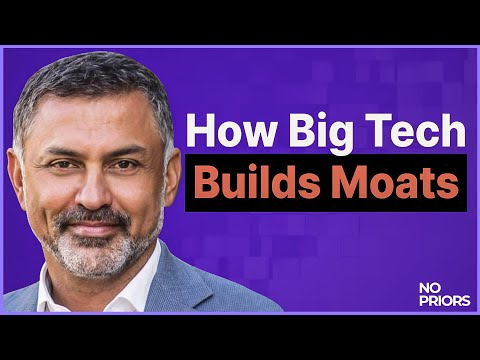
No Priors | With Palo Alto Networks CEO & Former Chief Business Officer of Google Nikesh Arora
Sarah Guo (host), Nikesh Arora (guest), Elad Gil (host), Elad Gil (host), Sarah Guo (host)
In this episode of No Priors, featuring Sarah Guo and Nikesh Arora, No Priors | With Palo Alto Networks CEO & Former Chief Business Officer of Google Nikesh Arora explores nikesh Arora on AI’s Disruption of Search, Security, and Workflows Nikesh Arora discusses how generative AI shifts search from information retrieval to ‘democratization of intelligence,’ and why Google’s distribution and AI chops position it well—if it can evolve its business model from leads to completed transactions.
Nikesh Arora on AI’s Disruption of Search, Security, and Workflows
Nikesh Arora discusses how generative AI shifts search from information retrieval to ‘democratization of intelligence,’ and why Google’s distribution and AI chops position it well—if it can evolve its business model from leads to completed transactions.
He argues that in enterprises, AI will move from assistive tools to precision task automation only once reliability is high, likely via AI-as-a-service tightly coupled to systems of record rather than thin wrappers over foundational models.
In cybersecurity, Arora sees the core challenge as compressing defense response times to match AI-accelerated attacks, which requires consolidating fragmented tools into true platforms, leveraging rich sensor data, and focusing on anomalous behavior rather than just blocking known threats.
He is broadly optimistic about AI’s impact on product quality, customer support, and organizational efficiency, and describes his leadership approach as setting a clear North Star, over-communicating the ‘why,’ and using distributed R&D via acquisitions to build a dominant security platform.
Key Takeaways
Search will evolve from link lists to intent-fulfilling agents.
Generative AI enables systems that answer user intent directly instead of returning pages of links, continuing Google’s long-standing vision of ‘answer my question, not my query’—but the key challenge is shifting the revenue model from lead generation to completed transactions.
Get the full analysis with uListen AI
Enterprise AI must be accurate, contextual, and tied to systems of record.
Unlike consumer use, enterprises can’t tolerate incorrect ‘agentic’ actions; useful AI will blend general-purpose models with proprietary domain data and workflows, acting as an AI layer over core records rather than a standalone chat interface.
Get the full analysis with uListen AI
AI wrappers without proprietary data or workflow depth are fragile businesses.
If a startup simply adds guardrails or UI on top of a model, it risks being absorbed as models add those features; durable value requires owning critical workflows plus the underlying data (the true system of record).
Get the full analysis with uListen AI
Cybersecurity must shift from point tools to data-rich platforms.
With attackers using AI to compress attack and exfiltration times to under an hour, defenders need broad sensor coverage, unified data, and ML on ingestion to detect unknown threats—making fragmented tool stacks and ‘after-the-fact’ SOC automation increasingly insufficient.
Get the full analysis with uListen AI
Identity security must move from static access to behavioral anomaly detection.
Because most breaches stem from credential theft and social engineering, Arora argues for ‘just-in-time’ access based on continuous behavioral analysis (e. ...
Get the full analysis with uListen AI
AI will likely shrink repetitive and support-heavy roles before core creative ones.
He expects major efficiency gains in documentation, back-office work, and especially customer support (potentially eliminating 80–90% over time), while sales and strong product teams will use AI to move faster rather than be replaced.
Get the full analysis with uListen AI
Aggressive, platform-scale growth comes from clear strategy and distributed R&D.
Arora’s playbook at Palo Alto is to set an ambitious platform North Star, over-communicate it across many direct reports, and use targeted acquisitions of #1 or #2 startups as ‘distributed R&D,’ often putting founders in charge of major product lines.
Get the full analysis with uListen AI
Notable Quotes
“I sort of call that democratization of intelligence. All of us will have the basic intelligence which every other person next to us has because we can kind of go figure it out.”
— Nikesh Arora
“In the enterprise world, there is not that tolerance for an inaccurate outcome… None of us are giving autonomy to any form of LLMs to create any agentic task or do any work for me.”
— Nikesh Arora
“Getting the smartest model in the world is like hiring the smartest PhD… For that PhD to be useful at Palo Alto, we still have to teach them our ways.”
— Nikesh Arora
“The fastest we’ve seen it right now is 23 minutes. So if the bad actor can get in an hour and exfiltrate data… then by physics, your response time has to be less than an hour.”
— Nikesh Arora
“Customer support exists because we build bad products. If you have great products, why would you have to have customer support?”
— Nikesh Arora
Questions Answered in This Episode
How will Google and other incumbents practically transition their ad businesses from lead generation to AI-driven completed transactions without destroying existing revenue streams?
Nikesh Arora discusses how generative AI shifts search from information retrieval to ‘democratization of intelligence,’ and why Google’s distribution and AI chops position it well—if it can evolve its business model from leads to completed transactions.
Get the full analysis with uListen AI
What concrete thresholds of reliability and governance would make enterprises comfortable delegating truly ‘agentic’ workflows to AI without humans in the loop?
He argues that in enterprises, AI will move from assistive tools to precision task automation only once reliability is high, likely via AI-as-a-service tightly coupled to systems of record rather than thin wrappers over foundational models.
Get the full analysis with uListen AI
In a world of converging model capabilities, what new moats can AI startups realistically build beyond proprietary data and workflow integration?
In cybersecurity, Arora sees the core challenge as compressing defense response times to match AI-accelerated attacks, which requires consolidating fragmented tools into true platforms, leveraging rich sensor data, and focusing on anomalous behavior rather than just blocking known threats.
Get the full analysis with uListen AI
How can large enterprises unwind deeply fragmented security stacks in practice, and what migration paths make it feasible to move from 100+ tools to a small number of platforms?
He is broadly optimistic about AI’s impact on product quality, customer support, and organizational efficiency, and describes his leadership approach as setting a clear North Star, over-communicating the ‘why,’ and using distributed R&D via acquisitions to build a dominant security platform.
Get the full analysis with uListen AI
If AI dramatically reduces customer support roles, what responsibilities do leaders have in reskilling those workers, and where should that displaced talent be redeployed?
Get the full analysis with uListen AI
Transcript Preview
(instrumental music plays) Hi, listeners. Welcome back to No Priors. Today, we're here with Nikesh Arora, the CEO of Palo Alto Networks. He joined Palo Alto in 2018 when it was the next gen firewall player, and has since grown it to six to seven times the size as a leader as a platform security company. Previously, he was the SVP and CBO of Google during its massive growth phase from 2004 to 2014. Welcome, Nikesh. Nikesh, thanks so much for being with us.
My pleasure.
Uh, I don't know where to start because I want to talk about AI, I want to talk about security, I want to talk about leadership. I do think given your history growing Google as chief business officer, like, we have to ask you, what do, what do you think is the future of search and how threatened is it?
Nothing like a slow little lowball-
Mm-hmm.
... welcome into your show.
Got to work him up a little bit.
Yeah.
This guy was with Google too at that point in time, wasn't you? So...
But I talk to him too much.
(laughs) And what does he think?
I think we should defer the question to you as the expert.
Oh, look at that.
(laughs)
He doesn't want to put his, put his own mouth.
Welcoming back.
He wants to have me do all the hard work.
(laughs)
Look, I think, um, the idea when, when search came about, I still remember going out there and trying to sell search to people. And it was the, "Oh my God, you mean I can just go to the internet, type something and I can get the answer?" And we spent two decades trying to get all the information out there on the internet so it was easily accessible to people. And I think you saw the benefits. You saw the benefits of, you know, democratization of information. Farmers in India could get stuff and people could get information. I think now, we're in an age people are saying, "Great. Now, don't give me all this stuff to sift through myself. Try and make sense of all of it for me because it's too much." And that's what you're seeing in today's generative AI models. So I- I sort of, in my own words, I call that democratization of intelligence. All of us will have-
Mm-hmm.
... the basic intelligence which every other person next to us has because we can kind of go figure it out. I don't have to hire the same people to solve the same problem for me the 10,000th time and pay them money because it's already been solved 9,999 times and the outcome is on the internet somewhere. So I think to the extent that Google has sharpened its sort of skills on putting all that information together, being able to synthesize it, understand it, being able to interpret my intention as an end user and try and present me the most likely outcome, I think that should translate well to the notion of generative AI being able to summarize the same thing in a much more enhanced or ordered way for them. So I think from that perspective, will they have the ability to transition the current search product into a future product which is basically, you know, call it what you want to call it, you know, ask me anything or... And I think it's so funny, like, you know, when you worked at Google 15 years ago, Larry had that vision. He used to talk about getting to a point where you answer my question, answer my intent, as opposed to answer what I type. So I, he, he had the foresight to talk about it, he used to talk about AI. So I think from a product perspective, they are in a good position to be able to transition the product to what the end users need. And you've seen that with Gemini, you see that with ChatGPT, you see that with other models which are getting to the same place. Let's not underestimate the distribution power they have. There are two or three companies in the world which have distribution in the billions. And whether it's Facebook with all their properties or it's Apple with their properties or Google with their properties. So they have the distribution, they have the product chops, they have the AI chops. I think the question, bigger question is how does the business model transform from what it has been with
Install uListen to search the full transcript and get AI-powered insights
Get Full TranscriptGet more from every podcast
AI summaries, searchable transcripts, and fact-checking. Free forever.
Add to Chrome