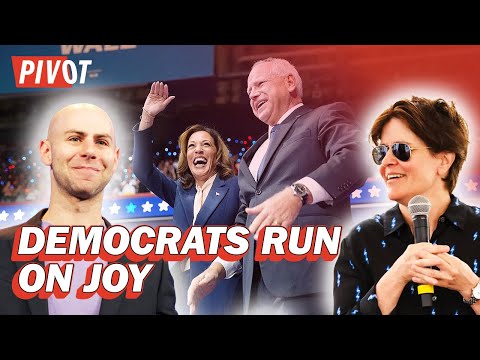
Kamala Harris and the Democrats are Running on Joy — Is That a Winning Strategy? | Pivot
Kara Swisher (host), Adam Grant (guest)
In this episode of Pivot, featuring Kara Swisher and Adam Grant, Kamala Harris and the Democrats are Running on Joy — Is That a Winning Strategy? | Pivot explores kamala Harris Bets On Joyful Hope As Trump Doubles Down Chaos The conversation examines Kamala Harris’s emerging campaign strategy centered on “joy,” reframing it as forward-looking hope and collective energy that contrasts with years of negative, fear-based politics.
Kamala Harris Bets On Joyful Hope As Trump Doubles Down Chaos
The conversation examines Kamala Harris’s emerging campaign strategy centered on “joy,” reframing it as forward-looking hope and collective energy that contrasts with years of negative, fear-based politics.
They argue Harris has injected fresh momentum into the race, especially among voters previously unenthusiastic about Biden, while Trump appears stuck in grievance, rudeness, and an undisciplined, backward-looking message.
The guests discuss how language choices like “weird” and “out of their damn minds” work politically because they validate common feelings without sounding elitist or cruel, and how Harris’s nuanced positions (e.g., on Israel–Palestine) help define what she stands for.
They also use Biden’s late exit as a case study in leadership, groupthink, and escalation of commitment, contrasting his struggle to step aside with Harris’s apparent willingness to invite dissent and stress‑test her own decisions.
Key Takeaways
Joy works politically when it is grounded in hope, not denial.
Durkheim’s “collective effervescence” underpins Harris’s joyful framing, but the power lies in channeling shared energy toward a better future while still acknowledging real pain and hardship.
Get the full analysis with uListen AI
Optimistic, future-focused campaigns can energize voters more than fear-based messages.
Harris’s tone echoes successful “Morning in America” campaigns by Reagan and Obama, giving voters something to be excited about rather than overwhelming them with messages like “democracy is on the ballot.”
Get the full analysis with uListen AI
Language that feels relatable yet non‑elitist is politically potent.
Terms like “weird” and phrases like “out of their damn minds” resonate because ordinary people use them, they validate existing feelings, and they avoid the harsh moral judgment that made “deplorables” backfire.
Get the full analysis with uListen AI
Harris’s main asset is momentum; her main risk is definition.
She currently benefits from fresh energy and curiosity, but many voters still lack a clear sense of her core principles and policies, making her next messaging choices critical.
Get the full analysis with uListen AI
Trump’s strategy of delegitimizing institutions still works, but his discipline is eroding.
By attacking media and other arbiters of credibility, he keeps doubts alive about his critics, yet his increasingly unfocused, rambling approach suggests a diminishing strategic core.
Get the full analysis with uListen AI
Leaders trapped in escalation of commitment need legacy‑focused reframing to change course.
Biden’s eventual decision to step aside became possible when advisers shifted from fear-of-loss arguments to legacy and “passing the torch” framing, consistent with research on deescalating failing commitments.
Get the full analysis with uListen AI
High-performing leaders actively solicit and reward dissenting views.
Harris is described as someone who asks, “What’s the worst thing here? ...
Get the full analysis with uListen AI
Notable Quotes
“What we're really talking about is energy people have around a possible future… the fact that it's forward-looking means it really is hope, not joy.”
— Guest (social scientist)
“I don't know why they have to crap all over joy… let 'em have it for a minute.”
— Kara Swisher
“Anyone who says they’re not weird is weird. That’s the thing.”
— Kara Swisher
“We all know weird people that we accept. It’s a way of saying, ‘Hey, you’re not like us,’ without saying, ‘You’re less than us.’”
— Guest (social scientist)
“Weak leaders shoot the messenger. Strong leaders praise the messenger, but truly great leaders promote the messenger.”
— Guest (social scientist)
Questions Answered in This Episode
Can a campaign built around joy and hope stay effective when negative attacks inevitably escalate, or will it be forced to harden its tone?
The conversation examines Kamala Harris’s emerging campaign strategy centered on “joy,” reframing it as forward-looking hope and collective energy that contrasts with years of negative, fear-based politics.
Get the full analysis with uListen AI
What specific policies or stories could Harris highlight to convert vague ‘momentum’ into a clearer sense of what she stands for?
They argue Harris has injected fresh momentum into the race, especially among voters previously unenthusiastic about Biden, while Trump appears stuck in grievance, rudeness, and an undisciplined, backward-looking message.
Get the full analysis with uListen AI
Is there any realistic scenario in which a Trump–Harris debate materially changes voter opinions, given how entrenched views of Trump already are?
The guests discuss how language choices like “weird” and “out of their damn minds” work politically because they validate common feelings without sounding elitist or cruel, and how Harris’s nuanced positions (e. ...
Get the full analysis with uListen AI
How can organizations and campaigns systematically protect themselves from groupthink when a powerful leader is emotionally invested in a failing course of action?
They also use Biden’s late exit as a case study in leadership, groupthink, and escalation of commitment, contrasting his struggle to step aside with Harris’s apparent willingness to invite dissent and stress‑test her own decisions.
Get the full analysis with uListen AI
Where is the line between using relatable language like “weird” or “out of their damn minds” and slipping into the kind of contempt that backfires politically?
Get the full analysis with uListen AI
Transcript Preview
Vice President Kamala Harris is moving into the next phase of her campaign with the Democratic National Convention now in the rear view mirror. The Harris campaign said over the weekend, it had now raised $540 million since launching last month, with $82 million coming during the convention. Nearly a third of those donations from the convention which, came from first time contributors. Um, I wanted... I, I, I started with the idea of joy that the Harris campaign and Democrats are leaning into heavily. Uh, we heard it mentioned in a number of convention speeches last week. Talk a little bit about i-... What do you think about the politics of joy? You've written in the past about the power of collective effervescence, which is kind of a cooler way to say it, but joy is an easier word, three, just three letters.
(laughs)
Essentially group happiness that was esce-... that was especially powerful post-COVID. Can you talk a little bit about this?
Yeah. I think the sociologist Durkheim first wrote about collective effervescence is that sense of energy and purpose you get in a group when you have a common goal together. And I do think that's what the Kamala Harris campaign has created for a lot of people who, you know, either thought Biden was too old or just weren't energized by his candidacy. (laughs) At the same time, you don't, you don't want to be a Pollyanna, as a leader.
Mm-hmm. Right.
Um, you want people to, to understand that you recognize the pain and the hardship you're, they're facing.
Mm-hmm.
And that's why I would frame this much more as hope than joy.
Mm-hmm.
I think joy is about the, the energy-
Well, hope was taken by Obama, but go ahead. I mean, for-
Well, you could, you could say that, but-
Right.
... I, I think in analyzing it, right?
Mm-hmm.
What we're really talking about is energy people have around a possible future.
Mm-hmm.
Not about the present, right? Nobody's feeling joy, um, around this if, you know, if Trump wins.
Mm-hmm.
So I think that, you know, the fact that it's forward-looking means it's, it really is hope, not joy. Um, I think it's anticipatory. I think it's excitement about what's to come, and I do think that energizes people to vote, and I think... (laughs) You know, we, we have had a, a long political, I guess, streak of, you know, of politicians bashing and trashing each other.
Mm-hmm.
But I don't want to assume it always has to be that way. I, I look-
Right.
... for example, at the campaign that Halla Þómasdóttir ran in Iceland-
Mm-hmm.
... for president recently, uh, where she won refusing to attack her opponents-
Uh-huh.
... running a campaign based on curiosity and hope and enthusiasm, and people resonated with that. Now, Iceland is a tiny country.
Install uListen to search the full transcript and get AI-powered insights
Get Full TranscriptGet more from every podcast
AI summaries, searchable transcripts, and fact-checking. Free forever.
Add to Chrome