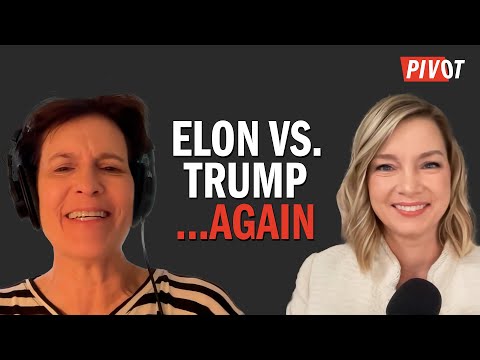
Elon vs. Trump: The Feud That Never Ends | Pivot
Kara Swisher (host), Kristen Soltis Anderson (guest), Narrator
In this episode of Pivot, featuring Kara Swisher and Kristen Soltis Anderson, Elon vs. Trump: The Feud That Never Ends | Pivot explores elon, Trump, and America’s Fractured Politics: Polls, Power, Perception Kara Swisher and Republican pollster Kristen Soltis Anderson unpack the escalating feud between Elon Musk and Donald Trump over Trump’s “Big Beautiful Bill,” Musk’s third-party fantasies, and how public opinion data explains the current political realignment. They dive into why Americans hate the two-party system yet don’t actually want Musk-style libertarianism, and why Trump’s bill polls terribly despite GOP determination to pass it. The conversation expands to media lawsuits and “lawfare” against news outlets, bipartisan backlash to federal AI preemption, and Trump’s shifting stance on a TikTok sale. Finally, they analyze Zoran Mamdani’s insurgent New York mayoral primary win as a case study in populist, media-savvy politics and what it signals—and doesn’t—for Democrats nationwide.
Elon, Trump, and America’s Fractured Politics: Polls, Power, Perception
Kara Swisher and Republican pollster Kristen Soltis Anderson unpack the escalating feud between Elon Musk and Donald Trump over Trump’s “Big Beautiful Bill,” Musk’s third-party fantasies, and how public opinion data explains the current political realignment. They dive into why Americans hate the two-party system yet don’t actually want Musk-style libertarianism, and why Trump’s bill polls terribly despite GOP determination to pass it. The conversation expands to media lawsuits and “lawfare” against news outlets, bipartisan backlash to federal AI preemption, and Trump’s shifting stance on a TikTok sale. Finally, they analyze Zoran Mamdani’s insurgent New York mayoral primary win as a case study in populist, media-savvy politics and what it signals—and doesn’t—for Democrats nationwide.
Key Takeaways
Polling is better at describing the present than predicting tight future outcomes.
Kristen stresses that polls are often misused as precise forecasting tools; they’re far more reliable for capturing current attitudes than for calling close races a week or two out.
Get the full analysis with uListen AI
The U.S. electorate is not clamoring for a libertarian ‘America Party.’
Only about 5% of voters are socially liberal and fiscally conservative—the Musk lane—while a larger bloc is socially/culturally conservative but economically supportive of a strong safety net, making Musk’s preferred ideology a niche proposition.
Get the full analysis with uListen AI
Trump’s “Big Beautiful Bill” is a messaging nightmare despite GOP unity.
The bill bundles tax cuts, major Medicaid and SNAP cuts, work requirements, AI and EV provisions, and more; opponents can unite against it as “Trump’s bill,” while supporters are split across center-right and hard-right factions, driving very poor topline polling.
Get the full analysis with uListen AI
Work requirements and Medicaid cuts are a political time bomb.
While “work requirements” poll well as a slogan, Kristen notes that if millions—including many Trump voters—lose coverage due to paperwork and implementation snags, Republicans could face serious backlash in the midterms.
Get the full analysis with uListen AI
There is bipartisan resistance to blocking state AI regulation, especially on kids’ safety.
Polling for Common Sense Media showed Republicans and Democrats strongly oppose a 10-year federal preemption on state AI laws; even when presented with national-competitiveness arguments, most voters prioritize states’ rights and protecting children from tech harms.
Get the full analysis with uListen AI
Media settlements and legal attacks risk further eroding trust across the spectrum.
Trump’s wins against ABC and Paramount, Fox’s Dominion payout, and lawsuits targeting pollsters like Ann Selzer contribute to a climate where both Republicans and now Democrats increasingly distrust major media institutions.
Get the full analysis with uListen AI
Populist, media-savvy candidates like Zoran Mamdani can mobilize young voters.
Mamdani’s cost-of-living-focused, plainspoken, online-native campaigning turned young voters into the largest age bloc in a low-turnout primary—showing that authenticity plus clear economic populism can be powerful, even if his ideology isn’t easily generalizable nationwide.
Get the full analysis with uListen AI
Notable Quotes
““The bad news for those folks is in the data, it’s actually a very small portion of the electorate.””
— Kristen Soltis Anderson (on socially liberal, fiscally conservative voters)
““Less chainsaw, more Mars.””
— Kristen Soltis Anderson (on how Elon Musk could repair his brand)
““If the word Donald Trump is coming out of your mouth, you have created problems for yourself.””
— Kristen Soltis Anderson (on business leaders engaging with Trump)
““This bill is the Cheesecake Factory menu of conservative priorities… you’re kind of asking them to eat everything on the Cheesecake Factory menu all at once.””
— Kristen Soltis Anderson (on why Trump’s bill is so politically difficult)
““I think media savvy populism really sells, and be careful of thinking that you can make that really, really, really unpopular.””
— Kristen Soltis Anderson (on Zoran Mamdani and similar candidates)
Questions Answered in This Episode
Given Kristen’s data on ideological segments, what would a truly viable third party in America actually look like in terms of policy positions and branding?
Kara Swisher and Republican pollster Kristen Soltis Anderson unpack the escalating feud between Elon Musk and Donald Trump over Trump’s “Big Beautiful Bill,” Musk’s third-party fantasies, and how public opinion data explains the current political realignment. ...
Get the full analysis with uListen AI
If millions of Trump voters lose Medicaid coverage due to new work requirements and bureaucracy, how might that reshape GOP messaging or coalition-building in 2026 and beyond?
Get the full analysis with uListen AI
How can reputable pollsters and media organizations protect themselves from politically motivated lawsuits without chilling robust reporting and analysis?
Get the full analysis with uListen AI
What regulatory model for AI could balance national competitiveness with voters’ strong desire for state-level, especially child-focused, protections?
Get the full analysis with uListen AI
To what extent can Mamdani-style, left-populist, youth-driven campaigns be adapted to more moderate or conservative regions, or is this strictly a big-city, blue-state phenomenon?
Get the full analysis with uListen AI
Transcript Preview
Scorched earth is his kind of policy in lots of ways. He doesn't care. (instrumental music) Hi, everyone. This is Pivot from New York Magazine and the Vox Media Podcast Network. I'm Kara Swisher, and this episode is sponsored by IBM. Scott is off today sailing in some place, maybe Ibiza. Who knows? So in his place, I brought someone actually smart, a fantastic co-host, uh, Kristen Soltis Anderson, who is a pollster, a contributing opinion writer for The New York Times, and co-founder of Echelon Insights. I was on the Chris Wallace Show with her, um, and she is a Republican pollster. I am obviously, well, I don't know what I am. Anyway, welcome, Kristen.
Thank you so much for having me. I miss our weekly get-togethers, uh-
I know.
... with, with Chris Wallace refereeing.
Yes, I know. They're, they're quite good, but you're never really. Like, you're always so reasonable, and then you convince me of things I don't want to be convinced of. So, that's why (laughs) I'm having you here today. Um, but there's a ton going on. What, what are you up to mostly right now? I mean, obviously, you've been inundated with information as a pollster, right, because there's so much constant information.
There's a ton of stuff going on. So you've got, uh, the tariffs that next week we will see. 90 bill- 90 deals, 90 days, does that work out? So, lots of people interested in what's public opinion on tariffs and the economy. Everything that's going on in the Middle East. Do people feel safe? Do they feel unsafe? What's their reaction now that we've had a little bit of time to digest what happened? Um, and then, of course, what's going on with one big beautiful bill, and the many different ways you can try to gauge, do Americans even know what this bill is? And from what they've seen, do they even like it?
Right, which they don't, right? I mean, we'll get to that. We'll get to all those things. Um, do you... Right now, when you are doing polling, there's so much polling out there, and there's so much internet polling and everything else. Talk just a tiny bit about the business 'cause people, like, don't trust polls, but they're glued to them at the same time. So, give me an idea of how you figure this out when you're in, in this pool of info.
You're right. It's very much one of those, like, the portions are terrible and so small kind of situations where people will say that, "I hate polls. I don't trust polls." But they seem to know exactly what's going on in the polling averages. Uh, look, distrust of polls or skepticism of polls is completely natural. I, I understand it. Um, oftentimes polls are used to do something they are not built to do. They are not actually great at predicting down to within a point or two how a fluid situation might turn out a week or two down the road. And so, uh, uh, I get why people are skeptical. The other challenge we're facing is technology makes it easier for me as a pollster to find you and ask you questions, and it makes it easier for you as a respondent to evade me, ignore me, block me, and so on. And then you add to that the way that AI is gonna change our industry. Um, it's gonna make it so that you have, uh, more hurdles to jump through as a pollster to try to make sure, are the people that I'm contacting and surveying really legitimate, or are they bots? Are they bots that look an awful lot like people digitally? Um, these are challenges that we as an industry are facing, um, and really right now the big thing that I am watching is, uh... There was a great Atlantic article I think a week or two ago that was about how teenagers are asking for landlines again.
Install uListen to search the full transcript and get AI-powered insights
Get Full TranscriptGet more from every podcast
AI summaries, searchable transcripts, and fact-checking. Free forever.
Add to Chrome