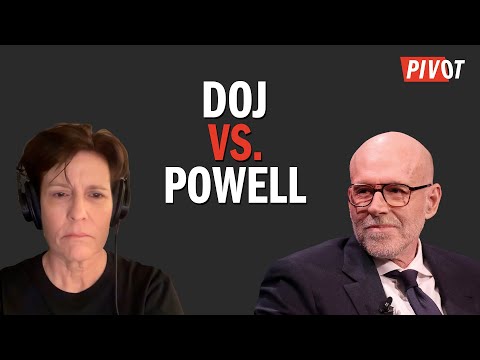
Why is the Justice Department Investigating Fed Chair Jerome Powell? | Pivot
Kara Swisher (host), Scott Galloway (host)
In this episode of Pivot, featuring Kara Swisher and Scott Galloway, Why is the Justice Department Investigating Fed Chair Jerome Powell? | Pivot explores powell under DOJ scrutiny; ICE killing, Iran turmoil, wealth tax clash The episode opens with a long, comedic, unusually candid exchange about Scott Galloway’s recent cosmetic surgery, insecurity/ageism, and the growing normalization of procedures among men.
Powell under DOJ scrutiny; ICE killing, Iran turmoil, wealth tax clash
The episode opens with a long, comedic, unusually candid exchange about Scott Galloway’s recent cosmetic surgery, insecurity/ageism, and the growing normalization of procedures among men.
They then focus on the Justice Department’s criminal investigation into Fed Chair Jerome Powell over the Fed HQ renovation and alleged statements to Congress, which they characterize as political intimidation aimed at undermining Fed independence.
The show pivots to outrage over the Minneapolis ICE shooting of Renee Good, criticizing both the agent’s conduct and conservative media framing, and arguing the administration is doubling down rather than seeking accountability.
They also cover Trump’s pressure campaign around Venezuela oil, debate a more interventionist stance toward Iran amid mass protests, and analyze Silicon Valley’s organizing against California’s proposed billionaire wealth tax, closing with wins/fails on institutional courage and tech platform responsibility.
Key Takeaways
Powell frames the investigation as a direct threat to Fed independence.
Powell’s video message argues criminal charges are being wielded to force rate-setting aligned with presidential preferences, not data—casting the dispute as institutional intimidation rather than procurement oversight.
Get the full analysis with uListen AI
The real target may be Powell’s post-chair influence on the Fed Board.
Galloway suggests the pressure is less about making Powell resign as chair (term ends in May) and more about pushing him off the Board of Governors entirely, reducing his authority to shape deliberations through 2028.
Get the full analysis with uListen AI
Independent central banks exist to resist short-term political “sugar highs.”
They argue presidents are structurally incentivized to push for lower rates that feel good immediately, while an independent Fed must prevent inflation spirals that can destabilize societies and trigger political unrest.
Get the full analysis with uListen AI
The Minneapolis ICE shooting is portrayed as unjustifiable even under the most generous reading.
They cite DOJ policy against lethal force when someone is fleeing and emphasize the agent’s alleged statement (“fucking bitch”) as revealing state of mind that could be pivotal in legal and public judgment.
Get the full analysis with uListen AI
Conservative media’s descriptors are criticized as coded dehumanization.
They argue labels like “lesbian activist,” “self-proclaimed poet,” and “divorced” are deployed to cue audience bias and soften outrage over the killing rather than illuminate relevant facts.
Get the full analysis with uListen AI
Trump’s Venezuela oil talk collides with market reality and corporate risk memory.
They note Venezuela’s heavy crude economics (high extraction/refining costs) plus past asset seizures make major US oil companies resistant; “uninvestable” becomes the key signal that business won’t follow political theater.
Get the full analysis with uListen AI
The wealth-tax fight highlights the gap between being ‘right’ and being ‘effective.’
Galloway argues wealth taxes often reduce revenue due to billionaire mobility, proposing alternatives like a stronger AMT, inheritance changes, and taxing capital gains based on where wealth accrued; Swisher counters the bill’s signaling power may be the point as backlash to Silicon Valley intensifies.
Get the full analysis with uListen AI
Notable Quotes
“The threat of criminal charges is a consequence of the Federal Reserve setting interest rates based on our best assessment of what will serve the public… or whether instead, monetary policy will be directed by political pressure or intimidation.”
— Jerome Powell (clip)
“This isn’t about trying to intimidate him into resigning. This is about trying to intimidate him into resigning from the Board of Governors.”
— Scott Galloway
“He put three bullets in the torso and face of a woman who has not physically threatened him… and then decided… to say, ‘Fucking bitch.’”
— Scott Galloway
“They kept referring to her as a lesbian… what they’re saying is: ‘Dear viewers, we think you are such raging… homophobes… you will have an easier time justifying the murder of this woman.’”
— Scott Galloway
“If the objective is to signal to billionaires… and you want to reduce receipts in the California government, then this is your bill.”
— Scott Galloway
Questions Answered in This Episode
What specific renovation line-items or contracting decisions are at the center of the DOJ’s Powell probe, and what evidence (if any) suggests he misled Congress?
The episode opens with a long, comedic, unusually candid exchange about Scott Galloway’s recent cosmetic surgery, insecurity/ageism, and the growing normalization of procedures among men.
Get the full analysis with uListen AI
If Powell stays on the Board through 2028, what formal powers does he retain—and how much informal influence would he realistically have over a Trump-appointed successor?
They then focus on the Justice Department’s criminal investigation into Fed Chair Jerome Powell over the Fed HQ renovation and alleged statements to Congress, which they characterize as political intimidation aimed at undermining Fed independence.
Get the full analysis with uListen AI
In the Minneapolis ICE case, what does DOJ lethal-force policy say about shooting at a departing vehicle, and how might the agent’s alleged ‘fucking bitch’ statement affect prosecutorial decisions?
The show pivots to outrage over the Minneapolis ICE shooting of Renee Good, criticizing both the agent’s conduct and conservative media framing, and arguing the administration is doubling down rather than seeking accountability.
Get the full analysis with uListen AI
How did Fox and other conservative outlets describe Renee Good, and which of those descriptors were factually relevant versus rhetorically loaded?
They also cover Trump’s pressure campaign around Venezuela oil, debate a more interventionist stance toward Iran amid mass protests, and analyze Silicon Valley’s organizing against California’s proposed billionaire wealth tax, closing with wins/fails on institutional courage and tech platform responsibility.
Get the full analysis with uListen AI
If Trump can’t compel Exxon/Chevron to invest in Venezuela, what levers does the US actually have—sanctions, shipping interdictions, secondary sanctions on China-bound crude?
Get the full analysis with uListen AI
Transcript Preview
I gotta say, everyone's like, "Why's Scott out?" And I'm like, "Uh," and they're like, "Facelift." [upbeat music] Hi, everyone, this is Pivot from New York Magazine and the Vox Media Podcast Network. I'm Kara Swisher, and guess who's back, back again?
It's Audie Cornish.
[chuckles] You wish. [laughing]
She's good.
She's good.
You know what I learned from her?
What?
She said something. She had the best line of any guest host. She said, you asked her for advice on the economy or asked her for input, and she said, "No, this isn't my area. I'm here to learn." I have got-- I sent her a note saying, "I took real notes from that," 'cause I have yet to find the confidence to actually say that I don't know, and that everything doesn't demand my judgment. Anyways, Audie Cornish gets co-host or gets substitute host of the week. How are you, Kara? Did you miss me?
I did.
Did you miss me?
I need you to explain where you've been to people, sir.
I was presented with an opportunity to bring potable water to the good people of sub-Saharan Africa.
[chuckles] No. Try again.
Uh, which is, which is Latin for, "I have had cosmetic surgery," Kara.
Yeah.
Um, and-
Yeah
... uh, essentially, uh, I just wanted to look natural, and I guess if looking natural means look, looking like you're surprised all the fucking time, and your nose looks like a minivan from the '80s, [chuckles] we've achieved that, Kara.
[chuckles] Sweet.
We have lift off. So the camera is off. Sorry, folks. I'm, I'm confident enough to be transparent. I'm not confident enough for the comments that we would receive right now.
Yeah, you-- I have seen the pictures, the pictures. Scott kindly sent me a picture, and I was-- at first I was like: "Oh, come on, how bad could it be?" And then I'm like: "Oh, no." [chuckles]
And there was no response. You usually respond within, like, ten seconds with something really crisp and funny or supportive. You're ac- you're a very-
Couldn't really tell me, no
... People notice about you.
I-
You're actually, you're a very loving, kind friend.
[chuckles]
People don't get that vibe. And you were just silent for fifteen minutes, and I'm like: "Is she gonna respond? [chuckles] Anything?"
Oh, you were off the Tramadol by then.
I told, I told my doctor, I said I wanted to look... People have compared me to Ryan Reynolds' older brother, and I'm like, "That's the look I'm going for." And I do look like him, but I look like his grandfather after he's gone into witness protection from literally trying to flee narco-terrorists and has had bad cosmetic surgery in, in Brazil.
This is good. I hope it's good. But you're gonna see. We're gonna see what, what it is, but, uh, when you have the big reveal or something like that. Ca- l- I'd love you to actually talk about it because men don't talk-- most people don't talk about their plastic surgery or, or whatever. Ta- and there's been a huge boom in men doing this, like, huge-
Install uListen to search the full transcript and get AI-powered insights
Get Full TranscriptGet more from every podcast
AI summaries, searchable transcripts, and fact-checking. Free forever.
Add to Chrome