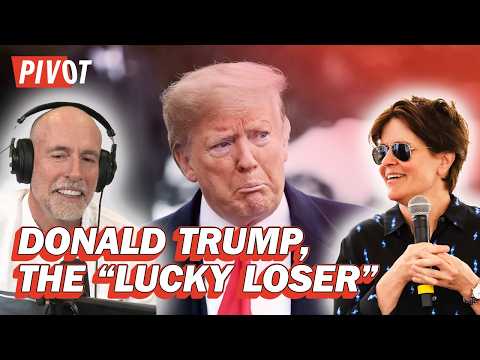
How Donald Trump Created a Facade of Success | Pivot
Kara Swisher (host), Ross Buettner (guest), Susanne Craig (guest), Scott Galloway (host)
In this episode of Pivot, featuring Kara Swisher and Ross Buettner, How Donald Trump Created a Facade of Success | Pivot explores inside Trump’s Finances: Inheritance, Illusions, And Reality-Defying Wealth Myths Investigative reporters Suzanne Craig and Russ Buettner discuss their book "Lucky Loser," which reconstructs Donald Trump’s true financial history using decades of tax returns and corporate records. They detail how Trump squandered a vast inheritance from his father, Fred Trump, repeatedly propping up failing ventures with outside cash, especially earnings from The Apprentice. The conversation contrasts Fred Trump’s profitable, government-enabled real estate empire with Donald Trump’s pattern of over-spending, poor operations, and aggressive self-promotion. The hosts and authors also examine how media, tax strategies, and financial engineering helped Trump manufacture an enduring but misleading image of business genius.
Inside Trump’s Finances: Inheritance, Illusions, And Reality-Defying Wealth Myths
Investigative reporters Suzanne Craig and Russ Buettner discuss their book "Lucky Loser," which reconstructs Donald Trump’s true financial history using decades of tax returns and corporate records. They detail how Trump squandered a vast inheritance from his father, Fred Trump, repeatedly propping up failing ventures with outside cash, especially earnings from The Apprentice. The conversation contrasts Fred Trump’s profitable, government-enabled real estate empire with Donald Trump’s pattern of over-spending, poor operations, and aggressive self-promotion. The hosts and authors also examine how media, tax strategies, and financial engineering helped Trump manufacture an enduring but misleading image of business genius.
Key Takeaways
Trump’s inherited fortune would be larger today if passively invested.
The authors estimate Trump effectively received about $413 million from his father; if that had simply gone into an S&P 500 index fund, it would likely be worth $10–20 billion today—more than his current estimated net worth.
Get the full analysis with uListen AI
Operationally, Trump’s own businesses have often been money losers.
Projects like casinos, certain towers (e. ...
Get the full analysis with uListen AI
Trump repeatedly backfilled business losses with outside windfalls.
First his father’s low-debt, cash-rich real estate empire, and later roughly $400 million from The Apprentice and licensing deals, were used to plug financial holes, sustaining the illusion of business success.
Get the full analysis with uListen AI
The less Trump manages a business, the better it tends to perform.
The authors observe a pattern that ventures where Trump’s role is limited to branding or passive involvement (like The Apprentice) fare better than those he actively designs, finances, and operates.
Get the full analysis with uListen AI
Media ‘wealth porn’ helped cement a false narrative of business genius.
From the 1970s onward, Trump exaggerated his net worth to outlets like The New York Times and leaned into shows like Lifestyles of the Rich and Famous, using helicopters, yachts, and rich lists to project success even during years of massive losses.
Get the full analysis with uListen AI
Fred Trump was both a competent builder and an early rule-bender.
Fred built thousands of profitable rental units leveraging government programs, but he was also criticized for exploiting loopholes, gouging tenants, and engaging in problematic practices, foreshadowing aspects of Donald’s approach.
Get the full analysis with uListen AI
Trump Media’s market value is wildly disconnected from its fundamentals.
Buettner notes that Trump Media’s revenue is so low it compares unfavorably to a single fast-food franchise or shoe store, calling it “not a real company,” and raising questions about how Trump might eventually monetize his large, illiquid stake.
Get the full analysis with uListen AI
Notable Quotes
“The less involvement he has in designing and operating a business, the greater its chances of financial success.”
— Russ Buettner
“He sort of builds up his reputation by saying he's gonna do things that never happen.”
— Russ Buettner
“That year he's writing a book saying he's this master deal maker and he lost $45 million that year.”
— Suzanne Craig
“If he had just invested it and gone sailing, then he'd probably be infinitely more wealthy than he is now.”
— Russ Buettner
“They're… it's just not a real company.”
— Russ Buettner, on Trump Media
Questions Answered in This Episode
How should voters weigh a political candidate’s self-described business success against independently verified financial data?
Investigative reporters Suzanne Craig and Russ Buettner discuss their book "Lucky Loser," which reconstructs Donald Trump’s true financial history using decades of tax returns and corporate records. ...
Get the full analysis with uListen AI
To what extent did mainstream media and ‘wealth porn’ programming enable Trump’s rise by prioritizing spectacle over scrutiny?
Get the full analysis with uListen AI
Where is the line between savvy use of tax and regulatory loopholes and unethical or abusive financial behavior?
Get the full analysis with uListen AI
What does Trump’s financial trajectory suggest about the broader American myths of meritocracy and self-made success?
Get the full analysis with uListen AI
If Trump Media’s valuation is largely detached from fundamentals, what risks does that pose to investors and to Trump’s personal finances?
Get the full analysis with uListen AI
Transcript Preview
Suzanne Craig and Ross Buettner are investigative reporters for the New York Times. That is underselling it. They're amazing (laughs) investigative reporters for the New York Times. They've written a new book based on a lot of their reporting they have published this year, uh, called Lucky Loser: How Donald Trump Squandered His Father's Fortune and Created the Illusion of Success. Suzanne and Russ, welcome.
Thanks for having us.
Thank you. Yeah, thanks for having us.
So I went to your book event here in, in DC. It was really interesting. But, uh, you've been reporting, for people who don't know, on Donald Trump's finances for years, but you go really in depth in the book. Talk to us about, uh, what... Obviously, Donald Trump's all about talking about money, but what does his financial history tell us about him as a businessman? Let's g- let's focus on that part.
Yeah, I think that was the- our big interest in, uh, in doing this book was to get to the bottom of that. We had done three longer stories in the Times that explored different windows, how much money he got from his father and how his businesses performed in the '80s and '90s and then again after the 2000s. But stringing all that together is where you really kind of see the pattern. Um, and I think what you notice is that he's very good at, as you would expect, drawing attention to himself, at selling things when there's things that need to be sold. Often, he's drawing attention to things he never does. That's one of the themes that runs through the book is he sort of builds up his reputation by saying he's gonna do things that never happen. But operationally, he has difficulties. Um, he never seems to be very careful about the finances of projects, so he regularly spends far more than what the projects bring in. He often says that. And then he needs money from other sources outside of his business operations to support those businesses, and what we saw was-
Right, so it's a bit of a Ponzi scheme is what it looked like.
A little bit. You see his inheritance filling in the holes, and then later the fortune from The Apprentice, uh, really filling in a lot of holes as well and sort of sustaining this image that he's a powerful businessman when he's really having problems that he's hiding from public view.
And, uh, Suzanne, talk a little bit about how you went about this reporting, because you've been doing this for a long time.
Right, and, and like Russ said, we, we had a number of stories at the Times. There's kind of three, three big ones. We've been covering him since 2000. It's hard to believe (laughs) we're coming up on nine years of this, but says every journalist, I think, covering this guy. Um, and then we decided after the 2020 story, it was a big story we had where we got decades of his corporate and personal tax returns. You know, we found out in that, that he wasn't paying much income tax ever. Um, we also got an incredible window into how much he'd made from The Apprentice. So we laid that out, and then Russ and I had a conversation, and, and we realized we had a- a, I think, you know, we call it a skeleton for a book. But we really saw this as an epic American tale, and we wanted to tell it, and we wanted to delve further into his father. We were really intrigued about his dad from the reporting we did, you know, while we were at the paper. Um, and then we wanted to just learn more about Fred and see that impact that it had had on his life and then re-explore Donald's life, because I think there's just a lot of misconceptions that were out there. Some of them were laid down by him early on and just repeated over and over and over. And so, you know, when we decided, Russ and I had a chat, and, and Russ took a- had very heavy lifting (laughs) on the writing. He's a beautiful writer. And, um, we worked together, and I did a lot of the reporting. So we just spent a couple of years just full at it every day trying to get this together.
Install uListen to search the full transcript and get AI-powered insights
Get Full TranscriptGet more from every podcast
AI summaries, searchable transcripts, and fact-checking. Free forever.
Add to Chrome