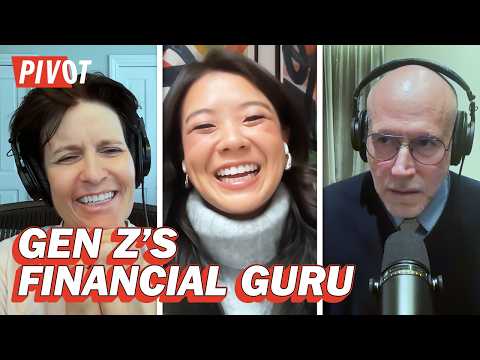
Healthy Financial Habits for 2025 and Finding Your Ikigai | Pivot
Kara Swisher (host), Vivian Tu (guest), Scott Galloway (host), Guest (likely Kara & Scott clip/voiceover segment) (host)
In this episode of Pivot, featuring Kara Swisher and Vivian Tu, Healthy Financial Habits for 2025 and Finding Your Ikigai | Pivot explores democratizing Money: Vivian Tu On Investing, Inequality, And Ikigai Careers Vivian Tu (“Your Rich BFF”) discusses how she translates complex financial concepts into clear, jargon-free, actionable advice for younger, often overlooked audiences such as women, people of color, immigrants, and low-income earners.
Democratizing Money: Vivian Tu On Investing, Inequality, And Ikigai Careers
Vivian Tu (“Your Rich BFF”) discusses how she translates complex financial concepts into clear, jargon-free, actionable advice for younger, often overlooked audiences such as women, people of color, immigrants, and low-income earners.
She outlines practical investing guidance, including age-based asset allocation, the use of low-cost index funds, and catch-up retirement contributions for people in their 50s who feel behind.
Tu warns that a Trump administration’s policies—tax cuts, deregulation, and tariffs—will likely deepen wealth inequality, creating a ‘golden era’ for high-net-worth investors while increasing cost-of-living pressures on lower-income households.
She closes by emphasizing the Japanese concept of ikigai—finding work that is enjoyable, needed, suited to your skills, and well-paid—and argues that most people must prioritize financial viability and lifestyle over pure passion when choosing careers.
Key Takeaways
Seek financial advice that is practical, jargon-free, and tailored to you.
Go beyond generic media and look for educators who break concepts down into clear, step-by-step actions you can directly implement in your daily financial life.
Get the full analysis with uListen AI
Use age-based rules to guide asset allocation, not fear.
Vivian suggests roughly matching your fixed-income percentage to your age minus 10 (e. ...
Get the full analysis with uListen AI
Maximize catch-up contributions if you’re over 50.
People above 50 can contribute more to IRAs and employer plans, giving late starters a powerful way to accelerate retirement savings and partially close the gap.
Get the full analysis with uListen AI
Own the market cheaply instead of trying to pick winning stocks.
Favor broad, low-cost index funds and ETFs—both in the U. ...
Get the full analysis with uListen AI
Diversify globally, not just within the U.S. market.
Given how expensive U. ...
Get the full analysis with uListen AI
Understand how policy choices widen the gap between investors and non-investors.
Tax cuts, deregulation, and tariffs tend to boost corporate profits and reward shareholders, while higher everyday prices (like for toilet paper) fall hardest on people who aren’t invested and live paycheck to paycheck.
Get the full analysis with uListen AI
Choose careers using ikigai—ensuring passion also pays the bills.
Aim for work that you enjoy, are good at, the world needs, and that pays well; most people without generational wealth cannot afford to follow passion alone and should prioritize roles that can fund their desired lifestyle.
Get the full analysis with uListen AI
Notable Quotes
“Traditional financial media has very much catered to folks who look like Scott and probably have as much money as he does.”
— Vivian Tu
“If you don’t know what you don’t know, you really don’t know which of these links to even click.”
— Vivian Tu
“If you are more worried about buying apples than Apple, you’re not gonna be participating in that upward growth.”
— Vivian Tu
“Shit’s gonna get tough, for lack of a better phrase.”
— Vivian Tu
“If you come from generational wealth, you have the luxury of following your passion. But if you are a regular shmegular person...pick a job that is going to create the lifestyle that you want.”
— Vivian Tu
Questions Answered in This Episode
How can someone with very little discretionary income realistically start investing and avoid feeling left behind by market gains?
Vivian Tu (“Your Rich BFF”) discusses how she translates complex financial concepts into clear, jargon-free, actionable advice for younger, often overlooked audiences such as women, people of color, immigrants, and low-income earners.
Get the full analysis with uListen AI
What practical steps can young people take to talk openly about money with friends and family and break the taboos Vivian describes?
She outlines practical investing guidance, including age-based asset allocation, the use of low-cost index funds, and catch-up retirement contributions for people in their 50s who feel behind.
Get the full analysis with uListen AI
How should investors adjust their strategies if policy changes deepen the K-shaped economy Vivian warns about?
Tu warns that a Trump administration’s policies—tax cuts, deregulation, and tariffs—will likely deepen wealth inequality, creating a ‘golden era’ for high-net-worth investors while increasing cost-of-living pressures on lower-income households.
Get the full analysis with uListen AI
What’s the best way for a student or early-career professional to apply ikigai when choosing a major or first job, especially under financial pressure?
She closes by emphasizing the Japanese concept of ikigai—finding work that is enjoyable, needed, suited to your skills, and well-paid—and argues that most people must prioritize financial viability and lifestyle over pure passion when choosing careers.
Get the full analysis with uListen AI
How can an average investor decide on an appropriate mix between U.S. and international index funds without becoming overwhelmed by macroeconomic research?
Get the full analysis with uListen AI
Transcript Preview
Vivian Tu is the host of the Vox Media podcast, Net Worth and Chill. She's also known as Your Rich BFF on social (laughs) media, where she's become a financial guru of sorts, dispensing advice and tips to millions of followers. Vivian, welcome.
Thank you so much for having me.
So, I love, I love, uh, y- there's been iterations of what you're doing for many years, and lots of newspapers I used to work for, all kinds of stuff, and I just love this kind of thing. But what you're doing is really particularly, um, (clicks tongue) y- you know, important for young people. So, if, if, for people not familiar with Your Rich BFF, can you explain what it's about? Um, and you have f- found a way, as m- many writers in this area do, to make it understandable and accessible, especially to young people. I'd love to know what you think traditional media gets wrong when it comes to financial literacy. So, explain what Rich BFF is, and then how, how is it different from previous iterations of this?
Yeah. I think for a really long time, a lot of us have just wanted to be heard, or even seen. Um-
Mm-hmm.
... and traditional financial media has very much catered to folks who look like Scott and probably have-
Hmm.
... as much money as he does. (laughs) Um, I joke.
Mm-hmm.
But transparently, like, it, it really hasn't offered much to women, to people of color, to young people, people who grew up low income, immigrants, anything of that nature. And it's really hard to find good reputable information in this space, because when you Google the words "Roth IRA," you get three million hits. And if you don't know what you don't know, you really don't know which of these links to even click. So, it's really hard to begin that journey, because jargon is so, um, rampant in the financial news media, that we're seeing in writing, on TV, everywhere. Um, but what Your Rich BFF does essentially is it is a financial equity platform that's breaking down this information for the next generation, so that everybody can have access to it and then implement it into their daily lives. It's actual, usable, actionable tips versus, "Oh, in theory, this could happen." It's, you know, "This is how you actually make your life better."
Mm-hmm. Okay. And, and talk about what, w- who are you aiming at? What does Rich BFF mean? Is it just, you know, 'cause it's fun on social media?
Yeah.
Or what's the, what's the concept behind it?
Yeah. The big concept behind it is, you know, my friends had come to me for this kind of information, for these tips, for this advice, and the whole premise, everybody focuses so much on Rich, but the real word that we should be focusing on is BFF. I'm not lecturing you like a college professor. I am not talking to you like I'm a parent. I'm not talking to you like I'm better than you, smarter than you, richer than you. I'm talking to you as a friend. What advice would a rich friend give you in this arena if they wanted to see you succeed, if they wanted to see you do well?
Install uListen to search the full transcript and get AI-powered insights
Get Full TranscriptGet more from every podcast
AI summaries, searchable transcripts, and fact-checking. Free forever.
Add to Chrome