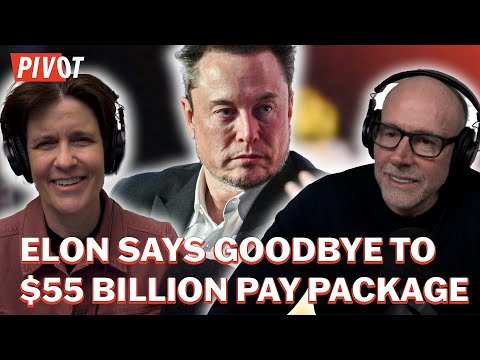
What's Next for Elon Musk After Judge Voids Tesla Pay Package
Kara Swisher (host), Scott Galloway (host)
In this episode of Pivot, featuring Kara Swisher and Scott Galloway, What's Next for Elon Musk After Judge Voids Tesla Pay Package explores court Smacks Down Musk’s Tesla Pay, Exposes Broken Board Governance The episode dissects a Delaware judge’s decision to void Elon Musk’s $55 billion Tesla compensation package, calling it an “unfathomable sum” enabled by a conflicted, rubber‑stamp board. Kara Swisher and Scott Galloway emphasize that the ruling is less about the size of the package and more about catastrophic governance failures and lack of board independence. They explore Musk’s threats to reincorporate Tesla in Texas, the legal and shareholder risks of such a move, and what it signals about the limits of founder power. Overall, they frame the case as a landmark moment for corporate governance and as part of Musk’s evolution from visionary entrepreneur to cautionary tale about unchecked influence.
Court Smacks Down Musk’s Tesla Pay, Exposes Broken Board Governance
The episode dissects a Delaware judge’s decision to void Elon Musk’s $55 billion Tesla compensation package, calling it an “unfathomable sum” enabled by a conflicted, rubber‑stamp board. Kara Swisher and Scott Galloway emphasize that the ruling is less about the size of the package and more about catastrophic governance failures and lack of board independence. They explore Musk’s threats to reincorporate Tesla in Texas, the legal and shareholder risks of such a move, and what it signals about the limits of founder power. Overall, they frame the case as a landmark moment for corporate governance and as part of Musk’s evolution from visionary entrepreneur to cautionary tale about unchecked influence.
Key Takeaways
The ruling centers on governance failures, not just the size of Musk’s pay.
While the compensation was huge, the judge focused on the board’s conflicts, emotional loyalty to Musk, and flawed process, signaling that process and independence matter as much as dollar amounts.
Get the full analysis with uListen AI
Tesla’s board was deemed an ineffective fiduciary for shareholders.
Swisher and Galloway stress that directors are supposed to represent all shareholders and stakeholders, not just Musk, and the court effectively branded the board as rubber‑stamping his wishes.
Get the full analysis with uListen AI
Reincorporating in Texas could spark new legal and shareholder challenges.
Legal experts quoted suggest that moving from Delaware, especially if seen as a way to restore Musk’s pay package, would likely invite additional investor lawsuits and scrutiny.
Get the full analysis with uListen AI
Tesla will need truly independent directors on its compensation committee.
To avoid another court rejection, the company must seat credible, independent board members on key committees—something that clashes directly with Musk’s desire for unquestioning loyalty.
Get the full analysis with uListen AI
This case is a warning shot to boards across corporate America.
The hosts argue that the ruling sends a signal: even at hot, founder‑driven companies, boards must act as real fiduciaries or face legal consequences, particularly around outsized CEO pay.
Get the full analysis with uListen AI
Board service remains attractive despite risks, due to proximity to power.
Galloway notes that prestige, D&O insurance, and the allure of being near influential figures mean Musk will likely still find people willing to join the board, even under greater scrutiny.
Get the full analysis with uListen AI
Musk’s image is shifting from untouchable genius to governance cautionary tale.
While they credit his product vision and impact, the hosts argue his behavior—threats, tantrums, and attacks on judges—undermines his legacy and reinforces the need for robust checks on founder power.
Get the full analysis with uListen AI
Notable Quotes
“This effectively says that this board is so incompetent and so conflicted that any decisions they make might not hold up in court because of the conflicts here.”
— Scott Galloway
“CEOs serve at the luxury of shareholders, not vice versa.”
— Scott Galloway
“There’s no independence among any of these people on this board.”
— Kara Swisher
“Delaware has just said, ‘When you’re a public company and you sell shares to retail investors, you have certain obligations.’ And this board isn’t living up to it.”
— Scott Galloway
“He is a bold, visionary genius when it comes to products and risk-taking… But he’s just totally… He’s a cautionary tale.”
— Scott Galloway
Questions Answered in This Episode
How might this ruling practically change the balance of power between founders and boards at other high‑growth tech companies?
The episode dissects a Delaware judge’s decision to void Elon Musk’s $55 billion Tesla compensation package, calling it an “unfathomable sum” enabled by a conflicted, rubber‑stamp board. ...
Get the full analysis with uListen AI
What would a truly independent and defensible compensation package for Elon Musk actually look like?
Get the full analysis with uListen AI
If Tesla attempted to reincorporate in Texas, how could shareholders and courts realistically respond?
Get the full analysis with uListen AI
Does this case signal the beginning of a broader pushback on extreme CEO compensation, or will it remain an outlier?
Get the full analysis with uListen AI
How should investors evaluate whether a board is a genuine fiduciary versus a rubber stamp, before buying into a company?
Get the full analysis with uListen AI
Transcript Preview
Elon Musk suffered a major loss in a Delaware court this week when a judge voided his $55 billion compensation package from Tesla. Uh, Judge Kathaleen McCormick, uh, called the compensation, quote, "An unfathomable sum," and it was unfair to shareholders and the process leading to its 2018 approval was deeply flawed. When you read through the documents, it really, (laughs) it was such a back-scratchy situation among the board members, who are all friends of his. Um, apparently one of them cried how, how much he loved Elon o- on it, which was kind of disturbing. Uh, Elon responded to the ruling on X, posting, "Never incorporate your company in the state of Delaware." Too late, Elon. And also, you should have had, uh, stock that ha- puts you in contro- control of the, uh, dual-class shareholders, which you didn't do either. Um, so too bad. You know, that w- if you had a time machine. Um, were you surprised by the ruling, first of all? The judge, let me, gives you more facts. The judge ordered Tesla to cancel the stock options award to Elon valued at about 51 billion, which is where most of his compensation is. Tesla's directors now have to figure out a new compensation plan that passes legal muster and keeps Elon happy and does it at an arm's length, which is, good luck with that, 'cause this board has shown itself to be a giant rubber stamp for Elon Musk. Um, we haven't heard if he's gonna appeal, but after a poll on X, he's now saying Tesla will hold a shareholder vote to incorporate in Texas. Um, h- uh, anyway, what does the ruling mean for Elon's quest to get that 25%?
I've never, I've never heard of this happening or seen it happen. The fact that I've been on compensation committees of boards, I've never had a shareholder lawsuit against the compensation, the schematic you put in place. But to have a shareholder lawsuit, I've heard of them. Like Martin Sorrell had, uh, shareholder lawsuits constantly around his-
Yeah.
... compensation.
Mm-hmm.
But to have it rejected... I mean, effectively, the shareholders decide who the board is.
Mm-hmm.
And so if the shareholders, uh, decide who the board is, who decides the compensation, then technically the owners of the company have decided, you know, what, what he or she gets. I'm not a... I don't believe you should limit compensation. I think we live in a capitalist society, and I don't like the idea. I, I do believe that we should have a more progressive tax structure. But anyways, that's another talk show. But this effectively says that this board is so incompetent and so conflicted that any decisions they make might not hold up in court because of the conflicts here. Even if you read the ruling, it, it, they talk about the size of it, but what they talk about is the conflicts and just how, uh, poor the rationalization was for giving him this. 'Cause as much as the compensation was, I mean, just to, just to be fair and try, try and call balls and strikes, him getting incr- an incremental 50 billion if he increases the sh- value of the company 500 billion, that's, that's not... I've seen compensation, uh, plans that on, you know, I mean, it's exceptional, but on a proportionate size or percentage of value increase, it wasn't outrageous. What this says is, you know what's gonna end up happening here? Uh, h- he's not gonna be able, uh, to reincorporate all this, all these threats, all these jazz hands, all this fake-
Install uListen to search the full transcript and get AI-powered insights
Get Full TranscriptGet more from every podcast
AI summaries, searchable transcripts, and fact-checking. Free forever.
Add to Chrome