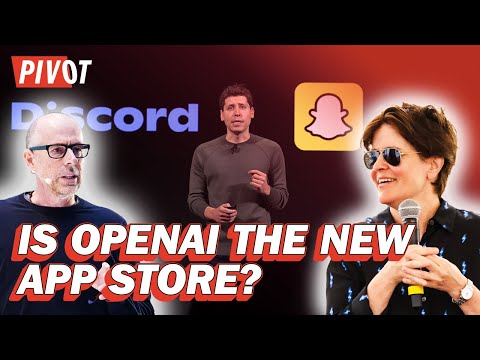
Sam Altman announces GPT Store at OpenAI DevDay
Kara Swisher (host), Sam Altman (guest), Scott Galloway (host)
In this episode of Pivot, featuring Kara Swisher and Sam Altman, Sam Altman announces GPT Store at OpenAI DevDay explores openAI’s GPT Store Positions Sam Altman As AI’s New App King Kara Swisher and Scott Galloway unpack OpenAI’s DevDay announcements, focusing on the GPT Store, custom GPTs, and a cheaper, more powerful GPT-4 Turbo model. They frame the GPT Store as the new App Store, arguing OpenAI is shifting from product to dominant platform. The conversation explores Altman’s emerging role as a visionary counterweight to Elon Musk, including leadership style and public image. They also highlight regulatory concerns, competitive dynamics, and high-impact use cases in healthcare, mental health, and everyday applications that could emerge from this platform.
OpenAI’s GPT Store Positions Sam Altman As AI’s New App King
Kara Swisher and Scott Galloway unpack OpenAI’s DevDay announcements, focusing on the GPT Store, custom GPTs, and a cheaper, more powerful GPT-4 Turbo model. They frame the GPT Store as the new App Store, arguing OpenAI is shifting from product to dominant platform. The conversation explores Altman’s emerging role as a visionary counterweight to Elon Musk, including leadership style and public image. They also highlight regulatory concerns, competitive dynamics, and high-impact use cases in healthcare, mental health, and everyday applications that could emerge from this platform.
Key Takeaways
OpenAI is transforming from product provider to platform operator.
By launching the GPT Store and enabling custom GPTs, OpenAI is positioning itself as the core marketplace and infrastructure layer for AI applications, analogous to Apple’s App Store era.
Get the full analysis with uListen AI
Lower prices alongside better models increase adoption and accelerate AI’s GDP share.
Galloway underscores that OpenAI is simultaneously improving capability, expanding data limits, and cutting costs, which contrasts with traditional industries that typically raise prices when products improve.
Get the full analysis with uListen AI
A copyright liability shield reduces enterprise hesitation to adopt AI.
OpenAI’s promise to cover legal costs for certain copyright claims, similar to moves by Microsoft and others, lowers perceived legal risk and makes AI deployment more palatable for companies.
Get the full analysis with uListen AI
Custom GPTs make sophisticated AI accessible to non-technical creators and brands.
The hosts note that what once required dedicated teams (e. ...
Get the full analysis with uListen AI
Sam Altman is emerging as a ‘visionary without assholery’ counter-model to Musk.
Galloway hopes Altman will embody a kinder, more civic-minded leadership archetype that still delivers huge value, offering a cultural alternative to Musk-style combative CEO behavior.
Get the full analysis with uListen AI
Regulatory capture and platform dominance are looming concerns.
Swisher warns that Altman’s strong rapport with regulators and the scale of OpenAI’s platform could enable rulemaking and ecosystem control that disadvantage startups and open-source competitors.
Get the full analysis with uListen AI
Healthcare and youth mental health are prime domains for high-impact GPT apps.
Galloway highlights opportunities for preventive healthcare guidance and support for struggling young people, especially when AI tools are developed in concert with trusted medical and psychological institutions.
Get the full analysis with uListen AI
Notable Quotes
“We're gonna launch the GPT store. You can list a GPT there and we'll be able to feature the best and the most popular GPTs.”
— Sam Altman
“We believe that AI will be about individual empowerment and agency at a scale that we've never seen before.”
— Sam Altman
“They always have these conferences when they get big... honestly, it sounds like the App Store on steroids.”
— Kara Swisher
“This is the key difference between technology and every other business... the product is distinctly better and we're massively cutting costs.”
— Scott Galloway
“I’m hopeful that Sam Altman will have the same type of credibility as a visionary... while being a thoughtful, kind person that cares about the commonwealth.”
— Scott Galloway
Questions Answered in This Episode
How might the GPT Store’s economics and governance differ from Apple’s App Store to avoid the same antitrust and dominance issues?
Kara Swisher and Scott Galloway unpack OpenAI’s DevDay announcements, focusing on the GPT Store, custom GPTs, and a cheaper, more powerful GPT-4 Turbo model. ...
Get the full analysis with uListen AI
To what extent will OpenAI’s copyright shield practically protect small developers and enterprises from real-world litigation risks?
Get the full analysis with uListen AI
How can regulators encourage safety and accountability in AI without allowing large incumbents like OpenAI to entrench their market power?
Get the full analysis with uListen AI
What safeguards are needed if GPT-based apps begin playing a significant role in healthcare triage, diagnosis support, or mental health guidance?
Get the full analysis with uListen AI
Will the ease of creating custom GPTs lead to a healthy diversity of specialized tools or an overwhelming, low-quality flood that users struggle to navigate?
Get the full analysis with uListen AI
Transcript Preview
It's been almost a year since OpenAI released ChatGPT to the public, kicking off an AI gold rush. The company shared what's coming next at their inaugural OpenAI developer conference this week. They always have these conferences when they get big. The announcements included introduction of custom GPTs, this was fascinating, for people to create their own, an upcoming app store, and a new turbo model of ChatGPT-4. OpenAI CEO Sam Altman spelled out the company's vision in his keynote. Let's listen to a bit.
We're gonna launch the GPT store. You can list a GPT there and we'll be able to feature the best and the most popular GPTs. We believe that AI will be about individual empowerment and agency at a scale that we've never seen before, and that will elevate humanity to a scale that we've never seen before either. We're excited to see what you all will do with this technology and to discover the new future that we're all going to architect together.
Blah, blah, blah, blah, blah. Love that, Sam Altman, but honestly, it sounds like the App Store on super, on, on steroids essentially. That's what's happening here. They're becoming a platform. Uh, that's what jumped out at me about this announcement. Um, a number of people on X were comparing Sam Altman to Steve Jobs after that presentation. I would agree. But it was the App Store, that's what it seemed to be, and they're becoming a platform. Um, what do you think?
Uh, I th- I think you're right, but the App Store is arguably one of the most valuable businesses in the world.
Exactly. Yeah, it's the new App Store.
And as someone who spent... or my team spent a couple of months trying to figure out how to build a PropG.AI, and then basically now anyone (laughs) can do it by just going to the platform, I think we should have waited two or three months. Um, I... Look, i- i- it kind of... I- I was blown away by this, and it indicates why software continues and technology continues to every year grab more and more of the world's GDP. And that is they said, "Okay, we're massively upgrading the product. You can now upload enormous amounts of data for, for these LLMs to analyze. We have decided we're taking out fear. We're giving you umbrella protection liability from any copyright infringement," which I thought was extraordinary. I'm on the board... I'm on the board of, um, Maia Tech Startup section and the CEO uploaded the board deck to, to, uh, ChatGPT, uh, 4, 4.5 and said, "Act, uh, in the voice of an aggressive growth board member. Um, give me feedback and ask me questions." And the questions it came back with were, were chilling. They were so insightful and, uh, I mean, they kind of provoked an interesting conversation at the board level. It was like we had another board member in the room. And while they're doing all this, while they're offering custom, you know, chatbots, the ability to make these things more relevant, they've updated the input or the, the news up until April, they've updated the amount of data they're scraping up until, or current events up until April. They dramatically lowered the costs, and this is the key difference between technology and every other business. Businesses measure their power and their leverage by management's ability to raise prices. And since whatever you wanna call it, Moore's law, the gestalt in technology is let's massively upgrade the product and let's lower prices. If this had been a consumer company that said, "We've dramatically improved the quality of this car, this scarf, this soda, this streaming media platform," the immediate next sentence would be, "As a result, we're raising prices 15% 'cause we have the margin power." Instead these guys say, (sighs) "The product's incr- is just distinctly better and we're massively cutting costs." I was, I was totally blown away by this thing.
Install uListen to search the full transcript and get AI-powered insights
Get Full TranscriptGet more from every podcast
AI summaries, searchable transcripts, and fact-checking. Free forever.
Add to Chrome