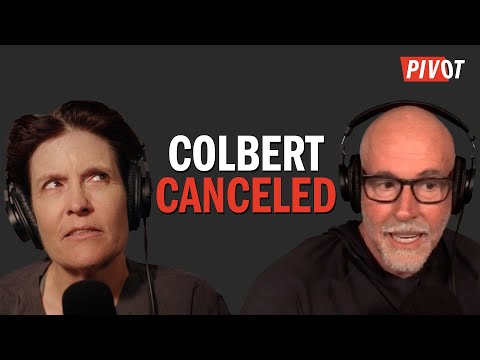
Colbert Canceled: Is Late Night TV Over? | Pivot
Scott Galloway (host), Kara Swisher (host), Narrator, Narrator, Narrator
In this episode of Pivot, featuring Scott Galloway and Kara Swisher, Colbert Canceled: Is Late Night TV Over? | Pivot explores colbert canceled, late night collapses, shame culture and Musk's monopoly collide Kara Swisher and Scott Galloway unpack a viral CEO–HR affair caught on a Coldplay kiss cam to explore industrialized public shaming, workplace power dynamics, and the erosion of privacy in a camera-saturated world. They then analyze CBS canceling Stephen Colbert’s Late Show, arguing it’s primarily a hard-nosed financial decision and emblematic of the broader collapse of the late-night TV business model amid digital fragmentation and creator-driven podcasting. The conversation shifts to Trump’s distraction tactics around the Epstein scandal, including a massive defamation suit against Rupert Murdoch and the Wall Street Journal, which they see as both legally weak and politically motivated, and to the national-security risks of U.S. dependence on Elon Musk’s SpaceX/Starlink. They close with personal “wins and fails,” touching on masked law-enforcement, political leadership, California’s business climate, and the enduring appeal of legacy brands and prestige TV.
Colbert canceled, late night collapses, shame culture and Musk's monopoly collide
Kara Swisher and Scott Galloway unpack a viral CEO–HR affair caught on a Coldplay kiss cam to explore industrialized public shaming, workplace power dynamics, and the erosion of privacy in a camera-saturated world. They then analyze CBS canceling Stephen Colbert’s Late Show, arguing it’s primarily a hard-nosed financial decision and emblematic of the broader collapse of the late-night TV business model amid digital fragmentation and creator-driven podcasting. The conversation shifts to Trump’s distraction tactics around the Epstein scandal, including a massive defamation suit against Rupert Murdoch and the Wall Street Journal, which they see as both legally weak and politically motivated, and to the national-security risks of U.S. dependence on Elon Musk’s SpaceX/Starlink. They close with personal “wins and fails,” touching on masked law-enforcement, political leadership, California’s business climate, and the enduring appeal of legacy brands and prestige TV.
Key Takeaways
Workplace romance at the top is inherently high-risk and should be pre-governed.
Galloway argues boards should set bright-line rules: below a certain level, consensual relationships are inevitable and often positive, but above an executive threshold, leaders must treat their “fly as up and locked” because of power asymmetries and organizational risk—as illustrated by the CEO–head-of-HR affair that instantly cost both their jobs.
Get the full analysis with uListen AI
Public shaming has been “industrialized,” turning a social corrective into an entertainment weapon.
Scott frames shaming as historically useful for social cohesion, but says platforms and virality have created an “industrial shaming complex” that monetizes humiliation, disproportionately targets high-status figures, and now erodes rather than restores the social fabric.
Get the full analysis with uListen AI
In a camera-saturated world, privacy in public spaces is effectively gone—and behavior adjusts.
Kara notes that kiss cams and candid recordings aren’t new, but the scale and speed of virality are; both hosts say being recognized constantly makes them behave better and more politely in public, aware that any misstep could become a viral “Karen” clip.
Get the full analysis with uListen AI
Colbert’s cancellation reflects a broken late-night business model, not just politics.
They cite data showing late-night ad revenue falling roughly by half since 2018 and Colbert’s show reportedly losing around $40 million annually with 200 staff—while digital-native shows and podcasts generate more revenue per employee and often match or exceed late-night audiences in target demographics.
Get the full analysis with uListen AI
Star talent can earn more with lean teams in podcasting and live formats than legacy TV.
Swisher and Galloway point to examples like Conan O’Brien, SmartLess, Amy Poehler, and Jon Stewart, arguing that Colbert could replicate or surpass his TV income with a well-run podcast, live tours, or weekly formats using a fraction of the staff and overhead.
Get the full analysis with uListen AI
Trump is using a 24-hour distraction cycle to blunt the Epstein narrative.
They see his lawsuit against Murdoch/WSJ, threats about the Washington Commanders’ stadium and name, and AI propaganda videos as deliberate “weapons of mass distraction” designed to hijack media attention away from deepening reporting about his ties to Jeffrey Epstein.
Get the full analysis with uListen AI
SpaceX/Starlink is simultaneously America’s greatest space asset and a dangerous monopoly.
With SpaceX handling the vast majority of U. ...
Get the full analysis with uListen AI
Notable Quotes
“This isn't the end of The Colbert Show, Kara. This is the end of late night television.”
— Scott Galloway
“Shaming was meant to restore fabric. It's cutting out our fabric now.”
— Scott Galloway
“When you go to concerts now or anywhere, you should have no expectations of privacy.”
— Kara Swisher
“It would be fair to say the U.S. doesn't have a space program, it has SpaceX.”
— Scott Galloway
“You can't just take what you want and leave and then kick [California] on the way out.”
— Kara Swisher
Questions Answered in This Episode
Where should companies draw the line between allowing consensual workplace relationships and protecting employees from power-abusive dynamics?
Kara Swisher and Scott Galloway unpack a viral CEO–HR affair caught on a Coldplay kiss cam to explore industrialized public shaming, workplace power dynamics, and the erosion of privacy in a camera-saturated world. ...
Get the full analysis with uListen AI
Is there any ethical way to harness public shaming as a social corrective without turning it into click-driven entertainment?
Get the full analysis with uListen AI
What realistic business model could sustain politically sharp, high-production-value comedy like Colbert’s in a post-broadcast world?
Get the full analysis with uListen AI
How should regulators balance preserving SpaceX’s technological lead with reducing national-security risk from Musk’s concentrated power?
Get the full analysis with uListen AI
At what point do Trump’s “weapons of mass distraction” stop working on the media and the public, and what would it take to reach that point?
Get the full analysis with uListen AI
Transcript Preview
This isn't the end of The Colbert Show, Kara. This is the end of late night television.
(instrumental music) Hi, everyone. This is Pivot from New York Magazine and the Vox Media Podcast Network. I'm Kara Swisher.
And I'm Scott Galloway.
We got a lot to get to today, including Trump suing Rupert Murdoch and CBS canceling Colbert. I know you have a lot of thoughts on this. But, uh, it's really hard not to talk about the Coldplay situation, the cold playing of it all. The CEO of data ops platform Astronomer, I don't know why it was called Astronomer, Andy Byron has resigned after being caught on camera at a Coldplay concert having an intimate moment with the company's head of HR. You literally cannot make this up. "We had our own steamy date at Coldplay, caught on camera, which people can see on our socials." As listeners pointed out, of course, "You're the small spoon, Scott." Another commenter said, "I would let Kara swaddle the fuck out of me." One more, someone said, "Scott would be an awful head of HR. He would have to call himself to his office on a daily basis for the latest inappropriate joke." I mean, what do you think of this thing? This was, this is a phenomena, menomena.
Well, first off, I mean, distinct of all the humor and the-
Yeah.
... uh, uh, the reality is-
It's good humor. Good humor.
... the reality is a mother who trusted this guy, who thought she'd found the love of her life-
Yeah.
... and was raising children with someone-
Mm-hmm.
... found out in the worst way possible-
The worst.
... that he's a fan of Coldplay.
(laughs) I knew that-
Aah.
I knew. I was like-
Aah.
... "Where is he going?" 'Cause he could care less.
Aah. Look, I-
Anyway. Coldplay was a little bit embarrassing. I have to say, I would agree. I would agree.
Whatever. He works for Astronomer. He, he was studying Uranus. Um...
Oh.
Oh, no.
Oh, how long did you wait for that one?
No, no.
How long?
Okay, I'll be serious.
Did you s-
I'll be serious for a question. I always go... I think it reflects something kind of weird about our society.
Yeah.
Shaming, I think a lot about shaming-
Mm-hmm.
... because I think a lot about depression.
Yep.
And what triggers you. And the reality is, shaming is an important part of our society.
Yeah.
And that is, to be shamed is meant to restore the social fabric. You are not supposed to beat up children in your tribe and if you do, you are shamed. And there's a good reason for it. It's meant to create cohesion and a more civil, uh, you know, civil community and species. The problem is now we have industrialized shame, and we use it for entertainment. And, in my opinion, a lot of what was meant to be, shaming was meant to restore fabric. It's cutting out our fabric now. And that is, there's just too much economic incentive to shame people. Also, on a more meta level, I find there's an industrial shaming complex, is essentially a form of mini revolution, because essentially you're always, they're always shaming rich white people 'cause people are so pissed off that CEOs are now making 300 times the average salary, not 30. And let me just go to a very tactical level here. We deal with this all the time on boards because men will mistake kindness for sexual interest, and women mistake, uh, sexual interest for kindness. There is always a mismatch instinctively. Men, when they get to a certain level, start believing that that woman is interested in me. And this is, you know, reportedly what-
Install uListen to search the full transcript and get AI-powered insights
Get Full TranscriptGet more from every podcast
AI summaries, searchable transcripts, and fact-checking. Free forever.
Add to Chrome