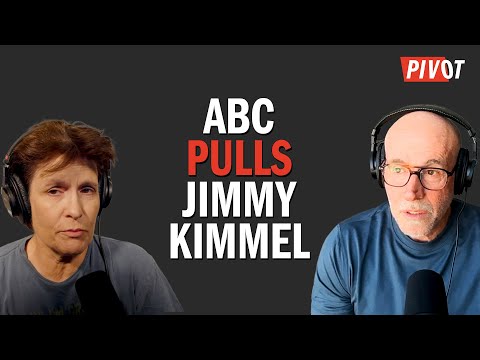
Jimmy Kimmel’s Removal Proves America Is Now a "Full Oligarchy" | Pivot
Scott Galloway (host), Kara Swisher (host), Jimmy Kimmel (guest), Narrator, Donald Trump (guest), Pam Bondi (guest), Narrator, Commentator (hate speech / Kimmel segment) (guest), President Joe Biden (guest), Narrator
In this episode of Pivot, featuring Scott Galloway and Kara Swisher, Jimmy Kimmel’s Removal Proves America Is Now a "Full Oligarchy" | Pivot explores kimmel’s Firing Exposes Oligarchic Power, Media Capture, and Hypocrisy Kara Swisher and Scott Galloway dissect Jimmy Kimmel’s removal from ABC after a joke about Charlie Kirk’s killing, framing it as a watershed moment of oligarchic control over American media and free speech. They argue that Disney’s Bob Iger capitulated to pressure from Trump-aligned FCC commissioner Brendan Carr and conservative broadcast owners Sinclair and Nexstar, normalizing overt government intimidation of critical voices. The conversation broadens into concerns about rising authoritarianism, selective “cancel culture” outrage on the right, threats to independent media, and the hollowing out of legacy TV as audiences shift to streaming and podcasts. They also touch on Kash Patel’s combative congressional testimony, Nvidia’s stake in Intel, Trump’s TikTok carve‑up for allies, and the need for economic and electoral pushback rather than passive outrage.
Kimmel’s Firing Exposes Oligarchic Power, Media Capture, and Hypocrisy
Kara Swisher and Scott Galloway dissect Jimmy Kimmel’s removal from ABC after a joke about Charlie Kirk’s killing, framing it as a watershed moment of oligarchic control over American media and free speech. They argue that Disney’s Bob Iger capitulated to pressure from Trump-aligned FCC commissioner Brendan Carr and conservative broadcast owners Sinclair and Nexstar, normalizing overt government intimidation of critical voices. The conversation broadens into concerns about rising authoritarianism, selective “cancel culture” outrage on the right, threats to independent media, and the hollowing out of legacy TV as audiences shift to streaming and podcasts. They also touch on Kash Patel’s combative congressional testimony, Nvidia’s stake in Intel, Trump’s TikTok carve‑up for allies, and the need for economic and electoral pushback rather than passive outrage.
Key Takeaways
Kimmel’s firing marks a new level of overt state-influenced censorship.
Swisher and Galloway argue that Brendan Carr’s threats about ABC’s broadcast license—and Sinclair/Nexstar’s demands—created a coercive environment where Disney pulled Kimmel not for ratings but to appease a Trump-aligned FCC, crossing from private editorial choice into government-chilled speech.
Get the full analysis with uListen AI
Bob Iger’s decision is framed as appeasement that will stain his legacy.
They contend Iger chose shareholder comfort and short-term stock price over defending free expression, comparing him unfavorably to Neville Chamberlain and stressing that few executives have his power to resist and set a precedent; instead, he “bent the knee.”
Get the full analysis with uListen AI
Conservatives’ anti–cancel culture rhetoric is fundamentally hypocritical.
The hosts juxtapose years of right-wing complaints about cancel culture and defense of offensive speech with current efforts by Trump allies to get critics fired, labeled as hate speakers, or legally targeted—demonstrating that their free-speech stance is purely situational.
Get the full analysis with uListen AI
Legacy broadcast’s decline limits its real power but amplifies symbolism.
They note that late-night TV and network news have aging, shrinking audiences, so while taking Kimmel off ABC is symbolically authoritarian and dangerous, the practical impact will be to push talent like Kimmel to streaming, YouTube, Substack, and podcasts where FCC leverage is weaker.
Get the full analysis with uListen AI
Economic leverage by affluent consumers could be a powerful form of protest.
Galloway suggests that the top few percent of earners—responsible for a disproportionate share of consumer spending—could wield targeted boycotts, reduced holiday consumption, or capital moves (e. ...
Get the full analysis with uListen AI
Trump’s TikTok ‘deal’ illustrates crony capitalism and right-wing socialism.
They describe the proposed ByteDance spin-out to Oracle, Silver Lake, and Andreessen Horowitz—with a government-appointed board member—as both carving up a valuable asset for political donors and inserting the state into corporate governance, while leaving the Chinese-controlled algorithm risk largely intact.
Get the full analysis with uListen AI
Authoritarian drift is accelerating while public attention is misdirected.
The hosts argue that spectacles like Kash Patel’s theatrics or the Kimmel saga distract from more serious issues—such as Putin testing NATO, media consolidation under Trump allies, and legal attacks on outlets like the New York Times—underscoring the urgency of organized electoral and economic resistance.
Get the full analysis with uListen AI
Notable Quotes
““This is full oligarchy now; it has nothing to do with the government.””
— Scott Galloway
““Bob Iger is gonna go down in history as Neville Chamberlain in a cashmere sweater, minus the dignity.””
— Scott Galloway
““They are quashing free speech… He is crossing the line as a government official making these kind of threats due to speech.””
— Kara Swisher on FCC commissioner Brendan Carr
““You said something… I love the Washington Post statement, ‘Democracy dies in darkness,’ and you’ve always said, ‘No, it’s dying in full light of day.’””
— Scott Galloway paraphrasing Kara Swisher
““You don’t carve up companies and give them to your political allies… That is exactly what this is.””
— Scott Galloway on Trump’s TikTok deal
Questions Answered in This Episode
Where is the line between a private company’s content decision and government-coerced censorship, and has that line been crossed in Kimmel’s case?
Kara Swisher and Scott Galloway dissect Jimmy Kimmel’s removal from ABC after a joke about Charlie Kirk’s killing, framing it as a watershed moment of oligarchic control over American media and free speech. ...
Get the full analysis with uListen AI
What realistic forms of economic protest—boycotts, spending slowdowns, moving capital—could actually influence oligarchic behavior without hurting vulnerable workers?
Get the full analysis with uListen AI
How can independent and digital media build resilience against both government pressure and legal harassment as traditional broadcast outlets are captured or cowed?
Get the full analysis with uListen AI
If Trump’s TikTok carve-up proceeds, what mechanisms (if any) would prevent continued CCP influence via the algorithm, and who should oversee that risk?
Get the full analysis with uListen AI
At what point should citizens treat these trends—not just rhetoric about cancel culture, but concrete threats from officials—as evidence of a genuine authoritarian turn requiring more radical democratic action?
Get the full analysis with uListen AI
Transcript Preview
You said something that always struck me that I love the Washington Post statement, "Democracy dies in darkness." And you've always said, "No, it's dying in full light of day." (instrumental music)
Hi, everyone. This is Pivot from New York Magazine and the Vox Media Podcast Network. I'm Kara Swisher, and I have not been canceled yet. What about you?
I think the key word there is yet. Um...
(laughs) As if.
As if. Uh, I'm, uh, yeah, I'm Scott Galloway. I'm sitting here in Nashville, massively jack, jet-lagged. I was in London about 22 hours ago, and I'm in New York and now here, and I'm watching across, I'm staying at the... Where am I? The Grand Hyatt? No. I'm staring at the Grand Hyatt, um, and the JW Marriott. And across the street is this parking lot being torn down-
Yeah.
... by these two massive cranes.
That's fun to watch.
And it's oddly relaxing.
Yeah. It's fun.
I've just been sitting here thinking about, you know, metaphors with the U.S. society, but anyways, I'm in Nashville. Where are you?
I, I'm back in D.C. I was in, um, Ann Arbor yesterday doing my class at the University of Michigan, and also interviewing Pete Buttigieg.
You mean where your son is?
Yes, yes, where my son is.
Oh my God. What, what are you... I'm sorry. What are you teaching in Michigan? Uh, Justin Wolfers.
Scott Galloway 101. That's really, I just talk about you. That's all.
Baby, unlocking my heart is an enigma.
Will you come talk to the class? I think they would like that.
Oh, 100% no.
R- remote, remotely.
Oh, remote? Yeah, I would do remote.
Yeah. You have to look at the camera so people can look at your pretty face.
No, I'm sorry. I'm, I'm looking literally at this parking lot being torn down.
I know, you're staring at the like, we're, it's, you know what? There, there are videos.
Next thing you're gonna want me to stop masturbating in the middle of our podcast.
Okay. All right.
Leave me alone.
Listen to him, listen to him. Um, I think I'm the only person who didn't care that he did that. I saw him recently at CNN. I didn't care. I didn't care.
You know, remote work is just gonna have some externalities, folks, I mean... (laughs)
Whatever. I mean-
Yeah.
... it was not in good taste, I would say, but I wouldn't-
W- No, no, no, no, no.
... so fired him.
Good taste i- immedietely implies that he made a conscious decision to masturbate with the camera on. He didn't. He didn't reali- He was at home. I'm gonna go out on a limb here and say he's not the first person to masturbate at home.
Install uListen to search the full transcript and get AI-powered insights
Get Full TranscriptGet more from every podcast
AI summaries, searchable transcripts, and fact-checking. Free forever.
Add to Chrome