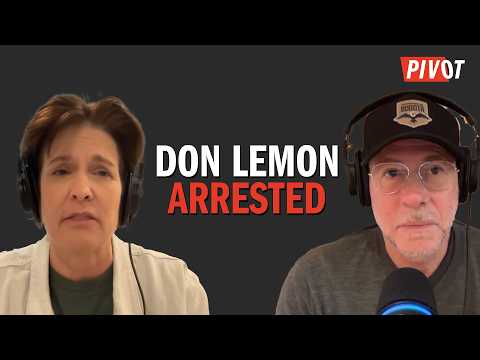
Don Lemon Arrest: "First Step Towards Mass Repression”
Kara Swisher (host), Scott Galloway (host)
In this episode of Pivot, featuring Kara Swisher and Scott Galloway, Don Lemon Arrest: "First Step Towards Mass Repression” explores pivot reacts to Don Lemon arrest as authoritarian press crackdown escalates Pivot hosts Kara Swisher and Scott Galloway record an emergency episode after journalist Don Lemon is arrested in Los Angeles, allegedly tied to a protest event he covered at a church in St. Paul, Minnesota.
Pivot reacts to Don Lemon arrest as authoritarian press crackdown escalates
Pivot hosts Kara Swisher and Scott Galloway record an emergency episode after journalist Don Lemon is arrested in Los Angeles, allegedly tied to a protest event he covered at a church in St. Paul, Minnesota.
They contend Lemon was acting as a journalist, and frame the DOJ’s actions—ordered by Attorney General Pam Bondi—as an intentional attempt to criminalize journalism rather than enforce law.
Galloway warns that targeted arrests of controversial journalists are historically the “first step” toward wider repression, self-censorship, and eventual economic decline, citing Turkey, Russia, Weimar Germany, and Hong Kong.
Swisher adds that alongside “hard” repression (arrests), “soft” media capture by powerful owners and tech billionaires is muting institutional resistance, and urges immediate public pushback to prevent normalization.
Key Takeaways
They frame Lemon’s arrest as targeted political policing, not routine law enforcement.
Galloway distinguishes mass-arrest scenarios (e. ...
Get the full analysis with uListen AI
Normalization is the real danger: controversial figures are used as test cases.
Both hosts argue governments often start by going after polarizing targets the public is split on; if society accepts it because “they don’t like him,” the enforcement quickly expands to broader speech and dissent.
Get the full analysis with uListen AI
The show warns this is an early marker of “state capture of truth.”
Galloway calls journalist arrests a first step toward mass repression because controlling who can safely speak changes public reality-making from debate to a permission structure.
Get the full analysis with uListen AI
Historical precedent suggests repression leads to self-censorship, then decline.
Galloway cites Turkey’s shift to becoming a leading jailer of journalists and Russia’s press-freedom collapse, arguing the chilling effect (spiked stories, reduced scrutiny) often precedes instability and poorer economic outcomes.
Get the full analysis with uListen AI
Media freedom is threatened both by coercion and by ownership pressure.
Swisher argues beyond arrests (“hard grab”), “soft grabs” occur when wealthy owners reshape coverage and editorial posture—she mentions Bezos/Washington Post and Ellison-related influence—reducing institutional willingness to confront government.
Get the full analysis with uListen AI
The creator economy becomes collateral damage in a politicized speech regime.
Galloway argues that if independent creators see that success outside traditional media can still lead to arrest for disfavored viewpoints, it chills participation and undermines a fast-growing segment of the digital economy.
Get the full analysis with uListen AI
They call for immediate, unified pushback and rejecting ‘both-sides’ framing.
Swisher urges listeners not to let media or officials rationalize the arrest as ambiguous or deserved; both emphasize rapid public backlash is historically the best chance to halt escalation.
Get the full analysis with uListen AI
Notable Quotes
“They arrest journalists. That's kind of the first step towards mass repression.”
— Scott Galloway
“Once the state decides who may safely speak, politics stops being a debate, and it becomes a permission structure.”
— Scott Galloway
“This wasn't... 50 people refusing to leave an area... This was our attorney general... specifically targeting specific journalists.”
— Scott Galloway
“The First Amendment says, 'Government shall make no law.' This is the government acting.”
— Kara Swisher
“Pretty much anybody should be able to say pretty much anything about pretty much anyone else.”
— Scott Galloway
Questions Answered in This Episode
What specific federal statute did the DOJ claim Lemon violated, and what evidence (if any) supports “coordination” versus newsgathering?
Pivot hosts Kara Swisher and Scott Galloway record an emergency episode after journalist Don Lemon is arrested in Los Angeles, allegedly tied to a protest event he covered at a church in St. ...
Get the full analysis with uListen AI
Swisher mentions a magistrate judge rejected an earlier DOJ attempt—what was the legal basis for that rejection, and how did DOJ proceed anyway?
They contend Lemon was acting as a journalist, and frame the DOJ’s actions—ordered by Attorney General Pam Bondi—as an intentional attempt to criminalize journalism rather than enforce law.
Get the full analysis with uListen AI
If Lemon entered a church with protesters, where is the practical legal line between lawful reporting and participation (trespass, aiding/abetting, conspiracy)?
Galloway warns that targeted arrests of controversial journalists are historically the “first step” toward wider repression, self-censorship, and eventual economic decline, citing Turkey, Russia, Weimar Germany, and Hong Kong.
Get the full analysis with uListen AI
Galloway cites Turkey 2013 and Russia 2000s—what were the first comparable “test cases,” and what mechanisms made repression expand quickly?
Swisher adds that alongside “hard” repression (arrests), “soft” media capture by powerful owners and tech billionaires is muting institutional resistance, and urges immediate public pushback to prevent normalization.
Get the full analysis with uListen AI
Swisher argues there’s both “soft” capture (ownership/editing pressure) and “hard” capture (arrests). Which is more dangerous in the short term, and how do they reinforce each other?
Get the full analysis with uListen AI
Transcript Preview
The more Donald Trump gets away with, if he is allowed to pardon people, and there's not enough uproar about it, and nothing happens, then he's gonna, um, uh, pick- he's gonna arrest people without due process on the streets or detain them, uh, even if they're American citizens. [upbeat music]
Hi, everyone. This is Pivot from New York Magazine and the Vox Media Podcast Network. I'm Kara Swisher.
And I'm Scott Galloway.
Uh, again, Scott, we have to do an emergency episode. This is getting kind of ridiculous. Uh, we had to jump in here to talk, uh, to our audience about what's happening right now with journalist and our friend Don Lemon. Right now, he was recently on the show, uh, as a guest host while you were away. Um, but he was arrested by authorities in Los Angeles Thursday night, where he was covering the Grammy Awards, um, accused of violating federal law tied to a protest he covered as a journalist at a Minnesota church earlier this month. Lemon and three other journalists were arrested in connection with the, with this, uh, this event at the City's church in St. Paul, Minnesota. Attorney General Pam Bondi said she ordered the arrest of Don and three others, uh, citing a connection to a coordinated attack on the church. Don has repeatedly said he was there as a journalist, not a protester, and if you watch what he did there, that's what he was doing, including interviewing the pastor and others. A magistrate judge rejected an earlier attempt by the DOJ to bring charges against Don, uh, and other protesters, and the DOJ petitioned a federal appeals court to force the judge to issue an additional warrant, only to be denied, but the DOJ went ahead anyway, even though courts and prosecutors within those offices in Los Angeles and Minnesota are resisting this. Lemon's lawyers called the attack... uh, the arrest, an attack on the First Amendment, obviously, and says Lemon will fight the case in court. He's supposed to be, uh, arraigned, uh, today in Los Angeles. Obviously, Don's a friend of ours, a friend of mine. Um, he's been, uh, been reaching, uh, reaching out. At Pat- when he, when he was fired from CNN, he and I got to know each other 'cause I helped him sort of mount what he was doing, which was independent journalism, and I've been very proud of him, what he's been doing. He's doing a lot of street journalism, taking his, his, uh, microphone to people, asking them questions. He's built a big following on YouTube. I think he crossed a million subscribers recently. But what's- what he's doing is really amazing. He's doing these things, and what he does, he's a man on the street, essentially. And so he went into this church while this event was taking place and, um, and was doing reporting, and which a lot [chuckles] of reporters should do, you know? I think he's found a new life in doing it as an independent journalist, and it's pretty, um, pretty amazing, all the stuff he's been doing. Very varied and talking to all kinds of people, not just, uh, liberals or but conservatives. He goes in places other journalists don't go. Um, and I think it's a real value, what he's doing. And so he was doing this here. Um, he was... Then it was the Grammys. I mean, it's very varied where he goes. Uh, he was in New Orleans for New Year's and stuff, and so what he was doing here was journalism. And because, you know, he's had a target on him by the Trump administration, who never liked him when he was at CNN, and, uh, and so this is what they're doing, and they're getting- what they were getting is a lot of pressure from church groups for this group going into a church, and you can debate whether they should have gone in that church, but a journalist certainly could follow a group of people in there. He did not coordinate the attacks. They're gonna try to allege he did, that he was part of it. Um, but it's really, again, part of this, uh, what I said, uh, on, in today's episode that just aired, was they're gonna keep escalating 'cause they're desperate, and they're losing the public case. Um, and so part of their, their, their, uh, handbook here, the fascist handbook, is to attack journalists. It's happened in Turkey. It's happened in all manner of the aut- uh, authoritarian countries, and this is what you do. And, uh, and so doing these high-profile cases, even though judges and lawyers do not want to do this and say it's full of shit, which it is, um, is really frightening. Um, and it's meant to frighten, and what we have to do is push back. We have to fight it, but the fact is, they will keep doing this, and they will not back out. They will not de-escalate. This is part of the, the... This is part of the problem, is you all think you can work with these people, and you cannot. Uh, any thoughts you have? I, I'm, uh, it makes me nervous. I have a lot of people who have, have been threatening to me, and, uh, it makes every journalist-
Install uListen to search the full transcript and get AI-powered insights
Get Full TranscriptGet more from every podcast
AI summaries, searchable transcripts, and fact-checking. Free forever.
Add to Chrome