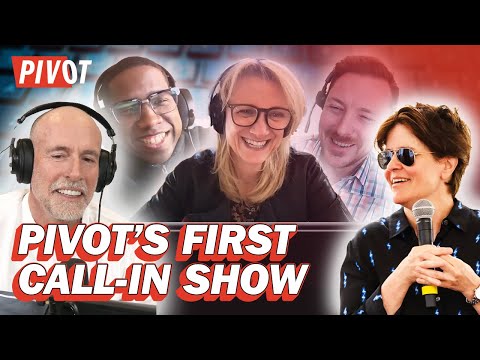
Kara and Scott Take Questions from Pivot Fans
Kara Swisher (host), Scott Galloway (host), Sean (caller) (guest), Caller (guest) (guest), Suzanne (Dean Suzanne, caller) (guest)
In this episode of Pivot, featuring Kara Swisher and Scott Galloway, Kara and Scott Take Questions from Pivot Fans explores pivot listeners grill Kara and Scott on Musk, medicine, and AI This episode of Pivot features listener call‑ins that prompt Kara Swisher and Scott Galloway to weigh in on Elon Musk’s governance and fiduciary risks, the broken U.S. health insurance system and weight‑loss drugs, and how AI should be integrated into education. They argue Musk’s behavior is an unprecedented governance failure enabled by a weak, conflicted Tesla board and a tight circle of friendly investors. On healthcare, they describe insurance as an “industrial complex” that blocks access to transformative GLP‑1 drugs like Ozempic, especially for poorer patients, and call for government intervention. On AI in schools, they urge educators to embrace AI as a creative tool, focus on critical thinking and relationships, and co‑learn with students rather than fixate on cheating.
Pivot listeners grill Kara and Scott on Musk, medicine, and AI
This episode of Pivot features listener call‑ins that prompt Kara Swisher and Scott Galloway to weigh in on Elon Musk’s governance and fiduciary risks, the broken U.S. health insurance system and weight‑loss drugs, and how AI should be integrated into education. They argue Musk’s behavior is an unprecedented governance failure enabled by a weak, conflicted Tesla board and a tight circle of friendly investors. On healthcare, they describe insurance as an “industrial complex” that blocks access to transformative GLP‑1 drugs like Ozempic, especially for poorer patients, and call for government intervention. On AI in schools, they urge educators to embrace AI as a creative tool, focus on critical thinking and relationships, and co‑learn with students rather than fixate on cheating.
Key Takeaways
Musk’s behavior exposes a governance vacuum at Tesla.
Galloway and Swisher describe Musk’s public demands for more voting control and tens of billions in additional compensation as actions that would get any other CEO fired, but persist because the Tesla board is weak, conflicted, and effectively controlled by him.
Get the full analysis with uListen AI
Public vs. private status shapes shareholder legal options.
They note that public companies are frequent targets for class‑action shareholder suits, while X’s status as a private firm with a small, Musk‑aligned investor base makes legal challenges to his behavior far less likely.
Get the full analysis with uListen AI
Tesla’s relocation to Nevada changes fiduciary‑duty calculus.
The caller points out that moving incorporation from Delaware to Nevada may introduce intent requirements and other legal nuances that make breach‑of‑duty cases harder, further insulating Musk and the board.
Get the full analysis with uListen AI
The health insurance system functions as a regressive tax on the poor.
Galloway argues that U. ...
Get the full analysis with uListen AI
Transformative obesity drugs are being blocked from those who need them most.
Both hosts and Dr. ...
Get the full analysis with uListen AI
AI will likely enhance, not replace, student creativity if used well.
They see AI as a powerful research and ideation assistant that can broaden thinking and free time for deeper discussion, provided educators frame it as a tool for exploration rather than a shortcut for finished work.
Get the full analysis with uListen AI
Educators must actively adopt and model AI use.
Swisher emphasizes that teachers should experiment with AI themselves, involve students in showing how they use it, and shift assessment toward critical thinking, factual rigor, and synthesis instead of rote research tasks AI can do instantly.
Get the full analysis with uListen AI
Notable Quotes
“He is effectively a walking plaintiff’s attorney dream.”
— Scott Galloway (on Elon Musk)
“It looks like he's sort of blackmailing the board.”
— Kara Swisher (on Musk’s demands to Tesla’s board)
“I think the insurance in the United States…is literally one of the biggest economic taxes that the poor pay.”
— Scott Galloway
“Their health span dies long before their lifespan.”
— Kara Swisher (on chronic disease and the diabetes ‘industrial complex’)
“Learning how to research, and this is how people are gonna research in the future, is a critical thinking skill.”
— Kara Swisher (on AI in education)
Questions Answered in This Episode
At what point does a CEO’s “value creation” stop justifying exceptional treatment by boards and regulators?
This episode of Pivot features listener call‑ins that prompt Kara Swisher and Scott Galloway to weigh in on Elon Musk’s governance and fiduciary risks, the broken U. ...
Get the full analysis with uListen AI
How could U.S. policy practically rein in the insurance ‘industrial complex’ without disrupting care for current patients?
Get the full analysis with uListen AI
What mechanisms would ensure equitable access to GLP‑1 drugs for low‑income and rural populations as prices evolve?
Get the full analysis with uListen AI
How should schools redesign assignments and assessments so that AI use is expected, transparent, and still challenges students’ own thinking?
Get the full analysis with uListen AI
What governance models or legal reforms could prevent a repeat of the Musk–Tesla dynamic in future high‑growth companies?
Get the full analysis with uListen AI
Transcript Preview
Get excited, Scott, because we're doing things a little differently today. It's a special show with Pivot listeners calling in and asking us their questions on all sorts of topics. We're gonna meet the people, Scott! The people!
I don't like surprises. At 49, I could slip and break a hip when you do this to me.
(laughs) I think you're gonna love it. Our first listener call ever, so this is a very exciting thing. Sean, welcome!
Well, hi, Kara and Scott. Thanks for having me on. Um, I'll try to set the bar as low as possible-
(laughs) Oh, okay.
... for any subsequent, uh, listeners who are asking questions, uh, so they don't have a tough act to follow. Um, so I'm a longtime listener-
Uh-huh.
... and I'm an attorney.
Uh-huh.
And, uh, I, I worked in private practice as a litigator for a while.
Uh-huh.
And the past few years, I've worked in the public sector.
Uh-huh.
Um, I've got a question about your favorite 3D-
Can I ask you a number-
Yeah.
... of questions? Are, are-
Sure.
Do you, do you like the penis jokes? No, not that one totally. Don't.
(laughs) Uh, I appreciate Scott's humor, but I feel like now being on the podcast, I'll be unemployable for the foreseeable future. So-
Well, that's what we like to do-
... uh, I appreciate it.
... here. We like to ruin careers. (laughs)
Yeah. (laughs)
Thank you, Sean. Let's listen to your question. Let's listen to your question.
So it's about, it's about Elon, and it's something of a legal question, but it's way outside of my-
Who?
... area.
Who? Who is it a... Who?
Elon.
Who? We, we've never heard of him, but go ahead.
Yeah. Never, yeah, you don't talk about him on this show.
No.
No, not a lot.
No, no.
Um...
But it's outside of my area of expertise-
Second-biggest complaint, by the way-
(laughs)
... is we talk a bit too much about Elon.
Uh, so here's my question. Uh, in buying the platform, Elon's turned himself into the main character on Twitter, uh, and he's repeatedly posted controversial tweets. Uh, in multiple instances, Elon's tweets have had a negative impact on the financial interests of X, uh, not to mention Tesla. Um, so what I wanna know, uh, you know, if you guys have any insight into this, particularly you, Scott, since you've served on boards, uh, over the years. Is there some reason, legal, practical, or otherwise, that no shareholder has pursued legal action against Elon asserting that his tweets, uh, have constituted a breach of his fiduciary duties? And I'm putting that, uh, unsuccessful 420 lawsuit from a few years back in a separate bucket because it involved alleged fraudulent misrepresentations about the company itself, whereas some of his other tweets are just lightning rods for controversie- controversy that cause the stock price to dip. Um, so I'm wondering if you guys have any insight on that.
Install uListen to search the full transcript and get AI-powered insights
Get Full TranscriptGet more from every podcast
AI summaries, searchable transcripts, and fact-checking. Free forever.
Add to Chrome