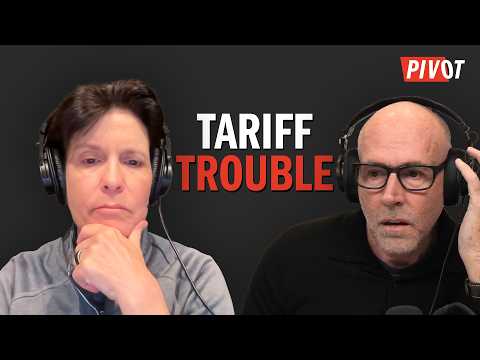
What Is Going On with Trump's Trade War? | Pivot
Scott Galloway (host), Kara Swisher (host), Narrator, Narrator
In this episode of Pivot, featuring Scott Galloway and Kara Swisher, What Is Going On with Trump's Trade War? | Pivot explores trump’s Tariff Shock, Musk’s Power Grab, And AI’s Bubble Risks Kara Swisher and Scott Galloway open by revisiting a recent plane crash segment, issuing a sincere on-air apology for sounding glib and stressing the human tragedy behind such events. They then dive into Trump’s new tariffs on Canada, Mexico, and China, arguing they function as a hidden tax on U.S. consumers, damage critical alliances, and appear tailored to advantage Elon Musk and Tesla. The conversation widens to Trump’s broader Project 2025-style agenda: mass deletion of federal websites, attacks on DEI and public-health information, dismantling USAID, and empowering Musk’s Doge team to slash government programs and control payments infrastructure. Finally, they assess big tech earnings and the AI funding frenzy, questioning whether OpenAI’s sky‑high valuation is sustainable, and close with reflections on foreign aid cuts, harsh immigration tactics, and the growing moral and strategic costs of U.S. policy shifts.
Trump’s Tariff Shock, Musk’s Power Grab, And AI’s Bubble Risks
Kara Swisher and Scott Galloway open by revisiting a recent plane crash segment, issuing a sincere on-air apology for sounding glib and stressing the human tragedy behind such events. They then dive into Trump’s new tariffs on Canada, Mexico, and China, arguing they function as a hidden tax on U.S. consumers, damage critical alliances, and appear tailored to advantage Elon Musk and Tesla. The conversation widens to Trump’s broader Project 2025-style agenda: mass deletion of federal websites, attacks on DEI and public-health information, dismantling USAID, and empowering Musk’s Doge team to slash government programs and control payments infrastructure. Finally, they assess big tech earnings and the AI funding frenzy, questioning whether OpenAI’s sky‑high valuation is sustainable, and close with reflections on foreign aid cuts, harsh immigration tactics, and the growing moral and strategic costs of U.S. policy shifts.
Key Takeaways
Tariffs act as a regressive tax on American consumers and allies.
The new 25% and 10% tariffs on Canada, Mexico, and China will raise prices on everyday goods—food, lumber, cars, toys—without offsetting tax relief for most households, effectively functioning as a consumer tax while sparing the wealthy.
Get the full analysis with uListen AI
Punishing Canada and Mexico undermines vital alliances and long-term U.S. interests.
Targeting close partners who share security burdens, intelligence, and economic integration erodes trust and encourages them to deepen ties with rivals like China, weakening America’s strategic position for short-term political theater.
Get the full analysis with uListen AI
Musk appears to be shaping policy to advantage Tesla over traditional automakers.
Because Tesla’s supply chain is more vertically integrated in the U. ...
Get the full analysis with uListen AI
Deleting federal web content disproportionately harms poor and vulnerable populations.
Removing CDC pages on HIV, STDs, vaccines, and civil-rights resources reduces access to critical health and legal information for people without money, lawyers, or private doctors, effectively making ideological battles a war on poor people’s rights and safety.
Get the full analysis with uListen AI
Centralizing government digital and payments power in Musk’s hands is a systemic risk.
Giving a single billionaire and his loyal, largely unelected team the ability to shut off aid, disrupt benefits, or close agencies via executive control creates “private capture” of the state and weakens democratic checks and oversight.
Get the full analysis with uListen AI
AI may create massive societal value without producing equivalent mega-winners.
Galloway argues AI could resemble the airline or PC industries—transformative for productivity yet fiercely competitive and low-margin—meaning consumers and the broader economy gain more than any one firm, casting doubt on sky-high valuations like OpenAI’s.
Get the full analysis with uListen AI
Cutting foreign aid and aggressive immigration raids are morally and strategically self-defeating.
Ending programs that feed refugees, fight malaria, and stabilize fragile regions opens space for China and Russia to expand influence, while workplace and school raids against undocumented immigrants remove essential labor that underpins U. ...
Get the full analysis with uListen AI
Notable Quotes
““The definition of stupid is doing something that hurts others and hurts yourself.””
— Scott Galloway (on Trump’s tariffs, especially against Canada)
““They aren’t the 51st state, but they sure as hell aren’t just another country.””
— Kara Swisher (on the depth of U.S.–Canada economic integration)
““Whatever the FAA has been doing the last 30 or 40 years has resulted in outstanding metrics… then DEI should be incorporated into every organization.””
— Scott Galloway (arguing that blaming DEI for aviation accidents is absurd given safety records)
““We no longer are a trusted ally… he is taking that, and he is eroding it at an unbelievable rate.””
— Scott Galloway (on the long-term damage to U.S. global goodwill)
““AI might be the airline or the PC industry where there's enormous value created and it's all captured by consumers… but no one company is able to capture the trillions of dollars in value.””
— Scott Galloway (on why the AI mega-bubble may not deliver the expected corporate jackpots)
Questions Answered in This Episode
How will Trump’s tariffs tangibly affect prices that ordinary Americans see at the grocery store, car dealership, and online, and how quickly will those increases be felt?
Kara Swisher and Scott Galloway open by revisiting a recent plane crash segment, issuing a sincere on-air apology for sounding glib and stressing the human tragedy behind such events. ...
Get the full analysis with uListen AI
What realistic mechanisms exist—legal, political, or market-based—to check Elon Musk’s growing role in federal operations and prevent private capture of public power?
Get the full analysis with uListen AI
If AI value largely accrues to consumers and the broader economy rather than a few firms, how should investors and policymakers rethink their expectations for companies like OpenAI, NVIDIA, and Microsoft?
Get the full analysis with uListen AI
In what ways does deleting federal health and civil-rights information reshape public understanding of issues like HIV, vaccines, and housing rights, and who is most at risk from that information vacuum?
Get the full analysis with uListen AI
What are the long-term geopolitical consequences of slashing U.S. foreign aid for America’s ability to deter adversaries, prevent terrorism, and maintain its image as a global “good guy”?
Get the full analysis with uListen AI
Transcript Preview
... and I also occasionally, if I have both a gummy and, um, a couple of Maker's in ginger-
Mm-hmm.
... I put in my AirPods and I dance to '80s music-
(laughs)
... without my, without my shirt on.
(instrumental music) Hi, everyone. This is Pivot from New York Magazine and the Vox Media Podcast Network. I'm Kara Swisher, and I am in San Francisco, and was on a flight last night, uh, having to read about Doge working all weekend taking over the government.
Good to see you, Kara. Uh, wh-
(laughs) I'm so tired.
Are you? Why are you back in San Francisco?
Oh, I have a bunch of things to do here. I'm speaking in front of a group from Columbia, uh, University Journalism school. Um-
Uh-huh.
... I've got some appointments. I've got, uh, a whole bunch of stuff that I'm doing here in San Francisco. I like to come and visit the place f- every now and then to find out what's going on.
You love it there.
I do. I do. I don't have a lot of time here this time, but I am, uh, I'm excited to be here. Anyway, it was a long weekend. Listen, uh, this whole Doge thing has got me off to a bad start. Um-
Yeah.
... but, uh, but I am glad I'm in San Francisco, that's for sure. How are you doing?
Well, I'm good. I'm about to get on a plane for Orlando.
Oh, nice.
(sighs) Yeah. Um, I have a speaking gig at Walt Disney World.
What?
Uh, yeah. Uh, don't ask. I don't know. I don't know. I just go where they send me.
Why?
Yeah. I'm s-
Which place?
What's that?
Why? Who is at Walt Disney World?
Uh, they do a lot of conventions there, I guess.
Uh-huh.
I don't know. Uh, uh, foreigners? I don't know. I... Foreign...
Uh-huh.
I don't know what's going on there, I just know I'm going. And, uh, and then I, I spend a day there and then I go to New York for three or four days, and then home.
Oh, how nice. Yeah. It's, February's gonna be a big month. It's gonna be a big month, and it has been in Washington, as I said, but it's just, it seems very active. It used to be a lot slower in the winter. Now it seems crazy. Maybe it's just I'm tired from s- flying all night and then being here.
Yeah. I don't know. I don't... You spend... It's interesting, as close as we are-
Mm-hmm.
... professionally and personally-
Very so.
... uh, we are never in the same place.
Mm-hmm.
You spend most of your time in DC and San Francisco-
Install uListen to search the full transcript and get AI-powered insights
Get Full TranscriptGet more from every podcast
AI summaries, searchable transcripts, and fact-checking. Free forever.
Add to Chrome