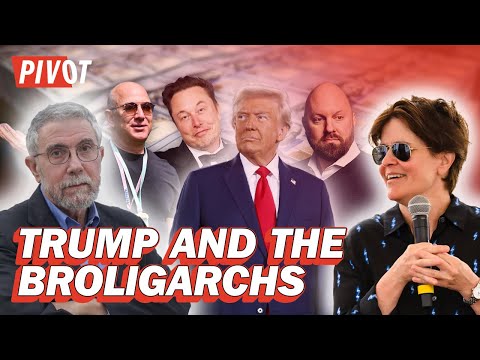
The Price of Power: Donald Trump and the Tech Broligarchs | Pivot
Kara Swisher (host), Paul Krugman (guest)
In this episode of Pivot, featuring Kara Swisher and Paul Krugman, The Price of Power: Donald Trump and the Tech Broligarchs | Pivot explores trump, Tech Billionaires, And How Power Corrupts America’s Innovation Edge The discussion examines ABC News’ $15 million defamation settlement with Donald Trump as an example of powerful figures using legal threats to intimidate media and businesses. The guests argue this is less about legal merit and more about fear of government retaliation under a potential second Trump administration. They warn that Trump’s discretionary power over tariffs, regulation, and government favors risks turning the U.S. into a protection-racket economy where success depends on political loyalty. The conversation also explores how aging tech oligarchs are abandoning libertarian ideals to curry favor with authoritarian power, endangering rule of law, innovation, and long‑term economic growth.
Trump, Tech Billionaires, And How Power Corrupts America’s Innovation Edge
The discussion examines ABC News’ $15 million defamation settlement with Donald Trump as an example of powerful figures using legal threats to intimidate media and businesses. The guests argue this is less about legal merit and more about fear of government retaliation under a potential second Trump administration. They warn that Trump’s discretionary power over tariffs, regulation, and government favors risks turning the U.S. into a protection-racket economy where success depends on political loyalty. The conversation also explores how aging tech oligarchs are abandoning libertarian ideals to curry favor with authoritarian power, endangering rule of law, innovation, and long‑term economic growth.
Key Takeaways
The ABC–Trump settlement signals fear-driven capitulation, not legal defeat.
Despite many lawyers believing ABC would win, the company settled and expressed regret, which the speakers interpret as paying 'protection money' to avoid future political retaliation from Trump if he returns to power.
Get the full analysis with uListen AI
Presidential discretion over tariffs can weaponize economic policy.
Because U. ...
Get the full analysis with uListen AI
A protection-racket style economy erodes growth and innovation.
When business success depends on political pull rather than products and ideas, capital misallocates, foreign talent is discouraged, and studies suggest such regimes shave roughly 1% off growth annually, compounding over time.
Get the full analysis with uListen AI
Tech giants have morphed from disruptive innovators into entrenched oligarchs.
Once-young disruptors now hold monopoly-like positions and are behaving like traditional oligarchs, seeking to secure their advantages by currying favor with political strongmen rather than relying on open competition.
Get the full analysis with uListen AI
Backing autocrats is a recurring oligarchic miscalculation.
The speakers draw parallels with Putin’s Russia, where oligarchs who thought they were buying power instead became subordinate to the regime, suggesting tech billionaires flirting with Trump may discover he holds the real leverage.
Get the full analysis with uListen AI
America’s innovation lead rests on rule of law and openness.
The U. ...
Get the full analysis with uListen AI
Status anxiety and lost adoration fuel tech billionaires’ aggrievement.
The conversation highlights how many tech titans, once widely admired, now face criticism and seem bitter; they can buy almost anything except genuine admiration, which may help explain their attraction to power and grievance politics.
Get the full analysis with uListen AI
Notable Quotes
“If you're ABC and you're looking at all the ways that Trump can hurt you if he wants to, then you pay protection money. That's what just happened.”
— Guest economist (Paul Krugman–type voice)
“Big business [is] already acknowledging that we've become a protection racket country. Pay for play.”
— Kara Swisher
“In regimes like that, according to an IMF meta-study, it subtracts about 1% from growth, year after year, indefinitely.”
— Guest economist
“Their libertarian ideology was never more than skin deep.”
— Guest economist
“These are people who can buy anything except love and adulation.”
— Guest economist
Questions Answered in This Episode
How might media organizations change their coverage of powerful politicians if they increasingly fear targeted legal or regulatory retaliation?
The discussion examines ABC News’ $15 million defamation settlement with Donald Trump as an example of powerful figures using legal threats to intimidate media and businesses. ...
Get the full analysis with uListen AI
What concrete legal reforms could limit presidential discretion over tariffs and reduce the risk of a protection-racket economy?
Get the full analysis with uListen AI
Can the U.S. maintain its innovation lead if immigration is restricted and tech visas are treated as political favors rather than economic tools?
Get the full analysis with uListen AI
Why did America’s Gilded Age elites stop short of fully undermining democratic institutions, and what’s different about today’s tech oligarchs?
Get the full analysis with uListen AI
What mechanisms—political, legal, or cultural—could effectively check the influence of tech billionaires who align themselves with authoritarian-leaning leaders?
Get the full analysis with uListen AI
Transcript Preview
... ABC News has agreed to pay $15 million to settle a defamation lawsuit brought by Donald Trump. The suit's centered around comments that ABC's George Stephanopoulos made against a c- uh, in a civil suit against Trump, brought by E. Jean Carroll. He said he was found liable for rape when he actually had been found liable for sexually assaulting and defaming Carroll. Uh, the judge had- had- had mentioned that it was in most terms that would be considered that, and that's, I think, why he said it. Um, but in fact, the- the- the jury had found him liable for, uh, sexual ass- assault, uh, and d- defamation. Under the terms of the settlement, ABC News will donate, uh, uh, the money, $15 million, uh, to a future presidential foundation and museum. And Stephanopoulos and ABC also- also issued a statement of regret for the mistake. Um, uh, many experts thought... I- I've talked to a dozen lawyers. They thought ABC would have won, uh, and Trump is... typically does this a lot, as a, as a... and so does... speaking of Elon Musk, we just talked about him. They use legal, uh, threats as a means of- of- of, uh, having people, uh, acquiesce. So, t- talk a little bit about this. I mean, from a business point of view, again, it's using censorship. It's using l- legal means. It's using anything but actual competition, or just like things work out.
And it's more than that. What we're seeing is that... I mean, some of us had warned that, um, that, uh, a Trump admi- second Trump administration would be one in which the, uh, coercive power of the government, uh, against business would become huge. That it... I mean, we're in a- a mixed economy where the government plays a big role, uh, private sector plays a big role. Uh, lots of things in the private sector depend upon government decisions that are reasonably favorable. Um, as long as you have rules, norms, rule of law, um, then that kind of works okay. But if you start to have arbitrary exercise, and then... One of the things we worry about on, on tariffs, um, it happens to be the case that the way that our trade laws are written, the president has enormous discretion in tariff setting. And in some ways, one of the worst things about Trump tariffs will be not the tariffs he applies, but the ones he doesn't, because he can play favorites with who gets to get exempted from a tariff. There is some evidence he did that even on the relatively small tariffs he imposed in the first term. So, if you're ABC and you're looking at, uh, at all the ways that Trump can hurt you if he wants to, uh, then you, you know, pay protection money. That's what just happened. And this is a much bigger thing than just competition. This is basically, um, big business already acknowledging that we've become a, uh, uh, a- a protection racket country.
Install uListen to search the full transcript and get AI-powered insights
Get Full TranscriptGet more from every podcast
AI summaries, searchable transcripts, and fact-checking. Free forever.
Add to Chrome