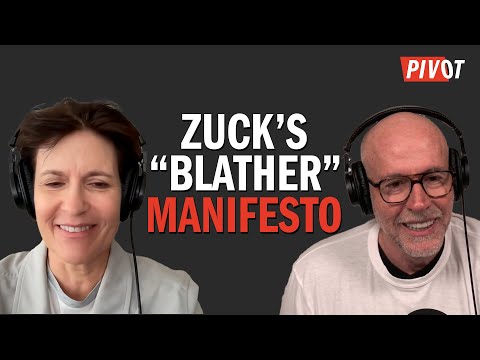
Kara and Scott Shred Zuck’s Vision for AI | Pivot
Scott Galloway (host), Kara Swisher (host), Kara Swisher (host), Guest (guest), Narrator, Mark Zuckerberg (guest), Guest (guest)
In this episode of Pivot, featuring Scott Galloway and Kara Swisher, Kara and Scott Shred Zuck’s Vision for AI | Pivot explores kara and Scott Skewer Tech, Tariffs, Guns, Rogan, and Zuck’s AI Kara Swisher and Scott Galloway open with the Manhattan office shooting, using it to examine America’s unique mix of gun access, mental health issues, CTE in football, and normalized mass-violence anxiety. They move to Washington, dissecting the stalled push to ban stock trading by lawmakers and arguing for mandatory blind trusts and much higher pay for public officials to curb corruption. The conversation then pivots to politics and media power: Joe Rogan and other ‘manosphere’ podcasters turning on Trump over Epstein, immigration raids, and free speech, and Trump’s baffling Epstein/Ghislaine Maxwell strategy. They close with big-picture economics and tech: Trump’s tariffs versus Powell’s restraint, AI-driven earnings explosions at Microsoft and Meta alongside Zuckerberg’s pseudo-philosophical AI “manifesto,” the disruptive rise of GLP‑1 weight-loss drugs, and why Figma’s IPO and EU antitrust show how regulation can actually strengthen markets.
Kara and Scott Skewer Tech, Tariffs, Guns, Rogan, and Zuck’s AI
Kara Swisher and Scott Galloway open with the Manhattan office shooting, using it to examine America’s unique mix of gun access, mental health issues, CTE in football, and normalized mass-violence anxiety. They move to Washington, dissecting the stalled push to ban stock trading by lawmakers and arguing for mandatory blind trusts and much higher pay for public officials to curb corruption. The conversation then pivots to politics and media power: Joe Rogan and other ‘manosphere’ podcasters turning on Trump over Epstein, immigration raids, and free speech, and Trump’s baffling Epstein/Ghislaine Maxwell strategy. They close with big-picture economics and tech: Trump’s tariffs versus Powell’s restraint, AI-driven earnings explosions at Microsoft and Meta alongside Zuckerberg’s pseudo-philosophical AI “manifesto,” the disruptive rise of GLP‑1 weight-loss drugs, and why Figma’s IPO and EU antitrust show how regulation can actually strengthen markets.
Key Takeaways
America’s gun problem is about weapons access, not uniquely American pathology.
Galloway stresses that the U. ...
Get the full analysis with uListen AI
We’ve normalized mass shootings, which quietly reshapes behavior and public space.
They note how Americans now accept heightened office security, background fear when kids are at school, and selective media outrage (more coverage when affluent white victims are involved), arguing this adaptation erodes societal wellbeing even if absolute risk remains statistically low.
Get the full analysis with uListen AI
Banning congressional stock trading requires both blind trusts and higher pay.
Kara and Scott argue every elected official should be forced into a blind trust; refusal is basically an admission you intend to benefit from nonpublic information. ...
Get the full analysis with uListen AI
Male-focused podcasts are a major, underpriced political force that’s moving on Trump.
They frame Joe Rogan, Andrew Schulz, Shane Gillis, and others as a ‘manosphere’ that once helped put Trump in office but is now increasingly criticizing him on Epstein, heavy-handed immigration raids, and censorship of students—potentially shifting young male sentiment in a way mainstream TV can’t match.
Get the full analysis with uListen AI
Trump’s Epstein/Ghislaine response looks legally defensive and morally revealing.
Trump’s shifting explanations for his Epstein break and his language about Epstein “stealing” a Mar-a-Lago employee make him appear more concerned about losing staff than about sexual abuse; the push to hear from Ghislaine Maxwell now, with immunity, seems transparently aimed at exonerating Trump and therefore backfires reputationally.
Get the full analysis with uListen AI
Trump’s chaotic tariff regime quietly turbocharges Big Tech dominance.
Because tariffs mostly hit manufacturers and global supply chains, investors flee complexity and regulatory risk by crowding into U. ...
Get the full analysis with uListen AI
AI capital spending is historically unprecedented and heavily rewarded by markets.
Microsoft and Meta are pouring tens of billions into AI infrastructure, with quarterly AI capex now exceeding total U. ...
Get the full analysis with uListen AI
Zuckerberg’s AI ‘personal superintelligence’ pitch masks a straightforward profit play.
Kara dismisses his manifesto about AI helping you “be a better friend” as anodyne branding—arguing Meta’s real goal is automating valuable work and extracting more data, with smart glasses framed as essential simply because Meta has a big bet there, not because of neutral technological inevitability.
Get the full analysis with uListen AI
GLP‑1 weight-loss drugs may be more transformative than AI for real-world health.
Galloway reiterates his view that GLP‑1s will massively reduce obesity-related disease and healthcare costs and should be made widely accessible. ...
Get the full analysis with uListen AI
Figma’s IPO showcases how antitrust can foster innovation, jobs, and investor access.
Blocked by EU regulators from being acquired by Adobe, Figma got a big breakup fee, stayed independent, and is now going public with strong growth, profitability, and broad enterprise adoption. ...
Get the full analysis with uListen AI
Notable Quotes
“We do not have a monopoly on angry young men or mental illness. What we have a monopoly on is that all of these people have access to weapons of war.”
— Scott Galloway
“The moment you are elected to office, you have to put your money in a blind trust. If you’re not willing to do that, you’re acknowledging you have special access that other people don’t.”
— Scott Galloway
“If I asked AI to give me an image of Mark Zuckerberg that defines who he is, it would be a guy at a really sad malt shop, sucking up the world’s user data through a straw.”
— Scott Galloway
“Social media is not going to make you a better friend or help you grow into the person you aspire to be, and neither does Mark Zuckerberg care about that.”
— Kara Swisher
“Microsoft is right now spending more money on AI than I think almost any organization in history has spent on anything—outside of countries at war.”
— Scott Galloway
Questions Answered in This Episode
How much political power do figures like Joe Rogan really hold over young men, and what evidence is there that their shifting views can change electoral outcomes?
Kara Swisher and Scott Galloway open with the Manhattan office shooting, using it to examine America’s unique mix of gun access, mental health issues, CTE in football, and normalized mass-violence anxiety. ...
Get the full analysis with uListen AI
Would a serious ban on congressional stock trading plus very high public salaries actually reduce corruption, or just attract a different kind of opportunist into politics?
Get the full analysis with uListen AI
Are massive AI capex budgets creating systemic economic risk if the technology under-delivers, and what would a ‘bubble burst’ look like given current concentration in a few firms?
Get the full analysis with uListen AI
Should GLP‑1 drugs be subsidized or publicly provided as a national health strategy, given their potential to reduce obesity-related costs, and how do we manage equity and safety concerns?
Get the full analysis with uListen AI
What kind of regulatory framework would prevent Big Tech from further entrenching power through AI while still allowing genuinely useful AI applications—like design tools such as Figma—to thrive?
Get the full analysis with uListen AI
Transcript Preview
If I asked AI-
Yeah.
... to give me an image of Mark Zuckerberg that defines who he is, I feel like it would be a guy at a really sad malt shop, sucking up the world's user data through a straw, and every time he made eye contact with you, he'd apologize and look away.
(instrumental music) Hi everyone. This is Pivot from New York Magazine and the Vox Media Podcast Network. I'm Kara Swisher from Scott Galloway's living room.
And I'm Scott Galloway.
We got a lot to get to today here from your apartment in, uh, Manhattan. Uh, blowup tech earnings, crazy, a big shakeup on the weight loss drug market, I really am interested in what you think about this, and how much does Trump need to worry about Joe Rogan? Joe Rogan is turning rogue on Trump on several topics. Uh, but first, the man who opened fire in a Manhattan office building on Monday, not, not terrifically far from here, killing four people and injuring a fifth, was targeting the NFL headquarters with a note claiming he suffered from CTE. A page, uh, in the shooter's note accused the NFL of concealing the dangers to football players' brains in order to maximize profits. This is a longtime thing. I, I, uh, I, I am, uh, lots of people are concerned. I didn't let my kids play football because I was worried about that. The shooter played high school football, but did not play professionally. And of course, what he did was heinous. Um, but pretty, uh, devastating that people, you know, same thing with Luigi Mangione, people acting out on anger. The, the level of anger in this society, and maybe, uh, well, m- you can only find out if you have CTE after you die, so I assume they'll check this and see if that's the case. But I think Sanjay Gupta said 40% of the people who claim they have CTE, uh, before they die actually have it, like of 100%, which is quite a lot. It's not nothing. So, I don't know. Any thoughts?
Yeah. I mean, well, first off, we don't know if and what role CTE played here. Um-
Right. We don't.
Um, so just distinctive whether or not it- this was- CTE played a role here, it is, you know, they, they... There was a study of former NFL players, and it found that of the 306- 76 players studied, 91% had CTE. I mean, you just have people running... It's not even the impact. I guess it's the rotation, sudden rotation, that a helmet can't solve for, right?
Yeah.
Your, your head twists, and the, the, whatever it is, the cortex or the brain spine just can't, can't respond that quickly.
Yeah.
Um, everyone's been talking about it for a while, but it's an- it, it's sort of an example of capitalism. I'm not sure for- you could really justify this sport if it didn't make billions each year, if it wasn't s- if it wasn't psychologically and economically just so ingrained in our culture. But they really are sort of modern-day gladiators, and they pay an enormous price. But the, the thing that struck me about this, Kara, or I think what the, uh, o- obviously, in addition to the tragedy of the families of the people who are-
Install uListen to search the full transcript and get AI-powered insights
Get Full TranscriptGet more from every podcast
AI summaries, searchable transcripts, and fact-checking. Free forever.
Add to Chrome