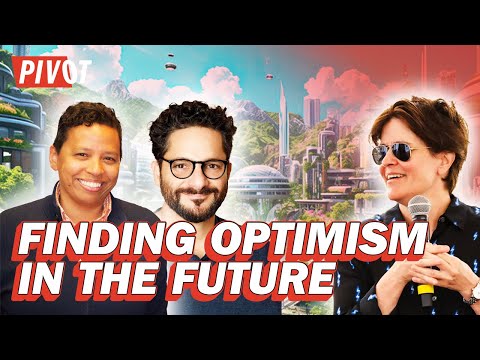
Futurist Explains Why Dystopia Is Not Inevitable | Pivot
Kara Swisher (host), Ari Wallach (guest), Lydia Polgreen (host)
In this episode of Pivot, featuring Kara Swisher and Ari Wallach, Futurist Explains Why Dystopia Is Not Inevitable | Pivot explores futurist Argues Hopeful, Human-Centered Futures Are A Choice, Not Fate Ari Wallach, futurist and host of PBS’s “A Brief History of the Future,” explains that futurism is a structured discipline that extrapolates from long-term megatrends to build probabilistic scenarios about the future, rather than making crystal-ball predictions.
Futurist Argues Hopeful, Human-Centered Futures Are A Choice, Not Fate
Ari Wallach, futurist and host of PBS’s “A Brief History of the Future,” explains that futurism is a structured discipline that extrapolates from long-term megatrends to build probabilistic scenarios about the future, rather than making crystal-ball predictions.
He argues that an overwhelming cultural diet of dystopia, especially for young people, is shaping collective expectations and driving pessimism, while many of the world’s most vulnerable populations actually exhibit the strongest optimism and agency about the future.
Wallach contrasts a doom-centric, short-term, tech- and profit-driven view of tomorrow with a “protopian” approach that focuses on incremental, better-than-now futures grounded in human needs, death awareness, and responsibility to future generations.
Through global examples—from African refugees to Afrofuturism, death doulas, dementia villages, and large-scale clean energy projects—he maintains that we’re at an inflection point where choosing hopeful narratives and long-term thinking can materially alter our trajectory.
Key Takeaways
Futurism is structured scenario-building, not prediction or hype.
Professional futurists analyze long-running megatrends and build probabilistic stories about multiple possible futures, helping people prepare and choose rather than promising a single, fixed outcome.
Get the full analysis with uListen AI
Narratives shape futures: constant dystopia breeds paralysis and dread.
Wallach links the dominance of dystopian fiction—especially in youth culture—to widespread anxiety about tomorrow, arguing that if people can only see doom, they are less likely to imagine, demand, or build better futures.
Get the full analysis with uListen AI
Viewing the future as a verb increases agency and optimism.
He finds that people who see the future as something they actively make, rather than a place they’re passively hurtling toward, are more hopeful and more willing to pursue constructive change.
Get the full analysis with uListen AI
Protopian thinking focuses on realistic, incremental improvement.
Instead of chasing utopia or avoiding worst-case dystopia, protopian futures aim for “better than today” worlds that center human flourishing over technology worship or zero-sum competition.
Get the full analysis with uListen AI
Death awareness and comfort with uncertainty enable long-term choices.
Conversations with a death doula and a hospice social worker highlight that moving from death anxiety to death awareness—and tolerating uncertainty—helps people make decisions that benefit the far future, beyond their own lifespan.
Get the full analysis with uListen AI
AI encodes values and biases that can last centuries.
By framing AI systems as “immortal machines,” Wallach stresses that the visions, ethics, and prejudices we program now could persist as long as legacy code like COBOL, making present-day AI governance a multi-century responsibility.
Get the full analysis with uListen AI
Human-centered redesign of institutions proves large-scale change is possible.
Examples like dementia villages in the Netherlands show that rethinking basic assumptions about care and community can produce radically better outcomes, fueling optimism that similarly bold redesigns can tackle other complex social problems.
Get the full analysis with uListen AI
Notable Quotes
“If all we're showing is doom and gloom, that is what we are going to head towards.”
— Ari Wallach
“Some people look at the future as a place they’re hurtling towards; others see it as a verb—something they are making.”
— Ari Wallach
“We've been living in a dystopia for 400 years.”
— Ytasha Womack, as quoted by Ari Wallach
“Until you can envision a world beyond your own lifespan, it's very difficult to take actions for the far future.”
— Ari Wallach (on lessons from a death doula)
“What we are building right now are immortal machines.”
— Ari Wallach (on AI)
Questions Answered in This Episode
How can educators and creators intentionally introduce more protopian narratives without minimizing real global crises?
Ari Wallach, futurist and host of PBS’s “A Brief History of the Future,” explains that futurism is a structured discipline that extrapolates from long-term megatrends to build probabilistic scenarios about the future, rather than making crystal-ball predictions.
Get the full analysis with uListen AI
What practical steps can individuals take to shift from seeing the future as fixed to seeing it as something they actively build?
He argues that an overwhelming cultural diet of dystopia, especially for young people, is shaping collective expectations and driving pessimism, while many of the world’s most vulnerable populations actually exhibit the strongest optimism and agency about the future.
Get the full analysis with uListen AI
How should policymakers and technologists change their approach to AI if they truly accept it as an 'immortal' infrastructure?
Wallach contrasts a doom-centric, short-term, tech- and profit-driven view of tomorrow with a “protopian” approach that focuses on incremental, better-than-now futures grounded in human needs, death awareness, and responsibility to future generations.
Get the full analysis with uListen AI
What would it look like to apply the dementia-village model of care and community to other vulnerable groups or social challenges?
Through global examples—from African refugees to Afrofuturism, death doulas, dementia villages, and large-scale clean energy projects—he maintains that we’re at an inflection point where choosing hopeful narratives and long-term thinking can materially alter our trajectory.
Get the full analysis with uListen AI
How can societies in the Global North learn from the optimism and agency of refugee communities and the Global South without romanticizing their struggles?
Get the full analysis with uListen AI
Transcript Preview
Ari Wallach is a futurist and the host of the new PBS series, A Brief History of the Future. The show examines the ways people are problem-solving and working to improve the world for the next generations. I welcome it. I wish I was a fut- futurist. So, Ari, explain what a futurist is.
So, you know, there... Look, there, there's two different ways of thinking about what a future is. There's a way that people think about it in the kind of common way, which is we have a crystal ball and we go into a room, or we go onto a stage and we tell s- and we predict, "This is what tomorrow is gonna be." The reality is, it's a, it's a much more structured endeavor. So, a lot of what we do is we look at mega trends. We look at things that have been happening for, for, for several years, oftentime decades, and then we start to extrapolate what those would be like moving forward the next five, 10, 15, 20 years. And then within that, we build scenarios or stories about what might happen. Not best case, not worst case, but probabilistically, what is likely to occur given these mega trends? So that, that's what kind of professional futurists do.
So, in this series, you're really offering a positive view of the future. There's so much dis- you know, especially in science fiction and elsewhere, you're trying to move away from doom and gloom and dystopia. Um, why did you feel it was important to explore? And I'll just make a note here. It's one of the things I've been trying to do a lot more lately about where the good parts are, especially around AI, and we'll get into that, and Lydia will have some questions. Um, but as you say in the show, um, we're currently at a sort of inflection point to decide our fate around the, th- especially in the environment, but also AI and all kinds of things. Talk a little bit about why you did the positive spin and what the inflection point is.
Look, it... Look, for, for 20 years, I, I've been a futurist, and I've been going into rooms and what more- w- what happens more often than not is CEOs or government leaders will s- will say the same thing. "What's the worst thing that's gonna happen and how do we position ourselves not to be part of the worst thing?" It's not how do we position ourselves-
Right.
... not to contribute to it, but how do we avoid it. Um, and so-
Right.
... it occurred to me, I have, I have 15-year-old twin daughters, and when I look at their bookcase in their room for young adult fiction, every single book that takes place in the future is dystopian. And then when we look at youth today, where depending on which poll you look at, anywhere from 70 to 80% say they, they have kind of dread towards the future. I think back about when I was their age, uh, i- in the '90s, and I was optimistic about the future. Now, obviously there were very different trends happening at the time, but net-net, and this goes back to sports psychology, you know, (laughs) i- if- if you can't see it, you can't be it. And if all we're showing is doom and gloom, and this is not to take away from the doom and gloom of the current moment, that is what we are going to head towards, right? W- if we look back at the last time there were good stories about tomorrow that took place not in a perfect future, but in a better future, we have to go back to the mid-1960s, to Star Trek, right? There was a first interracial kiss on Star Trek decades before we actually saw it anywhere else on TV. Um-
Install uListen to search the full transcript and get AI-powered insights
Get Full TranscriptGet more from every podcast
AI summaries, searchable transcripts, and fact-checking. Free forever.
Add to Chrome