Is It Too Late To Invest In Nvidia? | Pivot
Kara Swisher (host), Scott Galloway (host)
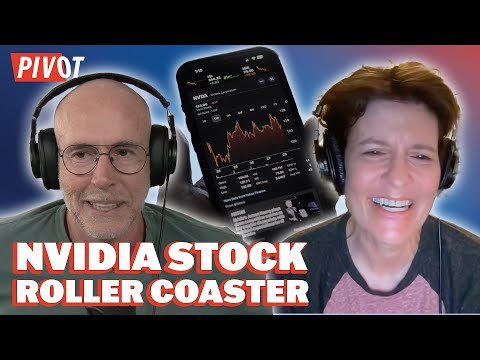
In this episode of Pivot, featuring Kara Swisher and Scott Galloway, Is It Too Late To Invest In Nvidia? | Pivot explores nvidia’s Wild Ride: One Stock Steering Markets, Wealth, And Hype Kara Swisher and Scott Galloway discuss Nvidia’s extreme market influence after a sharp pullback and rebound in its stock price. Galloway highlights how one company’s valuation swings now move the NASDAQ, S&P, and even broader economic sentiment, with implications for wealth concentration and housing markets. They explore the staggering value created per employee at Nvidia and the resulting impact on places like San Francisco real estate. Galloway ultimately argues that for most investors, broad index funds are a smarter, less stressful way to gain Nvidia exposure than betting directly on the stock.
Nvidia’s Wild Ride: One Stock Steering Markets, Wealth, And Hype
Kara Swisher and Scott Galloway discuss Nvidia’s extreme market influence after a sharp pullback and rebound in its stock price. Galloway highlights how one company’s valuation swings now move the NASDAQ, S&P, and even broader economic sentiment, with implications for wealth concentration and housing markets. They explore the staggering value created per employee at Nvidia and the resulting impact on places like San Francisco real estate. Galloway ultimately argues that for most investors, broad index funds are a smarter, less stressful way to gain Nvidia exposure than betting directly on the stock.
Key Takeaways
Nvidia’s size makes it a market bellwether.
Nvidia’s valuation is now so large that a double-digit percentage move can erase or add the equivalent of a major company like Mastercard, influencing the NASDAQ, S&P, and perceived health of the U. ...
Get the full analysis with uListen AI
Extreme concentration risk is building around one stock.
As Nvidia becomes the “magnificent one,” its volatility can disproportionately sway index performance and investor sentiment, making broad markets more sensitive to a single company’s fortunes.
Get the full analysis with uListen AI
Nvidia’s wealth creation per employee is unprecedented.
With roughly 30,000 employees and a multi-trillion-dollar market cap, Nvidia has created on the order of $100 million or more in market value per employee, leaving thousands suddenly worth $10–50 million on paper.
Get the full analysis with uListen AI
Tech-driven wealth is reshaping local housing markets.
A surge of newly wealthy employees in their 20s–40s is likely to drive demand for high-end and upgrade housing, particularly in tech hubs like San Francisco, pushing luxury real estate prices higher.
Get the full analysis with uListen AI
Market swings tied to Nvidia could become a political issue.
If Nvidia were to drop significantly, dragging markets down, it could shift the narrative around the economy and become a talking point in presidential politics, especially for Republicans criticizing economic management.
Get the full analysis with uListen AI
Treating Nvidia like a lottery ticket is risky.
Galloway notes he can imagine scenarios where Nvidia doubles or falls 50–80%, underscoring that buying it directly is highly speculative and emotionally taxing for average investors.
Get the full analysis with uListen AI
Index funds offer a balanced way to get Nvidia exposure.
By buying broad index funds such as SPY, investors automatically gain partial exposure to Nvidia and other mega-cap tech names, while remaining diversified across hundreds of companies, protecting both returns and mental health.
Get the full analysis with uListen AI
Notable Quotes
“When it loses 13% over the course of three days, it basically loses the value of Mastercard.”
— Scott Galloway
“It used to be the Magnificent Seven, now it’s the magnificent one.”
— Scott Galloway
“As Nvidia goes, so goes the market and the perception of the American economy.”
— Scott Galloway
“They’ve generated somewhere between 100 and 130 million dollars per employee.”
— Scott Galloway
“You wanna invest in Nvidia thoughtfully, you don’t need to know whether it’s gonna go up or down, buy an index fund.”
— Scott Galloway
Questions Answered in This Episode
How sustainable is Nvidia’s current valuation and can its fundamentals justify this level of market dominance over the long term?
Kara Swisher and Scott Galloway discuss Nvidia’s extreme market influence after a sharp pullback and rebound in its stock price. ...
Get the full analysis with uListen AI
What systemic risks arise when one company’s stock price can materially sway entire indices and economic sentiment?
Get the full analysis with uListen AI
How might a sharp correction in Nvidia affect housing markets and local economies that are heavily dependent on tech wealth?
Get the full analysis with uListen AI
At what point does concentration in mega-cap tech stocks become unhealthy for retail investors relying on index funds for diversification?
Get the full analysis with uListen AI
How should younger or first-time investors think about balancing FOMO on Nvidia with the discipline of long-term, diversified investing?
Get the full analysis with uListen AI
Transcript Preview
Another story that's really interesting, Scott, I, I noticed NVIDIA stock, they were talking about it here in Aspen, uh, it's been on a roller coaster this week. Shares are headed back up after multiple days of decline, which costs the company its title as the world's most valuable company. N- NVIDIA shares are still up over 160%, uh, since January. Uh, what do you think about this? Um, I, I think a lot of, uh, I think a lot of people thought this was coming. You, you talked about this a lot. Go ahead.
Yeah. But since it's rebounded 7%, it's not, uh, its ups and downs aren't that interesting. What's more interesting-
Mm-hmm.
... is that when it loses 13% over the course of three days, um, it basically loses the value of Mastercard.
Mm-hmm.
I mean, if you look at the blast zone or ground zero of essentially two trillion dollars in incremental value creation over the last-
Mm-hmm.
... six or 12 months, the knock-on effects are so dramatic. If this company, this company could go down to 80%, and all of a sudden, the NASDAQ and the S&P wouldn't be keeping pace with inflation. One company is now sort of as goes... I mean, it, uh, it used to be the Magnificent Seven, now it's the magnificent one. It's-
Mm-hmm.
It's the singular samurai, NVIDIA.
Right. Right.
So NVIDIA has now become the tail that's wagging the dog of almost everything, and I'm fascinated-
Mm-hmm.
... by this thing because people just-
Mm-hmm.
... can't imagine the kind of value creation here and what it means when it becomes so huge that, uh, in this volatile, it is th- I mean, the NASDAQ is effectively, the tone for the American economy right now-
Mm-hmm.
... is gonna be directly and indirectly dictated by the volatility of NVIDIA. Even, uh, uh, for example, 30,000 employees, three trillion plus market cap, so you're talking about $100 million per person.
Mm-hmm.
Oh, jeez. Uh, I worked my ass off, got so lucky with L2, sold it for $160 million after executing almost what I felt like was perfectly having just an inc- incredibly lucky, just finally I did something-
Mm-hmm.
... and I got, uh, all the moons lined up. $160 million, 80 people, so that's $2 million per employee. They've generated somewhere between 100 and $130 million per employee, and I would bet of those 30,000, 10,000 woke up, uh, last week and said, "I'm worth between $10 and $50 million."
Right. Right.
Which, what does that do to San Francisco real estate prices when all of a sudden-
Mm-hmm.
What do you do when you're 29 or 34?
It already is affected, you know that. We, we talked about that-
Is that right? (laughs)
... luxury housing is way up. Mm-hmm. Uh, uh-
Install uListen to search the full transcript and get AI-powered insights
Get Full TranscriptGet more from every podcast
AI summaries, searchable transcripts, and fact-checking. Free forever.
Add to Chrome