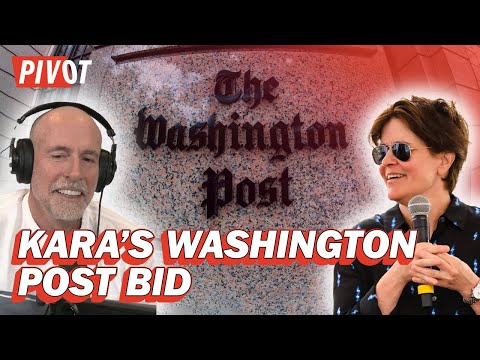
Kara Swisher Explains Plan to Buy The Washington Post | Pivot
Kara Swisher (host), Scott Galloway (host)
In this episode of Pivot, featuring Kara Swisher and Scott Galloway, Kara Swisher Explains Plan to Buy The Washington Post | Pivot explores kara Swisher Plots Transparent, Public Bid to Transform Washington Post Kara Swisher and Scott Galloway debate Swisher’s very real effort to assemble a group to buy The Washington Post from Jeff Bezos, despite no indication yet that Bezos wants to sell.
Kara Swisher Plots Transparent, Public Bid to Transform Washington Post
Kara Swisher and Scott Galloway debate Swisher’s very real effort to assemble a group to buy The Washington Post from Jeff Bezos, despite no indication yet that Bezos wants to sell.
Galloway argues serious bids are done quietly, via trusts that insulate owners from newsroom politics, while Swisher insists on a radically transparent, public approach that challenges backroom, male-dominated dealmaking.
Swisher outlines a vision of opening up the Post’s operations, turning its financial and editorial struggles into a public narrative—possibly even a docu-series—while preserving it as a critical democratic institution alongside outlets like The New York Times and Wall Street Journal.
The conversation also touches on newsroom culture, billionaire ownership, governance structures, and Swisher’s emotional and professional connection to the Post as she frames this bid as both an intellectual puzzle and a quasi-noble mission.
Key Takeaways
Any credible bid must address Bezos directly and offer him protection.
Galloway stresses that a serious acquisition would start with quiet, direct talks with Jeff Bezos, proposing structures (like trusts or shared ownership) that reduce his political grief and give him plausible deniability.
Get the full analysis with uListen AI
Swisher believes radical transparency can be a strategic advantage in media ownership.
She argues for broadcasting internal meetings, openly sharing losses and decisions, and making the Post’s reinvention a public narrative, breaking from the opaque, elite-driven tradition of media deals.
Get the full analysis with uListen AI
Legacy news outlets may be better held in trusts than as pure businesses.
Galloway suggests institutions like the Post and New York Times should be owned by mission-driven trusts that hire leadership and then “stay out of it,” reflecting their public-good role over profit maximization.
Get the full analysis with uListen AI
There is growing concern about concentration of serious national journalism.
Swisher emphasizes that it’s dangerous if The New York Times effectively stands alone, with uncertainty around the Wall Street Journal’s future and instability at other major outlets, making the Post’s health strategically important.
Get the full analysis with uListen AI
New storytelling formats could help revive interest in newsroom institutions.
Swisher floats ideas like an HBO-style series that follows a season in the life of the Post, akin to “Drive to Survive,” using narrative storytelling to reengage broader audiences with the drama and stakes of journalism.
Get the full analysis with uListen AI
Publicly challenging norms is part of Swisher’s strategy, not a side effect.
She explicitly rejects “quiet little deals that largely white men make,” arguing that forcing a public conversation about ownership and governance is itself a way to reshape how power in media is exercised.
Get the full analysis with uListen AI
Emotional ties and identity can drive high-risk media plays.
Swisher acknowledges a personal, emotional connection to the Post and frames the effort as both fun and ‘slightly noble,’ showing how legacy, identity, and mission can motivate bids that are not purely financial.
Get the full analysis with uListen AI
Notable Quotes
“At the end of the day, these are institutions that should be owned by trusts and they should have a trust that basically hires the right guy or gal to run the thing and they just stay the fuck out of it.”
— Scott Galloway
“I am so sick of these quiet little deals that largely white men make with others. So I’m doing it a different way.”
— Kara Swisher
“If I ran this thing, everything would be transparent. I’d broadcast the fucking meeting. What’s the secret here? It’s losing money.”
— Kara Swisher
“You are not gonna get this thing shit-posting the current CEO.”
— Scott Galloway
“Let me just tell you, this is my breath work and I’m gonna fucking do it… I predict in 2025, I will meet with Jeff Bezos or my name isn’t Kara Swisher.”
— Kara Swisher
Questions Answered in This Episode
How realistic is Swisher’s transparent, public approach to buying a major media institution in an industry built on private negotiations?
Kara Swisher and Scott Galloway debate Swisher’s very real effort to assemble a group to buy The Washington Post from Jeff Bezos, despite no indication yet that Bezos wants to sell.
Get the full analysis with uListen AI
What specific trust or governance structures could protect journalistic independence while still satisfying billionaire owners like Bezos?
Galloway argues serious bids are done quietly, via trusts that insulate owners from newsroom politics, while Swisher insists on a radically transparent, public approach that challenges backroom, male-dominated dealmaking.
Get the full analysis with uListen AI
Could turning a newsroom’s internal struggles into a serialized documentary meaningfully grow audience trust, or would it risk trivializing the work?
Swisher outlines a vision of opening up the Post’s operations, turning its financial and editorial struggles into a public narrative—possibly even a docu-series—while preserving it as a critical democratic institution alongside outlets like The New York Times and Wall Street Journal.
Get the full analysis with uListen AI
In an era of digital platforms and social media, how essential is it to preserve legacy brands like The Washington Post rather than building new ones from scratch?
The conversation also touches on newsroom culture, billionaire ownership, governance structures, and Swisher’s emotional and professional connection to the Post as she frames this bid as both an intellectual puzzle and a quasi-noble mission.
Get the full analysis with uListen AI
What are the ethical implications of billionaires owning key democratic institutions, even if they operate through hands-off trusts and public-facing transparency?
Get the full analysis with uListen AI
Transcript Preview
... the cartoonist of the Washington Post has quit after a cartoon depicting, uh, billionaires, including Jeff Bezos, kneeling before President-elect Donald Trump, was blocked from publication. Ann, uh, Telnaes, I think that's how you pronounce it, uh, published a sketch of the cartoon, uh, on Subsca- Substack, saying it was the first time a work had been rejected because of who it depicted. Uh, she's a Pulitzer Prize winner, by the way. Amazing cartoonist. The Washington Post editorial page editor, David Shipley, said the cartoon was rejected because of its similarity to columns at the paper rather than the subject, although he managed to publish many similar columns over and over again. This is, it's nonsense what David Shipley said, and now I can say it very explicitly 'cause Amanda quit the Washington Post. Uh, he is really, uh, uh, this, this was nonsense what he was, his excuse. Um, in other related news, uh, Amazon's announced that it will release a behind-the-scenes documentary on Melania Trump by Brett Ratner, who was sucked up into the Me Too stuff rather egregiously. He seems to be a really, um, problematic person. Uh, and, uh, uh, and there's, uh, the New York Times did some really astonishing coverage on his behavior. Uh, so that was nice. Um, uh, what do you think, Scott? You wanna buy the Washington Post with me?
This is such peacocking.
Yeah.
First off-
I didn't invite you.
... if I'm gonna spend a lot of money to be put in pain, uh, he or she better be wearing-
Yeah.
... leather and be hot. I just-
(laughs)
(laughs) What, what are you do- uh, I, uh, anyways. No, I'm not crazy. I, I, that is literally-
Okay. All right. Good.
... I would, I think I told you when I had an experience-
I'm waiting to hear your feedback.
Well, no. I have-
But go ahead.
I braised s- back in the heyday of hedge funds, I convinced a hedge fund manager to give me $600 million to become the largest, uh, shareholder in the New York Times, and I learned a decent amount about newsrooms and, and the collision between shareholder governance and journalism and newsrooms, and I quickly learned, or I got a very expensive lesson, these are important institutions. I even wonder at some point-
Right.
... if they should have some sort of tax benefit 'cause I think they do a really important, they do really important work.
I agree.
But at the end of the day, these are institutions that should be owned by trusts and they should have a trust, uh, that basically hires the right guy or gal to run the thing and they just stay the fuck out of it.
Maybe I have that idea. Maybe I'm not doing it your way. God damn.
Well, I know, but what I would argue ... So just, just to bring in the viewers, uh, just to ring the listeners up, there's been a lot of rumors that you're assembling a group to make a bid for-
Install uListen to search the full transcript and get AI-powered insights
Get Full TranscriptGet more from every podcast
AI summaries, searchable transcripts, and fact-checking. Free forever.
Add to Chrome