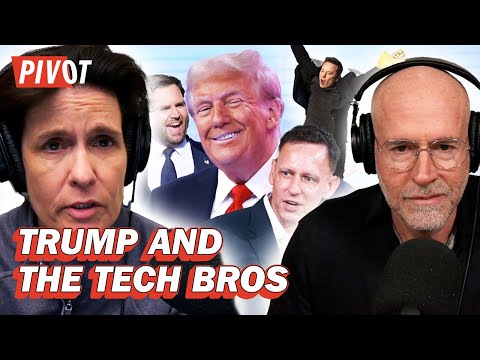
Elon Musk, Peter Thiel, and the Political Calculus of a Trump Victory | Pivot
Kara Swisher (host), Scott Galloway (host)
In this episode of Pivot, featuring Kara Swisher and Scott Galloway, Elon Musk, Peter Thiel, and the Political Calculus of a Trump Victory | Pivot explores musk’s Election Gambit, Thiel’s Quiet Power, And Broken Deterrence Math Kara Swisher and Scott Galloway dissect Elon Musk’s million‑dollar swing‑voter prize and whether it skirts or violates U.S. election law, arguing Musk is exploiting weak enforcement and minimal personal risk. They broaden this into a critique of the “algebra of deterrence,” claiming that in areas like tech regulation, taxation, and campaign law, penalties are too small and too slow to shape behavior of powerful actors. The conversation then shifts to the political calculus of a Trump victory, highlighting Peter Thiel’s behind‑the‑scenes influence, especially through J.D. Vance, and the growing risk of an autocratic turn. Both hosts conclude that Musk is a noisy distraction, while Thiel’s quiet, strategic power over a potential President or Vice President Vance poses the deeper long‑term threat.
Musk’s Election Gambit, Thiel’s Quiet Power, And Broken Deterrence Math
Kara Swisher and Scott Galloway dissect Elon Musk’s million‑dollar swing‑voter prize and whether it skirts or violates U.S. election law, arguing Musk is exploiting weak enforcement and minimal personal risk. They broaden this into a critique of the “algebra of deterrence,” claiming that in areas like tech regulation, taxation, and campaign law, penalties are too small and too slow to shape behavior of powerful actors. The conversation then shifts to the political calculus of a Trump victory, highlighting Peter Thiel’s behind‑the‑scenes influence, especially through J.D. Vance, and the growing risk of an autocratic turn. Both hosts conclude that Musk is a noisy distraction, while Thiel’s quiet, strategic power over a potential President or Vice President Vance poses the deeper long‑term threat.
Key Takeaways
Current election laws don’t effectively deter high‑profile actors from risky or possibly illegal tactics.
Because enforcement is slow, penalties are mostly financial, and officeholders keep their power even after violations, it’s rational for someone like Musk to push boundaries with voter‑targeted schemes.
Get the full analysis with uListen AI
The “algebra of deterrence” is broken for powerful corporations and ultra‑wealthy individuals.
When the expected cost of being caught (likelihood × penalty) is far lower than the upside, firms like Meta or rich taxpayers can rationally choose to keep breaking or bending the rules.
Get the full analysis with uListen AI
Underfunded regulators and agencies enable systematic rule‑breaking in tech and taxation.
Swisher and Galloway argue that historically weak IRS funding and lax enforcement of consent decrees have created strong incentives for aggressive tax strategies and harmful platform practices.
Get the full analysis with uListen AI
Autocrats create asymmetric incentives that push elites to support them preemptively.
If a democratic candidate wins, they’re unlikely to use the state for personal revenge, but an autocratic‑leaning leader openly promises retribution, making it safer for business elites to be on his side early.
Get the full analysis with uListen AI
Elon Musk may be less dangerous than the quieter, more disciplined Peter Thiel.
The hosts portray Musk as a loud, impulsive “circus” figure and Thiel as a “quiet and deadly” strategist who could effectively control a President or Vice President J. ...
Get the full analysis with uListen AI
J.D. Vance’s rise illustrates how moneyed backers can place loyalists near the presidency.
They stress that Vance’s proximity to power owes less to merit and more to Thiel’s financial support, raising alarms about a single donor’s potential de facto control over executive decisions.
Get the full analysis with uListen AI
Democratic institutions weren’t designed for actors who are shameless about violating norms.
Swisher argues that existing laws assumed a basic level of shame and respect for norms; figures like Trump and Musk exploit this gap, using the system’s reluctance to criminalize political behavior.
Get the full analysis with uListen AI
Notable Quotes
“All of our election laws are the following: lie, cheat, break the law, get in office, and then it'll be embarrassing, and the Election Commission will fine you, and they'll shame your campaign manager, and you're still the fucking senator.”
— Scott Galloway
“Our laws, especially election laws, do not anticipate shameless fucks.”
— Kara Swisher
“There’s two reasons that Senator Vance could be a heartbeat from presidency... The first is Peter. The second is Thiel.”
— Scott Galloway
“Peter Thiel is quiet and deadly. Elon Musk is loud and he just reminds me of some of these oligarchs that ended up not, not living.”
— Kara Swisher
“There is no… something Peter Thiel will never hear from a vice president or potentially a President Vance, something he will never hear is no. Ever.”
— Scott Galloway
Questions Answered in This Episode
How could election and campaign finance laws be redesigned to meaningfully deter billionaires from testing or breaking legal limits?
Kara Swisher and Scott Galloway dissect Elon Musk’s million‑dollar swing‑voter prize and whether it skirts or violates U. ...
Get the full analysis with uListen AI
What specific regulatory or enforcement changes would fix the ‘algebra of deterrence’ for tech platforms and ultra‑wealthy taxpayers?
Get the full analysis with uListen AI
To what extent can a single major donor like Peter Thiel realistically influence or control a vice president or president in practice?
Get the full analysis with uListen AI
Are existing democratic checks and balances sufficient against a coordinated network of wealthy backers and norm‑breaking politicians, or do they need structural reform?
Get the full analysis with uListen AI
How should voters and regulators distinguish between noisy, attention‑seeking power (like Musk’s) and quiet, strategic influence (like Thiel’s) when assessing political risk?
Get the full analysis with uListen AI
Transcript Preview
Elon is, uh, randomly awarding a million-dollar daily prize to registered swing voters who sign his PAC's petition supporting the First and Second Amendments. Federal law says it's a crime to pay people with the intention of inducing a reward and be... cast a vote or get registered, but election law experts are split over whether his actions cross the line. See, I think this is just risk assessment by Elon. Now, they're not gonna come after him, and if Trump wins, it won't matter. Uh, h- his allies argue 'cause he's not directly paying for registration, but for a petition signature, it's not illegal. It's very typical of him. This is a very typical risk he would take easily, including attacking Dominion Systems, which I think is probably not a great wis- risk to necessarily take. But go ahead. Finish what you were saying about him.
It all comes down to incentives and the algebra of deterrence. The whole point of our criminal justice system is that criminals do the math, or when you're about to commit a crime, you do a math, and it's the following: the likelihood on caught times the potential penalty has to be greater than the potential upside.
Mm-hmm.
In certain key sectors and com- components of our economic system, the algebra of deterrence is all fucked up, and I'll give you a couple of very... three stark examples. If I'm, if I'm Meta and I know... I h- I sit on top of research that is showing that there is a direct correlation between usage of my platform and teen depression and self-cutting, and I continue to engage in this, or I violate my consent decree and I knowingly violate my consent decree, I know that the likelihood I get caught, the delay and the size of the fine are vastly smaller-
Yeah, far too significant.
... than the upside of continuing to break the law.
Yeah.
In taxation, all really wealthy people have an incentive to be so fucking aggressive with their taxes because their taxes are so complicated. And the IRS has been, till Biden, so underfunded that the likelihood you'll get caught and the penalty are vastly overwhelmed by the amount of money you're going to save.
They can come get you in way bigger-
Yeah, by being incredibly aggressive on your taxes. And now let's go to Musk. Who gives a shit if it's illegal? They're not gonna, they're not gonna put him in jail. They're not gonna say to Trump, "You're no..." The, the... All of our election laws are the following: lie, cheat, break the law, get in office, and then it'll be embarrassing, and the Election Commission will fine you, and they'll shame your election, your campaign manager, and you're still the fucking senator. So the, the incentives, until they say... until there's some sort of com- uh, real risk that they can shut down, for example, all your media spending, if they say, "Okay, if, if this guy engages in this, he could go to jail," or the campaign has to stop all media spending, like, you could get an injunction if it's really blatant, what incentive is there for Musk not to do this?
Install uListen to search the full transcript and get AI-powered insights
Get Full TranscriptGet more from every podcast
AI summaries, searchable transcripts, and fact-checking. Free forever.
Add to Chrome