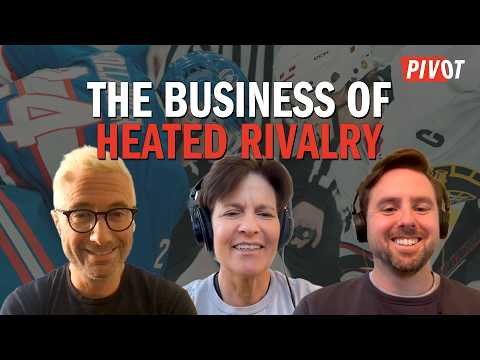
Heated Rivalry Producers: How We Made a Hit
Kara Swisher (host), Brendan Brady (guest), Jacob Tierney (guest), Jacob Tierney (guest)
In this episode of Pivot, featuring Kara Swisher and Brendan Brady, Heated Rivalry Producers: How We Made a Hit explores how Heated Rivalry became a hit via Canada’s producer-led system Jacob Tierney and Brendan Brady describe “Heated Rivalry” as a rare mainstream example of “queer joy” that avoids the typical trauma-first framing, which they argue is a major reason it resonated so widely.
How Heated Rivalry became a hit via Canada’s producer-led system
Jacob Tierney and Brendan Brady describe “Heated Rivalry” as a rare mainstream example of “queer joy” that avoids the typical trauma-first framing, which they argue is a major reason it resonated so widely.
They break down the Canadian financing model (license fee + provincial/federal tax credits + distribution advance), emphasizing a key tradeoff: less money up front, but producers retain underlying IP and long-term upside.
Production choices—six episodes written before prep, block-shooting all episodes like a feature, 36 shooting days, and shorter shoot days—kept costs low while protecting crew health and performance quality.
They discuss industry dynamics shaping entertainment: executive “notes” culture, second-screen viewing pressures, consolidation/competition concerns, and where AI could help (operations) without replacing creative collaboration and “friction.”
Key Takeaways
Queer romance succeeded by centering joy, not pain.
Tierney argues the show’s “soft power” is presenting queer love as expansive, pleasurable, and emotionally fulfilling without turning it into a lesson or punishment narrative—especially rare for stories about men.
Get the full analysis with uListen AI
The built-in audience was romance—and it’s largely female.
They credit the show’s breakout to a massive romance readership that is often dismissed due to misogyny; the adaptation “took seriously” women’s desire and the genre’s scale.
Get the full analysis with uListen AI
Canada’s system trades upfront cash for ownership and longevity.
A Canadian broadcaster typically covers ~20–30% via license fee, tax credits add ~20–30%, and producers raise the remainder—yet producers keep IP, enabling long-term upside (merchandise, future seasons, back-end returns).
Get the full analysis with uListen AI
They bet on themselves by reinvesting producer fees to close financing.
To finish the last portion of the budget, Tierney and Brady put in most of their producer fees—framing it as a calculated gamble because IP retention means a hit can pay out for decades.
Get the full analysis with uListen AI
Operational discipline can substitute for budget—if you design for it.
They shot six episodes in 36 days, block-shot as one movie, and entered prep with all scripts completed; this reduces costly rewrites, overtime, and inefficiencies common in some U. ...
Get the full analysis with uListen AI
Shorter days are both a cost strategy and an equity strategy.
They aimed for ~10-hour days to avoid overtime-driven budget ballooning and to reduce burnout—highlighting how pre-call-heavy departments (often staffed/led by women, e. ...
Get the full analysis with uListen AI
AI’s near-term value is administrative—not creative replacement.
Brady sees immediate benefits in scheduling, budgeting, and prep (data-heavy tasks), while both emphasize that creative “friction” and human alignment are difficult to replicate with AI and remain central to good work.
Get the full analysis with uListen AI
Notable Quotes
““Just present queer joy… that’s its soft power.””
— Jacob Tierney
““We don’t take female desire and stories seriously in media a lot of the times.””
— Brendan Brady
““We are the studio… in this system.””
— Jacob Tierney
““We shot all six episodes in 36 days… block shot them like one giant movie.””
— Brendan Brady
““It’s a rejection of an idea that everything has to come from one person… It’s very top-down.””
— Jacob Tierney
Questions Answered in This Episode
Can you give a concrete example of the “female entry point” note—who gave it, and how close did it get to changing the show?
Jacob Tierney and Brendan Brady describe “Heated Rivalry” as a rare mainstream example of “queer joy” that avoids the typical trauma-first framing, which they argue is a major reason it resonated so widely.
Get the full analysis with uListen AI
You cite ~3M CAD per episode: what were the top three cost drivers (cast, locations, hockey, intimacy coordination, post/VFX/music)?
They break down the Canadian financing model (license fee + provincial/federal tax credits + distribution advance), emphasizing a key tradeoff: less money up front, but producers retain underlying IP and long-term upside.
Get the full analysis with uListen AI
How did retaining underlying IP shape the HBO/Sky deal structure—what did you keep vs license, and what does the option for Season 2 actually cover?
Production choices—six episodes written before prep, block-shooting all episodes like a feature, 36 shooting days, and shorter shoot days—kept costs low while protecting crew health and performance quality.
Get the full analysis with uListen AI
What specific on-set practices enabled 10-hour days (shot lists, coverage philosophy, fewer takes, rehearsals, blocking choices)?
They discuss industry dynamics shaping entertainment: executive “notes” culture, second-screen viewing pressures, consolidation/competition concerns, and where AI could help (operations) without replacing creative collaboration and “friction.”
Get the full analysis with uListen AI
Tierney calls his approach “anti-fascist”: what are the decision rules for when you overrule collaborators vs defer to them?
Get the full analysis with uListen AI
Transcript Preview
[upbeat music] Hi, everyone. This is Pivot from New York Magazine and the Vox Media Podcast Network. I'm Kara Swisher. Today, we've got a special bonus episode, and it's not about anything terrifying or depressing. It's about the most addictive, delightful, surprise cultural phenomena of the decade, Heated Rivalry. Uh, I'm joined today by the show's creator, Jacob Tierney, and executive producer, Brendan Brady. Uh, welcome, you two.
Thank you.
You guys are a hoot already. I already-
Thanks, Kara.
We've been beset by some tech issues, but nonetheless, the gays will prevail.
[laughing]
Um, the success of the show is about so many things: queer joy, uh, uh, sex, inclusion. It's an amazing business story, and that's really what I wanted to talk about. Um, but first for the fans, are we getting a standalone episode before Season 2?
[laughing] Um, I love saying now... This is Brendan. So, uh, uh, I would say that, like, much like the best parts of this show, just enjoy the yearn.
[laughing] Enjoy the yearn? Is that on your T-shirts?
Uh, it could be.
Oh, no, soon. Trademark, trademark. We've trademarked it.
[laughing] Yeah, okay, because that means no. That's a no.
[laughing] That's-
We'll see.
Here, this is Jacob speaking now. Uh, that's a... Here's the, here's the truth, and that nobody actually wants to hear, is that we, we just don't know yet. We are... You know, we, we actually only finished this show a, basically a week before Episode 6 aired, and so this has been a, a, a massive, uh, surprise and endea- [laughing] and endeavor, and we didn't really have a moment to catch our breaths before answering questions like this. So the truth is, we're, we're getting a plan in place. We will have more information for folks soon. Uh, we understand that there's an appetite for a lot of this, and we're just trying to figure out what we can a- physically accomplish i- in, in the next year.
In the next year.
Yeah.
So one thing, this show has been a giant PR boost for the entire, your entire country. Here's Prime Minister Mark Carney at a recent media event. You had to... Speaking of feel the yearn, but go ahead.
The world knows that Shane and Ilya are rising hockey stars who fall for each other as they face off in one of the greatest rivalries the game has ever known. But they're also two young men who are terrified of being their fullest self, and we live in an increasingly dangerous, divided, and intolerant world. [applauding] A fundamental Canadian value is that people should be able to be whoever they want to be, to love whoever they want to love.
So, uh, the narrative has become that it was a little show out of Canada, obviously made in Canada, 'cause American distributors were afraid of the sex content. Why don't you start, Jacob? Uh, the reaction, first of all, and the kind of w- what you think is happening here, from... I mean, I'm sure you've answered this question, but he, he sort of articulates it rather well, is that people are, are upset and divided, and this brings a respite. But I think it's more than that, in my, in my opinion. But why don't you start, Jacob, and then you, Brendan?
Install uListen to search the full transcript and get AI-powered insights
Get Full TranscriptGet more from every podcast
AI summaries, searchable transcripts, and fact-checking. Free forever.
Add to Chrome