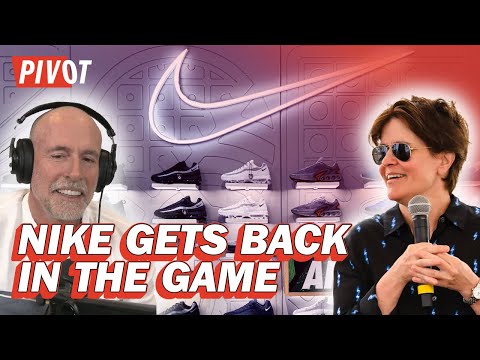
Can Nike Gets Its "Cool Factor" Back? | Pivot
Kara Swisher (host), Scott Galloway (host)
In this episode of Pivot, featuring Kara Swisher and Scott Galloway, Can Nike Gets Its "Cool Factor" Back? | Pivot explores nike Bets On Insider CEO To Regain Cool, Innovation, And Growth The discussion examines Nike’s CEO transition from John Donahoe to longtime insider Elliot Hill, and how the market has positively responded to the change. Scott Galloway outlines how Nike’s heavy pivot to direct-to-consumer, misread of post-pandemic retail, and underwhelming product innovation eroded market share and its cultural ‘cool factor.’
Nike Bets On Insider CEO To Regain Cool, Innovation, And Growth
The discussion examines Nike’s CEO transition from John Donahoe to longtime insider Elliot Hill, and how the market has positively responded to the change. Scott Galloway outlines how Nike’s heavy pivot to direct-to-consumer, misread of post-pandemic retail, and underwhelming product innovation eroded market share and its cultural ‘cool factor.’
They explore intensifying competition from brands like Adidas, Hoka, On, New Balance, and Uniqlo, alongside structural challenges such as the ‘China chill’ and shifting youth attention from broadcast advertising to social media and influencers.
Despite missteps, both hosts view Nike’s brand equity, distribution, and sports dominance as powerful assets, suggesting the company remains fundamentally strong but must re-energize product, speed to market, and retailer relationships under Hill’s leadership.
Key Takeaways
Rebalance direct-to-consumer with strong retail partnerships.
Nike’s aggressive DTC push, at the expense of supporting third-party retailers, backfired when physical retail rebounded faster than expected post-pandemic; companies should diversify channels rather than overbetting on one model.
Get the full analysis with uListen AI
Make product innovation the core growth engine again.
Competitors like Hoka, On, and Adidas have out-merchandised Nike with fresher designs and vintage revivals; Nike must accelerate product development cycles, emphasize performance and design, and get faster from concept to market.
Get the full analysis with uListen AI
Evolve marketing from broadcast dominance to social-native relevance.
Nike built its brand through iconic TV campaigns, but today’s 17-year-old discovers brands via TikTok, Instagram, influencers, and creators; marketing strategies need to pivot toward long-tail, social-first storytelling while leveraging sport.
Get the full analysis with uListen AI
Use insider leadership to restore morale and brand authenticity.
Elliot Hill, a lifelong ‘product guy’ who rose from intern to executive, is seen as highly respected and culturally aligned with Nike’s roots, which can help reset internal morale and re-center the company on what it historically did best.
Get the full analysis with uListen AI
Continuously protect the ‘cool factor’ across age groups.
When a brand becomes ubiquitous among older demographics without parallel traction among youth, it risks losing cultural cachet; Nike must reconnect with young consumers’ tastes to stay aspirational rather than just ubiquitous.
Get the full analysis with uListen AI
Factor geopolitical and regional risk into growth assumptions.
The ‘China chill’ has hurt Nike and peers, illustrating that dependence on key regions introduces volatility; diversified geographic growth strategies and scenario planning are essential.
Get the full analysis with uListen AI
Recognize that fashion cycles can flip the competitive hierarchy.
Brands like New Balance, once considered unfashionable, have resurged with younger consumers, underscoring how sneaker and apparel markets behave like fashion—taste shifts can quickly re-rank leaders and laggards.
Get the full analysis with uListen AI
Notable Quotes
“I think of Nike as intrinsic to an American ideal of individual performance, and running so hard you throw up.”
— Scott Galloway
“Their enormous bet on direct to consumer, at the cost of managing and supporting their third-party retail, backfired on them.”
— Scott Galloway
“To unseat Nike, it's a mistake on Nike's part, not to continue to be cool.”
— Kara Swisher
“Nike's weapon for fighting their wars was broadcast. They were the best broadcast advertiser in history.”
— Scott Galloway
“Well, that's the problem with the brand, Kara. I mean, no offense, but when 62-year-old podcasters [are] wearing Nike, that means it's all over.”
— Scott Galloway
Questions Answered in This Episode
What specific product categories should Elliot Hill prioritize to quickly restore Nike’s innovation edge and cool factor?
The discussion examines Nike’s CEO transition from John Donahoe to longtime insider Elliot Hill, and how the market has positively responded to the change. ...
Get the full analysis with uListen AI
How can Nike best rebuild and modernize relationships with third-party retailers without undermining its direct-to-consumer business?
They explore intensifying competition from brands like Adidas, Hoka, On, New Balance, and Uniqlo, alongside structural challenges such as the ‘China chill’ and shifting youth attention from broadcast advertising to social media and influencers.
Get the full analysis with uListen AI
What would a truly social-first, Gen Z–oriented marketing playbook look like for a legacy brand like Nike?
Despite missteps, both hosts view Nike’s brand equity, distribution, and sports dominance as powerful assets, suggesting the company remains fundamentally strong but must re-energize product, speed to market, and retailer relationships under Hill’s leadership.
Get the full analysis with uListen AI
How vulnerable is Nike to further geopolitical and regional shifts, and what diversification strategies could mitigate that risk?
Get the full analysis with uListen AI
In a market acting more like fashion, how can Nike systematically anticipate or shape the next big style and performance trends rather than reacting late?
Get the full analysis with uListen AI
Transcript Preview
Nike stock is surging following the news late last week that CEO John Donahoe is stepping down. Donahoe's four-year tenure was a rocky one, with Nike losing market share, breaking off relations with key retailers, and, according to some critics, losing its cool factor. Elliot Hill, a Nike veteran, is coming out of retirement, who you apparently know, Scott Galloway, to being the new CEO. You had talked about Nike's woes back in July. You predicted that Donahoe had 12 months to figure it out or he'd be removed. That's a lot, uh, sooner. (laughs) Uh, what do you... Uh, r- Nike shares rose 8% in after-hours trading on Thursday following the news. You also predicted that an activist investor was gonna come in and make some moves. Um, Bill Ackman's Pershing Square, uh, pursed it, purchased three million shares of Nike back in the second quarter, according to recent filings. Um, what do you think? Let me, let me hear your thoughts on him. Elliot Hill, he's a career Nike man. Um, started as an intern.
Nike was one of my biggest clients at L2, and I love this company. I mean, it's super smart people. I love the brand. I love the unapologist, the unapologetic brand positioning of, "You didn't win silver, you lost gold." I think of Nike as intrinsic to an American ideal of individual performance, and running so hard you throw up. I just, I just (laughs) love the, I love the brand. They've done an amazing job. Now, bringing in a guy who didn't have a background in merchandising, didn't have a background in apparel, didn't have a background in sports, he was basically a consultant, very impressive guy, and then ran a tech platform, was a decision for them to go all-in on tech. And I wanna be clear, I would have made the same decision, and I basically advocated when I was working with Nike for them to go more direct to consumer. What they weren't expecting and I wouldn't have predicted, and it's easy to Monday morning quarterback, so let me say, I would have gotten this wrong, is that retail came surging back much faster post-pandemic than people had expected. And their enormous bet on direct to consumer, at the cost of managing and supporting their third-party retail, backfired on them. In addition, we talked about this, the China chill has affected, infected a lot of these companies, uh, including Nike. And then what people will say that he has to take responsibility for is their product development hasn't been nearly as innovative as Adidas with their vintage line, or Hoka, or... Spun it to Hoka, or On Running, that they've basically been out-merchandised. This guy, I didn't spend a lot of time with him, but he's hugely respected, and it just feels like the right move from a morale standpoint. He's a product guy. He just, he kind of, he's outta central casting. He's one of these guys when I was in meeting with him, he was just sort of would... Was a great listener, and then when he spoke, everybody sort of waited to hear what this guy would say. So, I think it's great they brought back somebody from Nike, a Nike alumni. But the Nike brand and the relationships they have, and the resonance they have, and the distribution, I mean, you just do not wanna bet against this company. I think it's a-
Install uListen to search the full transcript and get AI-powered insights
Get Full TranscriptGet more from every podcast
AI summaries, searchable transcripts, and fact-checking. Free forever.
Add to Chrome