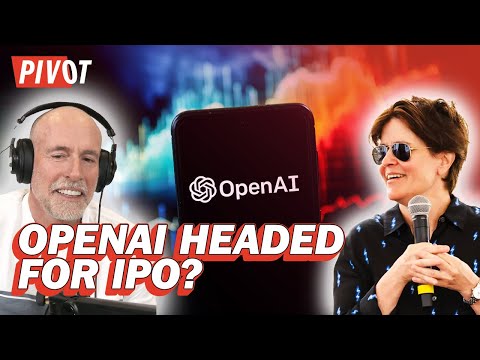
What Do OpenAI's Latest Moves Reveal About a Future IPO? | Pivot
Kara Swisher (host), Scott Galloway (host)
In this episode of Pivot, featuring Kara Swisher and Scott Galloway, What Do OpenAI's Latest Moves Reveal About a Future IPO? | Pivot explores openAI’s New NSA Board Member Signals Security Focus, IPO Ambitions The discussion centers on OpenAI’s appointment of retired NSA Director General Paul Nakasone to its board and a new safety and security committee, sparking backlash from figures like Edward Snowden and parts of the political left and right.
OpenAI’s New NSA Board Member Signals Security Focus, IPO Ambitions
The discussion centers on OpenAI’s appointment of retired NSA Director General Paul Nakasone to its board and a new safety and security committee, sparking backlash from figures like Edward Snowden and parts of the political left and right.
Kara Swisher and Scott Galloway largely praise the move, arguing that serious national security expertise is vital for AI companies and that suspicion of all security officials undermines institutions.
They then shift to OpenAI’s apparent plans to move from a nonprofit-controlled structure to a for‑profit (likely benefit corporation) model, positioning itself for an eventual IPO.
With rapidly growing revenues, aggressive partnerships (including in healthcare), and a seasoned CFO hire, they argue OpenAI is “running away with it” alongside NVIDIA and clearly dressing itself for the public markets.
Key Takeaways
Bringing in high-level national security expertise is a strategic move for AI governance.
Appointing General Nakasone equips OpenAI with seasoned cyber and national security insight, ensuring someone at the table can flag products or directions that pose genuine security threats.
Get the full analysis with uListen AI
Reflexive distrust of security officials can erode necessary institutions.
While abuses demand strong oversight, the hosts argue that assuming every NSA leader acts in bad faith undermines institutions needed to maintain peace and security.
Get the full analysis with uListen AI
Balanced board composition is crucial for responsible AI oversight.
They suggest pairing security-focused figures like Nakasone with directors who actively challenge government overreach, creating constructive tension rather than ideological deadlock.
Get the full analysis with uListen AI
OpenAI is clearly preparing to shift toward a more conventional for-profit model.
Altman’s comments about changing governance, and exploring a benefit corporation structure like Anthropic or xAI, indicate a move away from nonprofit board control to unlock more traditional capital and strategic options.
Get the full analysis with uListen AI
A public offering for OpenAI looks increasingly likely.
The hiring of veteran CFO Sarah Friar—experienced with IPOs at Square (Block) and Nextdoor—is read as a classic “dress for Wall Street” signal ahead of an eventual IPO.
Get the full analysis with uListen AI
OpenAI is outpacing many competitors on both revenue and partnerships.
With a reported $3. ...
Get the full analysis with uListen AI
OpenAI aims to be the ‘Google’ of this AI wave, not the ‘Netscape.’
By moving aggressively on products, partnerships, and capital markets, the company is trying to consolidate its lead rather than let others capitalize on its early innovations.
Get the full analysis with uListen AI
Notable Quotes
“Peace is not a natural right. It is earned, and it is not the natural order.”
— Scott Galloway
“The NSA does an amazing job keeping Americans safe, and it’s important that we have laws that keep them in check.”
— Scott Galloway
“Assuming every NSA chief has malintent is the way to bring down all institutions.”
— Kara Swisher
“They are clearly, clearly putting on their best dress for an IPO.”
— Scott Galloway
“They’ve decided to be Google and not Netscape.”
— Kara Swisher
Questions Answered in This Episode
How should AI companies balance incorporating national security expertise with protecting civil liberties and user privacy?
The discussion centers on OpenAI’s appointment of retired NSA Director General Paul Nakasone to its board and a new safety and security committee, sparking backlash from figures like Edward Snowden and parts of the political left and right.
Get the full analysis with uListen AI
What governance structures can realistically prevent both government overreach and corporate abuse in powerful AI systems?
Kara Swisher and Scott Galloway largely praise the move, arguing that serious national security expertise is vital for AI companies and that suspicion of all security officials undermines institutions.
Get the full analysis with uListen AI
If OpenAI becomes a for-profit benefit corporation, how might that change its mission, incentives, and relationship to its original nonprofit charter?
They then shift to OpenAI’s apparent plans to move from a nonprofit-controlled structure to a for‑profit (likely benefit corporation) model, positioning itself for an eventual IPO.
Get the full analysis with uListen AI
In what ways might an OpenAI IPO reshape the broader AI competitive landscape and regulatory response?
With rapidly growing revenues, aggressive partnerships (including in healthcare), and a seasoned CFO hire, they argue OpenAI is “running away with it” alongside NVIDIA and clearly dressing itself for the public markets.
Get the full analysis with uListen AI
Is OpenAI’s rapid commercialization and partnership strategy ultimately beneficial for society, or does it risk entrenching a single dominant player in AI?
Get the full analysis with uListen AI
Transcript Preview
OpenAI appears to be addressing recent security concerns with the new addition to its board of directors. The company announced last week that retired General Paul Nakasone, uh, will be joining the board. He's also, uh, sit on a newly formed safety and security committee. Nakasone was director of the NSA, which is causing a lot of, like, the crazy right to go crazy about this and saying it's a deep state, um, and led, uh, including Elon, I think, and led the US military's Cyber Command before stepping down early this year. He's very well regarded, but, uh, again, uh, this is a big appointment. Um, OpenAI said in a statement that this appointment underscores a growing significance of cybersecurity. Uh, what do you think about this, bringing in... uh, Edward Snowden wasn't happy. He posted on- this on social media saying, "Do not ever trust OpenAI or its products. There is only one reason for appointing an NSA director to your board." So, as usual, without proof, Edward. Uh, but, you know, okay, sure, spy is spy. So, uh, but it's one of those open-ended questions that never really has an answer or any proof attached to it. But that's okay, they c- they can do that, so it's a thing. What do you think about that?
I absolutely love it. Um, anyone who's an army general and works their way up as, as someone... You know, (laughs) General Nakasone isn't a, you know... uh, this is a very impressive person, and also, this person has proven themselves a patriot. And for all these weirdos on the far right that think there's a deep state, and for all these weirdos on the far left that are under the assumption that, that peace is a natural right, that it's not something that requires constant vigilance and sacrifice, we need... The NSA does an amazing job keeping Americans safe, and, uh, it's important that we have laws that keep them in check, but at the same time, I, I just, I worry that America has become so naive to this notion that peace is a right. It is not. It is earned, and it is not the natural order. As soon as people can come for our Netflix and espresso folks, they will. And they won't do it by interesting, nice means. They'll be violent about it, just as we are... need to be violent and smart about protecting our borders. So, to have someone like this on the board of OpenAI, to occasionally raise his or her hand and say, "You know what? That is a threat to America, and I am not down with this," I love having this guy on the board of OpenAI. I think it's a wonderful thing.
Yeah. I- it's interesting, because it sort of sets up these deep state, leave us alone, don't tread on me gang. Um, and I mean that in a negative don't tread on me way, the sort of demented don't tread on me. In Edward Snowden's case, I re- I recognize that he did uncover some really heinous behavior by our security officials. That said, the wa- there, there's plenty of argument to be made that, that how he handled it was wrong. But he couldn't have handled it... I, look, we can debate Edward Snowden all you want. I interviewed him once. It's a very complex topic. But, y- the fact... a- assuming every NSA chief is, has malintent is the way to bring down all institutions. Now, they've been abusive enough that there's, that there needs to be strong, um, strong laws and oversight in place. Absolutely. I, if a spy, a spy is gonna spy, that is just the way it goes, right? It's not, there's no other way to put it. And including the Chinese government, they're gonna spy whether you have proof or not. That's what they do. In this case, as many people on the board... Now, I would also put on someone who's, uh, more of a, like, a, sort of an opposite to him could be interesting. So, you have all the different outlooks brought there. And I'm not talking... The problem they had was they had people that were so at cross-purposes, there was no agreement. And I think if they bring in someone who's more, not distrustful of government, but then challenges government o- o- overreach, I think that's fantastic too, right? That's what you kinda want on a board. Um, but this guy has, has really, a very, a very strong reputation. I just... the immediate attacks on him were fascinating to watch in a lot of ways. Speaking of, of OpenAI, they're, uh, further angering all, all the PR crowd. Um, CEO Sam Altman has told some shareholders that the company is considering changing its governance to a pro- for-profit business that the nonprofit board doesn't control, according to the information.
Install uListen to search the full transcript and get AI-powered insights
Get Full TranscriptGet more from every podcast
AI summaries, searchable transcripts, and fact-checking. Free forever.
Add to Chrome