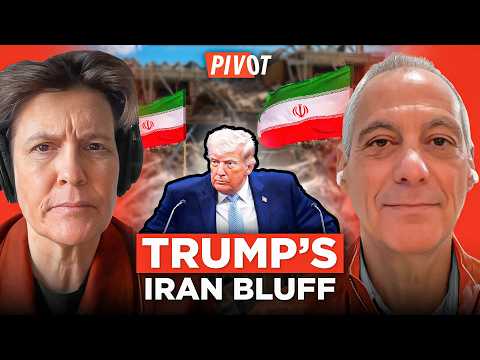
Rahm Emanuel: “Nobody Believes Our President” on Iran | Pivot
Rahm Emanuel (host), Kara Swisher (host)
In this episode of Pivot, featuring Rahm Emanuel and Kara Swisher, Rahm Emanuel: “Nobody Believes Our President” on Iran | Pivot explores rahm Emanuel dissects Trump’s Iran credibility crisis and Democratic strategy Emanuel argues Trump’s Iran threats and ad-hoc diplomacy have shredded the credibility and moral authority of the U.S. presidency in the eyes of allies and adversaries.
Rahm Emanuel dissects Trump’s Iran credibility crisis and Democratic strategy
Emanuel argues Trump’s Iran threats and ad-hoc diplomacy have shredded the credibility and moral authority of the U.S. presidency in the eyes of allies and adversaries.
He criticizes the administration’s national-security process as unserious and overly reliant on military power while economic, political, and cultural tools of influence atrophy.
Emanuel contends Democrats’ special-election swings signal independent-voter movement and Republican turnout depression, but warns Democrats must lead with a future-focused agenda rather than pure anti-Trump investigations.
He proposes a tactical 2027 Democratic legislative strategy: prioritize anti-corruption measures (notably banning officials and families from prediction markets) to split Republicans and force Trump into a politically costly sign-or-veto choice.
On AI, he frames Musk–Altman infighting and withheld “too risky” models as evidence the industry is implicitly begging for real-time oversight, and warns public backlash will grow if AI’s gains concentrate among a few winners.
He labels RFK Jr.’s HHS tenure as destructive and sees the podcast launch as image-washing amid alleged suppression of pro-vaccine evidence, ending on NASA’s Artemis as a unifying symbol of American optimism.
Key Takeaways
U.S. presidential credibility is a strategic asset—and it’s eroding.
Emanuel’s core claim is “nobody believes our president,” arguing that credibility affects deterrence, diplomacy, and ally coordination; once broken, it cannot be quickly “superglued” back together.
Get the full analysis with uListen
War requires stated objectives, a definition of victory, and an exit path.
He criticizes Trump’s rhetoric and process for failing to explain to troops and citizens what success looks like and how the conflict ends—turning force into improvisation rather than strategy.
Get the full analysis with uListen
Treat supply chains and chokepoints as the modern battleground.
He frames the era as defined by chokepoints like the Strait of Hormuz and critical inputs (energy, fertilizer, medical supplies), where small disruptions can halt the global economy.
Get the full analysis with uListen
Match tools to the region; don’t let the military become the entire toolbox.
Emanuel lays out four tools—military, economic statecraft, political persuasion, cultural attraction—and argues Trump has weakened three, leaving the U. ...
Get the full analysis with uListen
A coherent Hormuz plan should span short-, medium-, and long-term moves.
He suggests immediate “all ships or no ships” rules to pressure Iran/China, a UN-administered fee regime to prevent Iranian control, and infrastructure/pipelines via the Abraham Accords to reduce vulnerability.
Get the full analysis with uListen
Democrats should investigate corruption, not chase broad retribution narratives.
He draws a line between anti-corruption oversight (family enrichment, crony capitalism) and investigations that read as partisan payback, which can alienate independents.
Get the full analysis with uListen
Use 2027 legislation to split Republicans and define Democrats’ ‘for’ agenda.
He recommends forcing sign/veto moments that create intra-GOP fractures (echoing 1990 taxes and 2007 CHIP), spotlighting Trump’s self-interest versus public interest.
Get the full analysis with uListen
Prediction markets are a potent wedge issue because voters ‘hate a cheater.’
Emanuel argues a ban on participation by officials, staff, and families would resonate across regions and force Trump to defend perceived insider manipulation—especially if his family benefits.
Get the full analysis with uListen
AI companies withholding products is not a governance model.
He views OpenAI/Anthropic safety pauses as proof industry needs structured, real-time oversight rather than relying on CEO discretion; otherwise public backlash could stall deployments (e. ...
Get the full analysis with uListen
RFK Jr.’s podcast is framed as reputation management amid policy failures.
Emanuel characterizes RFK Jr. ...
Get the full analysis with uListen
Notable Quotes
“Nobody believes our president.”
— Rahm Emanuel
“It’s clear there isn’t a situation room. They’ve moved it into the Oval Office.”
— Rahm Emanuel
“You owe the troops a definition of why… what victory will look like… and here’s how it’s going to end.”
— Rahm Emanuel
“In twenty twenty-four, you didn’t have a choice. Twenty twenty-eight, it’s gonna be Baskin-Robbins, and I plan on being rocky road.”
— Rahm Emanuel
“The tech bros all basically urinating on each other’s leg, but telling you… it’s raining outside.”
— Rahm Emanuel
Questions Answered in This Episode
On Iran: What concrete evidence would you look for to judge whether the ceasefire is real versus a political announcement?
Emanuel argues Trump’s Iran threats and ad-hoc diplomacy have shredded the credibility and moral authority of the U. ...
Get the full analysis with uListen AI
Process critique: If there “isn’t a situation room,” what minimum decision protocol should Congress require before military action or major threats?
He criticizes the administration’s national-security process as unserious and overly reliant on military power while economic, political, and cultural tools of influence atrophy.
Get the full analysis with uListen AI
Hormuz proposal: How would an “all ships or no ships” policy be enforced without escalating into a broader naval conflict?
Emanuel contends Democrats’ special-election swings signal independent-voter movement and Republican turnout depression, but warns Democrats must lead with a future-focused agenda rather than pure anti-Trump investigations.
Get the full analysis with uListen AI
Allies: Which relationship is most damaged right now (NATO, Gulf partners, or Asian allies), and what would ‘earning back’ trust look like in the first 100 days of a new administration?
He proposes a tactical 2027 Democratic legislative strategy: prioritize anti-corruption measures (notably banning officials and families from prediction markets) to split Republicans and force Trump into a politically costly sign-or-veto choice.
Get the full analysis with uListen AI
Democratic strategy: What are the top 3 ‘affirmative agenda’ bills you’d prioritize in 2027 besides the prediction-markets ban?
On AI, he frames Musk–Altman infighting and withheld “too risky” models as evidence the industry is implicitly begging for real-time oversight, and warns public backlash will grow if AI’s gains concentrate among a few winners.
Get the full analysis with uListen AI
Transcript Preview
I would like to say you have dropped the F-bomb three times and I'm at zero.
I'm sor- I know.
Just for the record.
I know, I know. I know. You can do it any time.
Okay. I'm zero.
[upbeat music] Hi, everyone, this is Pivot from New York Magazine and the Vox Media Podcast Network. I'm Kara Swisher. Scott is off still. I don't know where Scott is. He's just off rambling around. Actually, I'm gonna see him tonight at the premiere of my, uh, new series for CNN. Uh, but I brought on another incredible co-host. He's been ambassador to Japan and the mayor of Chicago.
[chuckles]
It seems like he's running for president. It's Rahm Emanuel.
Mm-hmm.
Hey, Rahm. How you doing?
I'm good. How are you?
Good, good. You have been everywhere. What, what's happening?
[laughs]
Try to tell us what's happening, besides lecturing the Democratic Party, which we'll get to in a minute. But what, what-
Yeah
... what are, what are you doing?
Well, I'm, first of all, I'm listening to the American people. I've been out and, uh, talking to them about things like how to make sure they get ahead, their families get ahead on the community college plan. Uh, but also, you know, like a young man I met in Spartanburg who's going to community college, he's got a job waiting at GE for 33 an hour with benefits, and he was unemployed. And what they're doing at that community college is exactly what I wanna see us do everywhere, something similar to what we did in Chicago, something similar to La Crosse. But also, you know, listening to the nurse in Iowa who's talking about that she now spends close to 50% of her time arguing with insurance companies. So, and about how to make sure that people get the healthcare that they're actually, her and the doctor are prescribing.
Mm-hmm. You've been a public figure, but often in the, in the, in the national way, you've been a sort of behind the s- and you've been a congressperson, but h-how do you-- how is it different what you're doing here in terms of running for president? Or trying or thinking-
Well, I mean, I ha-
... about running for president.
Yeah, I mean, that's fair. Look, I mean, I've been a congressman, I've been a mayor of a-
Mm-hmm
... not insignificant city.
So front-facing.
Okay.
Yeah, front-facing.
Yeah. Uh, also chairman of, uh, a leadership in Congress. But that said, I mean, you're evaluating, uh, uh, and one of the things I know about running for office, uh, is you gotta make sure your head, your heart, and your gut are all aligned.
Mm-hmm.
Uh, I lo- I, I'm gonna just say it up fro- I don't need a title. I got more titles, I can auction 'em off. I'm also-- I'm about getting stuff done. Like take something I'm very proud about, you know this because from our many conversations. We raised our graduation rate from 56 to 83%. 98% of our kids had a plan post high school, college, community college, branch of the armed forces, vocational school. I'm not, I'm about getting stuff done, not about getting another title. And do I think I actually understand what it takes to move this country and mo- help the American people get ahead and their kids get ahead? And do I have the fortitude to do that? And so that's what, what I'm looking at. I'm not ti- I don't need, as I said, titles is for other people. Getting crap done is what we did in Chicago. 20,000 kids went to community college for free. Every child had a plan post high school on education. We started pre-K in kindergarten. So I'm into moving stuff and as I like, we like to say in Chicago, taking the garbage out, getting stuff done. And-
Install uListen to search the full transcript and get AI-powered insights
Get Full TranscriptGet more from every podcast
AI summaries, searchable transcripts, and fact-checking. Free forever.
Add to Chrome