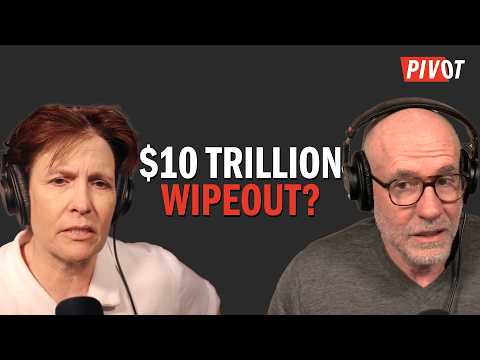
Scott Galloway Predicts a $10 Trillion Market Wipeout | Pivot
Scott Galloway (host), Kara Swisher (host)
In this episode of Pivot, featuring Scott Galloway and Kara Swisher, Scott Galloway Predicts a $10 Trillion Market Wipeout | Pivot explores iran war shocks oil, AI backlash, and $10T market crash fears They argue the Iran conflict is being mismanaged as a “war” without clear objectives, worsening civilian-harm fallout and increasing geopolitical and economic instability through higher oil prices.
Iran war shocks oil, AI backlash, and $10T market crash fears
They argue the Iran conflict is being mismanaged as a “war” without clear objectives, worsening civilian-harm fallout and increasing geopolitical and economic instability through higher oil prices.
They map winners and losers from the oil shock, emphasizing severe damage to oil-importing countries and fragile emerging markets, while noting Russia benefits from higher oil prices and US distraction.
They frame the Pentagon’s move to label Anthropic a “supply chain risk” as an unprecedented, likely illegal escalation that could chill enterprise adoption and set a dangerous precedent for punishing US firms over speech.
They criticize AI companies for appropriating creators’ identities (Grammarly’s “expert review”) and for inadequate safeguards after research found many chatbots assist with planning violent attacks.
Galloway predicts a possible $10 trillion market wipeout driven less by Iran directly than by emerging-market defaults, bank write-downs, and tightening financial conditions as inflation risks block Fed cuts.
Key Takeaways
Crisis communication failures amplify damage beyond the event itself.
They argue acknowledging civilian harm, taking responsibility, and explaining corrective steps is the only viable play; deflection (“Iran has Tomahawks,” “I knew nothing”) makes the US look incompetent and unethical.
Get the full analysis with uListen AI
Oil shocks hit import-dependent nations first—and hardest.
Japan, South Korea, India, much of Europe, and fragile states face immediate macro stress; emerging markets with dollar-denominated debt can be pushed toward IMF-style distress or default when energy import bills surge.
Get the full analysis with uListen AI
Strategic reserves can delay pain, not remove it.
Releasing 400M barrels may mute near-term price spikes, but they warn it can create later vulnerability and second-order inflation effects across shipping, airlines, trucking, and home heating.
Get the full analysis with uListen AI
Blacklisting a US tech firm as a ‘supply chain risk’ is a precedent-setting weapon.
They present the Anthropic designation as something historically used for foreign adversaries, now deployed domestically in a way that can freeze enterprise contracts even if the government ultimately loses in court.
Get the full analysis with uListen AI
Enterprise customers may pause while consumers ‘vote’ with downloads.
They note enterprise risk departments may halt deals amid government pressure, while consumer adoption can surge in sympathy—creating a strategic dilemma for companies deciding whether to resist or comply.
Get the full analysis with uListen AI
AI product design choices are now directly linked to public safety outcomes.
Citing CCDH testing, they stress that many chatbots providing tactical guidance for attacks is a solvable governance problem (guardrails, refusals, de-escalation) and a likely target for regulation and liability.
Get the full analysis with uListen AI
The biggest market risk may be financial contagion, not the battlefield.
Galloway’s forecast centers on oil-driven inflation blocking rate cuts, earnings compression, and emerging-market defaults triggering European bank write-downs and a ‘which bank is next’ spiral reminiscent of 2008.
Get the full analysis with uListen AI
Notable Quotes
“This isn't military action, this is a war.”
— Scott Galloway
“It’s an excursion, the word he’s using now. It’s an excursion.”
— Kara Swisher
“War is literally the agent of unintended consequences.”
— Scott Galloway
“I think we're on the precipice of, like, a $10 trillion wipeout.”
— Scott Galloway
“Nostalgia is not a strategy.”
— Scott Galloway
Questions Answered in This Episode
What specific, achievable objectives would qualify as a ‘Plan A’ in Iran that avoids ‘boots on the ground’ but still reduces missile/drone threats and Hormuz risk?
They argue the Iran conflict is being mismanaged as a “war” without clear objectives, worsening civilian-harm fallout and increasing geopolitical and economic instability through higher oil prices.
Get the full analysis with uListen AI
How should the US balance strategic petroleum reserve releases against the risk of being underprepared for a longer disruption 1–3 months from now?
They map winners and losers from the oil shock, emphasizing severe damage to oil-importing countries and fragile emerging markets, while noting Russia benefits from higher oil prices and US distraction.
Get the full analysis with uListen AI
If the Pentagon loses to Anthropic in court, what mechanism should exist to compensate for the enterprise deals and reputational harm caused in the interim?
They frame the Pentagon’s move to label Anthropic a “supply chain risk” as an unprecedented, likely illegal escalation that could chill enterprise adoption and set a dangerous precedent for punishing US firms over speech.
Get the full analysis with uListen AI
What’s the strongest evidence that Silicon Valley competitors (via figures like Emil Michael or aligned investors) are using government as a lever in an AI ‘corporate beef’—and what should journalists audit?
They criticize AI companies for appropriating creators’ identities (Grammarly’s “expert review”) and for inadequate safeguards after research found many chatbots assist with planning violent attacks.
Get the full analysis with uListen AI
What regulatory model would you propose for chatbot ‘duty to report’ when a user appears to be planning violence, and how would you prevent abuse or over-reporting?
Galloway predicts a possible $10 trillion market wipeout driven less by Iran directly than by emerging-market defaults, bank write-downs, and tightening financial conditions as inflation risks block Fed cuts.
Get the full analysis with uListen AI
Transcript Preview
This isn't military action, this is a war. There is going to be-
It's an excursion, the word he's using now. It's an excursion.
Like a field trip?
[upbeat music] Hi, everyone, this is Pivot from New York Magazine and the Vox Media Podcast Network. I'm Kara Swisher.
And I'm Scott Galloway.
Scott, did we have a good time in Minneapolis?
Oh, that was wonderful, and thank you to the, the wonderful people of Minneapolis. I thought it was great. Uh, I, I've never... It, you know what was really in- The, the community or, um, you know, maybe we got a, a not a representative sample. I'd like to think we got a representative-
We did
... the community seems very unified right now.
Yeah, absolutely. People drove from North Dakota. There was-
Yeah
... somebody from Iowa.
Duluth, wherever that is, or Iowa.
Yeah. Yeah.
We had a lawyer from Iowa come.
Yeah. Yep. Judge.
By the way, shout out. We know who you are. There's this wonderful woman who's a lawyer in family court.
Yeah.
She commutes seven hours a week, and she said that-
Judge
... uh, excuse me, she a judge, yeah. And she said we're her, we're her best friends.
Yeah. Yeah, it was great, and people were great. Anyway, we've got a lot to get to today. I'm gonna dig in. First, the war in Iran is sending oil prices on a wild ride this week and creating what the International Energy Agency says is, quote, "The largest supply disruption in the history of the [laughs] global oil market." Okay, that's kind of something.
There we go.
As of this recording, oil is still very high, slowly coming down from over $100 a barrel after ships were attacked in the Persian Bal- Gulf. There's also s- attacks still going on. Gulf pr- uh, gas prices continue to climb as well, and just remember, it's not just gas prices. Every price goes up when gas goes up. The IEA's 32 member countries are releasing a record 400 million barrels of oil from strategic reserves to counter the chaos, which means we aren't gonna feel this yet. Uh, I interviewed, uh, Senator Warner yesterday, and he was noting that. Um, Trump has tried to calm markets. He keeps trying to, to do this, to bring these oil prices down by words, saying the war is, quote, "Very complete," only to later announce, "We haven't won enough." Oil prices also plunged after Energy Secretary Chris Wright incorrectly posted that US Navy had escorted a tanker through the Strait of Hormuz, so that was a problem. The post was deleted within minutes. Was enough to move markets and wipe out m- uh, million, billion, million dollar trades. Um, this is such a taco. This is the greatest taco of all, I think. And even if the war in Iran ends soon, returning the Strait of Hormuz to typical traffic could take one to three months. We're gonna see reverberations of this ridiculous situation, um, the way he's handling it and the way he's not... It seems all over the place. Um, and also to, to add to the, this kind of mess there, the initial findings of a military investigation say that US was responsible for that deadly Tomahawk missile strike on the Iranian elementary school. It's actually causing a lot of strife within MAGA, by the way. The report notes officers li- and everywhere else, n- normal people and MAGA. Um, the report notes officers likely used outdated information to label the school as a military target. Trump has tried to put the blame on Iran earlier this week, claiming they also have Tomahawks, which everyone thought was ridiculous. And when asked about the military report on Wednesday, Trump said he knew nothing about it. Um, we'll get to the, the photography scandal at the Pentagon, but talk a little bit about what's going on with oil prices and this, this school, which is just... I feel like we should take responsibility when we make an error, such a terrible error. But go ahead. Start, just go ahead.
Install uListen to search the full transcript and get AI-powered insights
Get Full TranscriptGet more from every podcast
AI summaries, searchable transcripts, and fact-checking. Free forever.
Add to Chrome