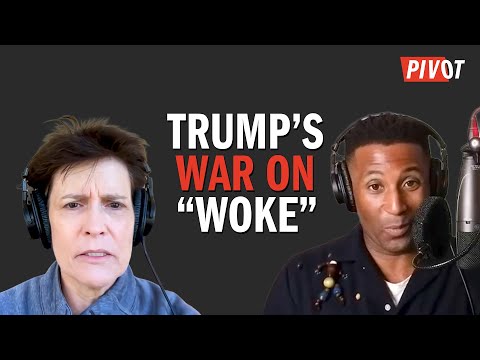
South Park, The Smithsonian, and Trump's Culture War | Pivot
Kara Swisher (host), Wesley Morris (guest), Narrator, Narrator, Narrator
In this episode of Pivot, featuring Kara Swisher and Wesley Morris, South Park, The Smithsonian, and Trump's Culture War | Pivot explores south Park, Trump’s Smithsonian Crusade, and Taylor Swift’s Podcast Power Kara Swisher and guest co-host Wesley Morris unpack Donald Trump’s latest cultural offensives, from threatening the Smithsonian’s slavery narratives to reshaping the Kennedy Center Honors, and how this fits a broader project of propaganda and historical “purification.” They analyze South Park’s savage new season skewering Trump, tech CEOs, and AI, and contrast that blunt satire with other cultural touchstones like Sex and the City’s revival, Spike Lee’s new film, and the state of summer movies. The conversation also dissects the White House’s use of TikTok despite past national security rhetoric, and the fragmentation of the social media landscape. Finally, they dive into Taylor Swift’s blockbuster appearance on Travis Kelce’s podcast as a masterclass in controlled authenticity and promotional power, before ending on a prediction that Adam Sandler is finally headed for an Oscar nomination.
South Park, Trump’s Smithsonian Crusade, and Taylor Swift’s Podcast Power
Kara Swisher and guest co-host Wesley Morris unpack Donald Trump’s latest cultural offensives, from threatening the Smithsonian’s slavery narratives to reshaping the Kennedy Center Honors, and how this fits a broader project of propaganda and historical “purification.” They analyze South Park’s savage new season skewering Trump, tech CEOs, and AI, and contrast that blunt satire with other cultural touchstones like Sex and the City’s revival, Spike Lee’s new film, and the state of summer movies. The conversation also dissects the White House’s use of TikTok despite past national security rhetoric, and the fragmentation of the social media landscape. Finally, they dive into Taylor Swift’s blockbuster appearance on Travis Kelce’s podcast as a masterclass in controlled authenticity and promotional power, before ending on a prediction that Adam Sandler is finally headed for an Oscar nomination.
Key Takeaways
Trump’s attacks on the Smithsonian fit a broader push to rewrite US history.
Morris frames Trump’s demand that museums spotlight the “brightness of America” over “how bad slavery was” as classic propaganda—an attempt to purify national narratives, minimize atrocities like slavery, and test-drive this approach in Washington, DC before exporting it to other cities.
Get the full analysis with uListen AI
The Kennedy Center Honors are becoming another Trump-branded cultural stage.
By installing allies, ousting longtime chair David Rubenstein, picking honorees like Stallone, KISS, and Gloria Gaynor, and openly joking about honoring himself, Trump is trying to turn a bipartisan, establishment arts ritual into a personal prestige vehicle and culture-war showcase.
Get the full analysis with uListen AI
South Park’s power comes from saying the quiet part out loud, relentlessly.
Swisher and Morris note that the show’s crude animation masks a very direct comedic ideology: it turns subtext into text, openly mocking Trump’s alleged bribery, tech’s sycophancy, and his “micropenis,” while also needling everyone from religion to trans issues with equal-opportunity cruelty.
Get the full analysis with uListen AI
Audience expectations around diversity shifted how legacy shows like SATC must evolve.
They argue that And Just Like That smartly absorbed criticism of the original’s whiteness by introducing characters like Sarita Choudhury’s real-estate mogul and Nicole Ari Parker’s Lisa in ways that feel socially and character-logically plausible, rather than tokenistic box-checking.
Get the full analysis with uListen AI
Social media is fragmenting, and younger users are gravitating to utility over spectacle.
While Trump cynically vacillates between calling TikTok a national security threat and exploiting it politically, both hosts describe their own and their kids’ drift toward Reddit and YouTube—for practical information and entertainment—rather than performative platforms like X.
Get the full analysis with uListen AI
Taylor Swift’s podcast appearance shows how she weaponizes “relatable” intimacy.
On New Heights, Swift uses an ostensibly casual conversation with her boyfriend and his brother to announce an album, detail the physical toll of the Eras Tour, and deepen her mythos; Morris sees it as controlled but genuine self-reflection in a safe space that she completely dominates.
Get the full analysis with uListen AI
Adam Sandler’s prestige run is likely to culminate in an Oscar nomination.
Morris predicts that a new Noah Baumbach film and a decades-long campaign by serious directors to tap Sandler’s dramatic potential will finally push him onto the Academy’s nominee list, though he argues the performance everyone loves is still the unbothered, Happy Gilmore–mode Sandler.
Get the full analysis with uListen AI
Notable Quotes
“If you remove slavery, we’re not America anymore. Like, who are we?”
— Wesley Morris
“There is not a number high enough to describe how bad slavery was.”
— Kara Swisher
“This is propaganda at its most blatant. Purifying the story of American history is part of it.”
— Wesley Morris
“The Easter egg is an omelet on South Park. You don’t have to look for it—they just say it.”
— Wesley Morris
“Taylor Swift does as she damn well pleases.”
— Kara Swisher
Questions Answered in This Episode
How far can a sitting president realistically go in reshaping national cultural institutions like the Smithsonian and the Kennedy Center before there’s meaningful institutional pushback?
Kara Swisher and guest co-host Wesley Morris unpack Donald Trump’s latest cultural offensives, from threatening the Smithsonian’s slavery narratives to reshaping the Kennedy Center Honors, and how this fits a broader project of propaganda and historical “purification. ...
Get the full analysis with uListen AI
Does South Park’s equal-opportunity offensiveness still function as useful satire in a polarized era, or does it risk normalizing harmful ideas under the banner of “it’s just jokes”?
Get the full analysis with uListen AI
What responsibilities do legacy shows like And Just Like That have to retroactively correct their blind spots around race and identity, and when does that evolution start to feel forced?
Get the full analysis with uListen AI
Is Taylor Swift’s intense control over her image and narrative a new, healthier model of pop stardom—or does it create impossible expectations and limit artistic risk-taking?
Get the full analysis with uListen AI
What would it mean for American film culture if the Academy finally rewarded Adam Sandler’s dramatic work—would it signal a real broadening of what counts as “serious” acting?
Get the full analysis with uListen AI
Transcript Preview
I don't think the Trump Administration thinks this is funny 'cause they have no sense of humor, right? Especially the micropenis part, which is what everybody thinks of Donald Trump. He has a micropenis.
Well, I mean, Kara, I can see the tie. (laughs)
(instrumental music) Hi, everyone. This is Pivot from New York Magazine and the Vox Media Podcast Network. I'm Kara Swisher, and August rolls on. Welcome back to-
(instrumental music)
... Got Re-August.
(laughs)
You like that? You like our sting? Scott is, uh, before I introduce you, yes, Scott is still away, and I know he misses me terribly. He's been posting a lot pretending he's still on the show, but pretty much he's gone, and, uh, he's sitting on the beach wishing 'cause there's so much news. But in his place, once again, I have yet another amazing co-host. He's a critic at large for the New York Times and two-time Pulitzer Prize winner, which Scott will never win, and the host of the Times' brand new podcast, Cannonball. It's Wesley Morris.
I, I can't believe, uh, this is happening to Scott again. (laughs)
I mean-
(laughs)
... each week at, eh, day after day, it's another fantastic person who is so more well-qualified to be my partner than other people. So, I'm thrilled that you are here. Uh, let me just explain what your podcast is all about. Now, you had a very popular podcast. Obviously, the New York Times is blowing up the whole podcast division with videos and this and that. So, talk about what, where the name Cannonball came from, and talk a little bit about your podcasting history 'cause it's been terrific actually.
Uh, thank you. Um, well, I, you know, Jay Wortham and I had this show called Still Processing. Um, it was, you know, one of the happiest things I've ever been involved with. Uh, and now I'm doing this other culture show, and I mean, mostly it's, it's me sort of thinking through, you know, art, TV shows, movies, books, sports. I mean, anything that I'm kinda curious about and trying to make these connections between y- uh, one thing to another thing. Usually, uh, you know, so far it's been me talking to other people about, like-
Right.
... what's coming up for them w- w- as I'm trying to work out my stuff with the other person. Um, and the name, you know, I, I wanted to call this show some other things-
Tell me.
... and-
Tell me the name you wanted. I know how the New York Times is about names. I shoved mine through so hard, but it was-
Did you have to fight to get Sway called Sway?
Oh, yeah. But-
Really?
... you know what? I didn't care. I refused to do it without the name. But what was the name you wanted? Tell me the name you wanted.
Install uListen to search the full transcript and get AI-powered insights
Get Full TranscriptGet more from every podcast
AI summaries, searchable transcripts, and fact-checking. Free forever.
Add to Chrome