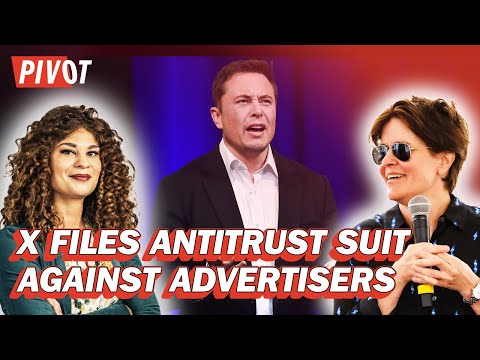
Elon Musk's Latest Lawsuit: X vs. Advertisers | Pivot
Noel King (host), Kara Swisher (host)
In this episode of Pivot, featuring Noel King and Kara Swisher, Elon Musk's Latest Lawsuit: X vs. Advertisers | Pivot explores musk’s Antitrust Gambit: X Targets Advertisers Amid Safety Backlash Kara Swisher and co‑host dissect Elon Musk’s new federal antitrust lawsuit against the World Federation of Advertisers, which claims major brands conspired to boycott X and cost it millions in ad revenue.
Musk’s Antitrust Gambit: X Targets Advertisers Amid Safety Backlash
Kara Swisher and co‑host dissect Elon Musk’s new federal antitrust lawsuit against the World Federation of Advertisers, which claims major brands conspired to boycott X and cost it millions in ad revenue.
They argue advertisers left primarily because Musk degraded brand safety on X and openly told them not to advertise, making the antitrust framing legally and logically weak.
Linda Yaccarino’s role and credibility as X’s CEO are sharply criticized, with her lawsuit announcement video portrayed as politically loyal, ineffective, and emblematic of X’s broader crisis.
The conversation expands to Musk’s broader pattern of using lawsuits as intimidation, his role in amplifying misinformation and far-right narratives, and closes with a brief discussion of Kamala Harris, TikTok policy, and her centrist political positioning.
Key Takeaways
Advertisers can and will walk away from unsafe platforms.
Brands are not obligated to spend on platforms that jeopardize their reputation; when X relaxed content moderation and Musk antagonized advertisers, major companies logically pulled their budgets.
Get the full analysis with uListen AI
Labeling an advertiser pullback as “antitrust” is legally tenuous.
Coordinated concern about brand safety does not automatically equal an illegal boycott, making Musk’s antitrust framing look more like political theater and pressure than a solid legal claim.
Get the full analysis with uListen AI
Lawsuits are being used as a strategic intimidation tool.
Musk’s pattern—suing Media Matters, OpenAI, advocacy groups, and now advertisers—mirrors tactics used by other powerful figures to drain critics’ resources, regardless of whether they ultimately win in court.
Get the full analysis with uListen AI
Leadership credibility matters as much as title in crisis communication.
Yaccarino’s lawsuit-announcement video is read as strained and inauthentic, reinforcing the perception that she is a “CEO in name only” and undermining X’s message to advertisers and regulators.
Get the full analysis with uListen AI
Misinformation persists because followers quickly move on, not because it’s proven.
When a claim is debunked, true believers often just shift to the next narrative instead of reassessing the source, making constant, shifting misinformation a durable political tool.
Get the full analysis with uListen AI
Musk’s political influence is growing and increasingly dangerous.
By amplifying false or inflammatory content (e. ...
Get the full analysis with uListen AI
Kamala Harris is strategically positioning herself at the center on tech issues.
Her stance on TikTok—supporting a change of ownership rather than an explicit ban—is framed as a lawyerly, moderate approach that balances national security concerns with constitutional and political realities.
Get the full analysis with uListen AI
Notable Quotes
“If advertisers don't want to advertise on your shitty platform, they shouldn't be made to.”
— Kara Swisher
“This whole case… Elon is engaging in a fantasy world of antitrust.”
— Kara Swisher (paraphrasing a former FTC policy director)
“His love language is lawsuits.”
— Kara Swisher
“He’s like trying to be Rupert Murdoch, except Rupert Murdoch is controlled about how he decimates society.”
— Kara Swisher
“One of the strengths of misinformation is when you have a piece of misinformation and it doesn't turn out to be true, you move to the next one.”
— Kara Swisher
Questions Answered in This Episode
Under what specific legal conditions would advertiser coordination on brand safety actually constitute an antitrust violation?
Kara Swisher and co‑host dissect Elon Musk’s new federal antitrust lawsuit against the World Federation of Advertisers, which claims major brands conspired to boycott X and cost it millions in ad revenue.
Get the full analysis with uListen AI
How should regulators distinguish between legitimate brand-safety collaboration and anti-competitive boycotts in digital advertising?
They argue advertisers left primarily because Musk degraded brand safety on X and openly told them not to advertise, making the antitrust framing legally and logically weak.
Get the full analysis with uListen AI
What governance or ownership models could realistically reduce the risks posed by a single unaccountable owner controlling a major social platform like X?
Linda Yaccarino’s role and credibility as X’s CEO are sharply criticized, with her lawsuit announcement video portrayed as politically loyal, ineffective, and emblematic of X’s broader crisis.
Get the full analysis with uListen AI
How can advertisers and civil society effectively push back against ‘lawsuit as intimidation’ tactics from powerful tech figures?
The conversation expands to Musk’s broader pattern of using lawsuits as intimidation, his role in amplifying misinformation and far-right narratives, and closes with a brief discussion of Kamala Harris, TikTok policy, and her centrist political positioning.
Get the full analysis with uListen AI
What would a balanced, constitutionally sound U.S. policy on TikTok and other foreign-owned social platforms look like under a Harris administration?
Get the full analysis with uListen AI
Transcript Preview
So, we're talking about one of your favorite people and his latest lawsuit. X filed a federal antitrust lawsuit against the World Federation of Advertisers. So, that group has a brand safety initiative, and this lawsuit alleges that the brand safety initiative and big companies that are members, CVS, Unilever, big guys here, conspired to illegally, conspired to illegally boycott X and deprive it of millions of dollars. Now, remind us, Kara, for those of us who have forgotten, why did advertisers flee X?
Well, it's easy. He told them not to advertise on his site.
(laughs)
He told them to go fuck themselves. He told them he's gonna let, you know, he's creating this lovely Nazi porn bar as I like to call it. Um, I, it's an astonishing lawsuit, and of course it was introduced by, you know, (sighs) if you want to continue with Nazis, the Eva Braun of this situation, um, uh, Linda Yaccarino, who, um, who just did this weird hostage-like video where she, she's such a scold as a person, um, and let me just say, uh, she g- sh- we had a set-to when we, at our conference, our co-conference last year, which she utterly made up, uh, that we had sandbagged her. She just did a terrible performance, and I've never seen someone act so prof- unprofessionally at a conference as her over the years. So, let me just put that out there. Um, she, she threw a fit because she-
What did she do? Yeah.
... didn't like who we had on stage before her, which of course is, that's exactly what a CEO does. Um, anyway, it was introduced, this idea that, th- the idea is that advertisers are plotting against them. They're conspiracy-minded people, and she has a situation where e- she's this, the purported c-, I call her CEO in name only, a sidenote, um, she, uh, she, she thinks that people have to advertise on their site even if they don't like what they're doing on their site, and it's so anti-capitalist, it's so ridiculous. This whole case, these, this guy went out of his way to tell advertisers to go fuck themselves a number, not just once, but a dozen times essentially, and now he doesn't like what he's reaping, what he, which is that he took away safety, he took away, he pl- replatformed all these terrible people, um, y- you know, and then of course he's doing it in the name of free speech, but then he cuts the speech of people he doesn't like, by the way. He's, he's apparently suppressing Kamala Harris's stuff, um, right now on the site. He closed down the Doods for Kamala Harris for a second.
Did he?
Um, you know-
I didn't know that.
... he just, this is just endless bullshit by these people, but at, it's very base. If advertisers don't want to advertise on your shitty platform, they shouldn't be made to. And even if they get together and say, "Isn't it a shitty platform?" it doesn't mean it's illegal. It's just, god, this is a shitty platform. And Linda Yaccarino who worked for NBC would have understood this rather easily. I don't want to advertise where it's unsafe, where I'm gonna suddenly be next to Andrew Tate or-
Install uListen to search the full transcript and get AI-powered insights
Get Full TranscriptGet more from every podcast
AI summaries, searchable transcripts, and fact-checking. Free forever.
Add to Chrome