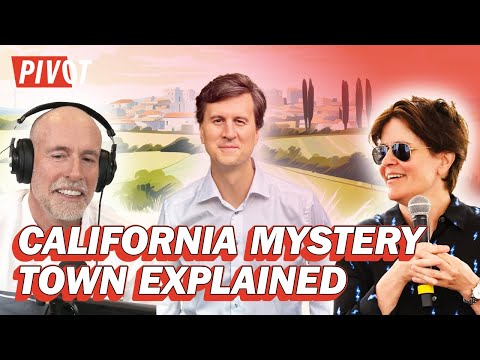
California Forever CEO Explains Plans to Build a New Community | Pivot
Kara Swisher (host), Jan Sramek (guest), Scott Galloway (host)
In this episode of Pivot, featuring Kara Swisher and Jan Sramek, California Forever CEO Explains Plans to Build a New Community | Pivot explores silicon Valley-Backed Plan Aims to Build Walkable City in Solano California Forever CEO Jan Sramek explains his plan to build a new, dense, walkable community on 62,000 acres in Solano County as a response to California’s housing crisis and growing inequality in the Bay Area.
Silicon Valley-Backed Plan Aims to Build Walkable City in Solano
California Forever CEO Jan Sramek explains his plan to build a new, dense, walkable community on 62,000 acres in Solano County as a response to California’s housing crisis and growing inequality in the Bay Area.
He argues the project follows historic precedents of privately initiated cities, focuses on traditional urbanism (street grids, mixed uses, starter homes), and explicitly rejects libertarian “network state” or smart-city experiments.
The conversation addresses skepticism about billionaire investors’ motives, questions around governance, secrecy in land acquisition, and lawsuits with local landowners, as well as the project’s potential economic benefits for Solano County and nearby Travis Air Force Base.
Sramek frames the effort as a long-term, for-profit but mission-driven investment meant to expand opportunity for working families and young people priced out of desirable walkable neighborhoods.
Key Takeaways
Building new walkable communities can directly address housing affordability.
By designing a dense, mixed-use city with row houses, small apartments, and starter homes, California Forever aims to produce units that are “affordable by design,” targeting starting prices around $400,000—below current new-build norms in Solano County.
Get the full analysis with uListen AI
Focusing on traditional urban design may be more viable than “smart city” experiments.
Sramek explicitly rejects high-tech governance or smart-city models, arguing that a simple, well-laid street grid and organic growth—mirroring neighborhoods like Noe Valley or the West Village—creates more resilient, beloved places.
Get the full analysis with uListen AI
Permitting reform is central to enabling large-scale housing production.
The project’s main governance “innovation” is faster permitting: a comprehensive environmental impact review for the whole community, then a 60‑day timeline for projects that conform to the plan, aiming to avoid the multi-year delays typical in cities like San Francisco.
Get the full analysis with uListen AI
Large, contiguous land control enables smarter planning and buffers.
Acquiring 62,000 acres quietly (via standard practice of masking the buyer’s identity) allowed California Forever to plan a cohesive layout and, for example, double the security buffer around the nearby Air Force base—something impossible with dozens of uncoordinated landowners.
Get the full analysis with uListen AI
Investor alignment on social outcomes can shape project priorities.
Though explicitly for-profit, Sramek says investors like Laurene Powell Jobs, Reid Hoffman, and others consistently push on issues such as teacher and nurse affordability, walkability, food access, sustainability, and broad opportunity—not just financial returns.
Get the full analysis with uListen AI
Local and political buy-in is a critical success factor for new cities.
State and federal actors are broadly supportive in principle, but their help is conditional on local community consent; early backlash from Solano officials and residents shows how mistrust of tech wealth and secrecy can slow or derail even well-intentioned projects.
Get the full analysis with uListen AI
Economic stagnation in “left-behind” regions creates an opening for ambitious projects.
With Solano County incomes now about 30% lower than the Bay Area average and a shortage of local employers, Sramek positions the new city as a way to bring jobs, tax base, and infrastructure investment to a region that has lagged for two decades.
Get the full analysis with uListen AI
Notable Quotes
“We run out of houses, we should find some land that is not prime farmland, that is not sensitive ecological habitat, and build a complete community there.”
— Jan Sramek
“I have zero interest in floating cities, network states, and smart cities. From that perspective, we’re really, really boring.”
— Jan Sramek
“If all we did over the next 30 or 40 years was build something that people looked at in 50 years the way they look at Noe Valley or the West Village, I would be over the moon.”
— Jan Sramek
“Young people have been held out from the American dream of buying a home.”
— Scott Galloway
“Whatever it is that we’re doing, California is no longer working for working families.”
— Jan Sramek
Questions Answered in This Episode
How can California Forever ensure long-term affordability for working families rather than drifting into another enclave for the wealthy?
California Forever CEO Jan Sramek explains his plan to build a new, dense, walkable community on 62,000 acres in Solano County as a response to California’s housing crisis and growing inequality in the Bay Area.
Get the full analysis with uListen AI
What concrete mechanisms will prevent this project from morphing into a de facto libertarian or exclusionary enclave despite current assurances?
He argues the project follows historic precedents of privately initiated cities, focuses on traditional urbanism (street grids, mixed uses, starter homes), and explicitly rejects libertarian “network state” or smart-city experiments.
Get the full analysis with uListen AI
How will the new community integrate with existing Solano County towns economically, socially, and politically, rather than overshadowing or displacing them?
The conversation addresses skepticism about billionaire investors’ motives, questions around governance, secrecy in land acquisition, and lawsuits with local landowners, as well as the project’s potential economic benefits for Solano County and nearby Travis Air Force Base.
Get the full analysis with uListen AI
What specific environmental safeguards are planned to protect local ecosystems, water resources, and agricultural activity while building at this scale?
Sramek frames the effort as a long-term, for-profit but mission-driven investment meant to expand opportunity for working families and young people priced out of desirable walkable neighborhoods.
Get the full analysis with uListen AI
If the model succeeds, how replicable is it in other regions facing housing and inequality crises, and what policy changes would be required to copy it?
Get the full analysis with uListen AI
Transcript Preview
Jan Sramek is the CEO and founder of California Forever. His company, with the help of some Silicon Valley billionaires, has acquired 62,000 acres in Solano County, California, which is north of, north and slightly east of San Francisco over the last few years with the goal of building a new community. So, we've wanted to have you on for while. We have so many questions. K- Scott particularly has a lot of questions. But there's been a lot of mystery around California Forever. I, I need you to explain exactly what you're planning and, uh, I, and I get a sense of why it was secret at the beginning is you were buying up all, 62,000 acres in this area north-east of San- just north-east of San Francisco, um, centered in, uh, you know, in Solano County. Um, so talk a little bit about what you're doing for people who don't know.
We are trying to get California to build again, uh, and solve this problem that we have, um... It's still the center of innovation, it's still this economic engine for the whole country, but it's the first time in the history of the country where people are moving out of a place like that. Um, and we're doing that by building a new community in Solano County, about an hour north of San Francisco. Uh, and in some sense, this should be the, um... This is the oldest kind of business model, um, in the world. We run out of houses, we should find some land, um, that is not prime farmland, that is not sensitive ecological habitat, and build a complete community there. And then I think what's different is we're not building a subdivision, we're building a complete community. And so we're building something that someone who grew up in an old neighborhood like Noe Valley or the Marina built a hundred years ago would recognize. A complete community with homes and apartments and schools and shops and jobs and churches, um, and, uh, we believe that this can be a really unique economic engine for Solano County, which is a part of the Bay Area that has been left out of the prosperity that, that's happened here o- over the last 20 years.
So, most cities just happen, you k- you know, they just sort of occur w- and then the, and then cities build on top of cities, right? That's the whole concept is, like, Rome has 10 different versions of itself depending on the era. Creating something out of nothing, a lot of cities that do this i- in the history have not worked out well. Brazilia, I was thinking lots of different things have, they've been trying to create the perfect city. Why did you, besides California needs more housing which, uh, obviously is, is a big deal, um, why do you think it'll work by just creating it out of nothing where people weren't naturally going to build themselves or settle themselves?
Install uListen to search the full transcript and get AI-powered insights
Get Full TranscriptGet more from every podcast
AI summaries, searchable transcripts, and fact-checking. Free forever.
Add to Chrome