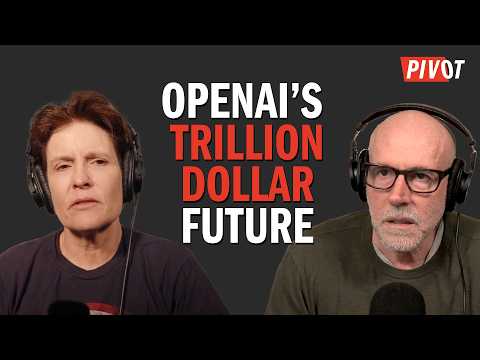
OpenAI’s Trillion-Dollar Future: “This Will Be a Monster IPO" | Pivot
Kara Swisher (host), Scott Galloway (host), Narrator, Narrator
In this episode of Pivot, featuring Kara Swisher and Scott Galloway, OpenAI’s Trillion-Dollar Future: “This Will Be a Monster IPO" | Pivot explores openAI’s IPO Hype, AI Therapy Risks, and Nvidia’s Market Power Surge Kara Swisher and Scott Galloway dissect OpenAI’s conversion to a for‑profit public benefit corporation and the likelihood of a trillion‑dollar IPO that will heavily rely on retail investors. They debate AI’s emerging role as de facto therapist, arguing platforms should face therapist‑like regulation, age gates, and parental alerts for self‑harm queries. The conversation widens to Nvidia’s outsized market influence, Jensen Huang’s political positioning, Elon Musk’s Grokipedia and Tesla pay package, and the broader AI-fueled stock boom at Microsoft, Meta, and Alphabet. They close by warning that AI is becoming “corporate Ozempic,” enabling growth with fewer workers and foreshadowing major white‑collar layoffs.
OpenAI’s IPO Hype, AI Therapy Risks, and Nvidia’s Market Power Surge
Kara Swisher and Scott Galloway dissect OpenAI’s conversion to a for‑profit public benefit corporation and the likelihood of a trillion‑dollar IPO that will heavily rely on retail investors. They debate AI’s emerging role as de facto therapist, arguing platforms should face therapist‑like regulation, age gates, and parental alerts for self‑harm queries. The conversation widens to Nvidia’s outsized market influence, Jensen Huang’s political positioning, Elon Musk’s Grokipedia and Tesla pay package, and the broader AI-fueled stock boom at Microsoft, Meta, and Alphabet. They close by warning that AI is becoming “corporate Ozempic,” enabling growth with fewer workers and foreshadowing major white‑collar layoffs.
Key Takeaways
OpenAI’s new structure paves the way for a blockbuster IPO fueled by hype.
By becoming a public benefit corporation with Microsoft owning 27% and the nonprofit retaining 26%, OpenAI is set up to tap massive public markets, likely at extreme revenue multiples that only retail investors will stomach after a carefully engineered first‑day ‘pop.’
Get the full analysis with uListen AI
AI platforms are already functioning as mass‑market therapists without therapist accountability.
With 800 million weekly ChatGPT users and a notable share using it for mental health, Swisher argues these systems enjoy huge therapeutic usage but face none of the licensing, privacy safeguards, or legal consequences that govern human therapists.
Get the full analysis with uListen AI
Regulation should differentiate AI access and responses for minors versus adults.
Galloway calls for identity and age verification, separate ‘under‑18’ AI modes with stricter filters, and automatic parental notification when kids search for self‑harm or similarly dangerous topics, mirroring rules for alcohol, guns, and restricted movies.
Get the full analysis with uListen AI
Public benefit corporation status is mostly branding unless backed by hard guardrails.
They argue PBC labels are marketing ‘jazz hands’ akin to BP’s “Beyond Petroleum,” and suggest real criteria—minimum tax payments, CEO pay caps relative to workers, and measurable public outcomes—if companies want to claim public‑benefit status credibly.
Get the full analysis with uListen AI
Nvidia and a handful of tech giants now pose systemic risk to global markets.
With Nvidia alone worth more than Germany’s GDP and Big Tech comprising a huge share of global market cap, a sharp correction in AI‑chip high‑flyers could drag down the S&P 500 and the broader economy, not just individual stocks.
Get the full analysis with uListen AI
Musk’s ventures increasingly blend ideology, control of ‘truth,’ and financial engineering.
Grokipedia is framed as an attempt to rewrite reference truth away from relatively neutral Wikipedia, while Truth Social’s new crypto prediction market and Tesla’s proposed trillion‑dollar pay package highlight Musk’s drive to monetize influence and narrative control.
Get the full analysis with uListen AI
AI is enabling revenue growth without headcount growth, accelerating white‑collar job risk.
Galloway likens AI to “corporate Ozempic”: firms like Meta and Amazon are proving they can grow 20–30% while shrinking staff, implying that more information‑economy companies (Etsy, Pinterest, Airbnb, etc. ...
Get the full analysis with uListen AI
Notable Quotes
“They have all the usage and none of the responsibility.”
— Kara Swisher (on AI platforms being used as therapists without regulation)
“This will be a monster IPO. CNBC will just sit there touching themselves talking about this for three weeks.”
— Scott Galloway (on a future OpenAI stock market debut)
“Public benefit corporation… it is such marketing and BS.”
— Scott Galloway (on the PBC label for companies like OpenAI)
“If NVIDIA throws up, I mean, everyone else has the stomach flu.”
— Scott Galloway (on Nvidia’s systemic importance to markets)
“AI is now absolutely the equivalent of corporate Ozempic.”
— Scott Galloway (on AI enabling growth with fewer employees)
Questions Answered in This Episode
If AI chatbots are de facto therapists for millions, what specific licensing, liability, and privacy regimes should we impose on them?
Kara Swisher and Scott Galloway dissect OpenAI’s conversion to a for‑profit public benefit corporation and the likelihood of a trillion‑dollar IPO that will heavily rely on retail investors. ...
Get the full analysis with uListen AI
How can regulators distinguish between genuine public‑benefit corporations and companies using the label as a marketing shield?
Get the full analysis with uListen AI
What is a realistic, sustainable valuation framework for OpenAI given the current hype and uncertain long‑term business model?
Get the full analysis with uListen AI
At what point does concentration of market value in Nvidia and a handful of AI giants become a systemic financial stability issue that regulators must address?
Get the full analysis with uListen AI
How should societies redesign tax, education, and safety‑net policies if AI allows companies to grow while permanently reducing demand for white‑collar labor?
Get the full analysis with uListen AI
Transcript Preview
Would you buy into it?
I mean, this will be a monster IPO ever- CNBC will just sit there touching themselves talking about this for three weeks. (instrumental music)
Hi, everyone. This is Pivot from New York Magazine and the Vox Media Podcast Network. I'm Kara Swisher.
And I'm Scott Galloway.
I have returned to our country, Scott.
Yeah. You look much better, um-
Thank you.
... how was your travel back, your trip back?
Uh, it's like takes, you know, you leave yesterday and arrive today, or no, you leave tomorrow and then you arrive today. I don't know. It just like, I got, I left at 10:00 AM and then I got back, it was the same day at 10:00 AM. That's all I know.
It's funny 'cause I, I can confirm you have not aged since yesterday.
(laughs) We've got a lot to get to today, including NVIDIA making history kind of crazy and Elon making Grokipedia. Oh my God. But first, OpenAI is finally a for-profit company, and I knew this would happen, Elon tried to stop it, but announced this week that has formed a public benefit corporation similar to the structures of AI, uh, xAI and Anthropic. Under the new setup, OpenAI's nonprofit foundation gets a 26% stake worth about $130 billion and will run, uh, the for-profit arm, Micro- it's the same board by the way, I think. Microsoft gets 27% and keeps exclusive rights to OpenAI's tech through 2032. Sam Altman reportedly does not have a significant stake. I, I, I feel like he's gonna do just fine. There's a buzz about an IPO as early as next year, possibly at a trillion dollar valuation outta the gate. But Altman's saying there's no specific timeframe yet. Um, uh, talk a little bit about this 'cause we've talked about the idea of them going public and this looks like, and, and a lot of companies not going public. And I just wanna note, uh, OpenAI is also sharing estimates for the first time, this is a drag on them I think, how many ChatGPT users are struggling with mental health issues. The company says in a typical week about 0.07% of users show possible signs of mental health emergencies. And while that percentage sounds small, remember ChatGPT has 800 million weekly active users. OpenAI says they've consulted with more than 170 mental health experts to help improve responses during "challenging conversations." Uh, Character.AI, which is probably the worst of them, is barring people under 18 from using its chat box starting next month. You're kidding, Character.AI. Uh, long time coming, should have happened right at the start. Um, so, th- these are a drag on these companies too, because these companies do know much more so than a Google Mental what people are asking specifically, uh, about. So talk a little bit about the IPO and possible drags on... I would say this would be a drag on it, but maybe not.
Install uListen to search the full transcript and get AI-powered insights
Get Full TranscriptGet more from every podcast
AI summaries, searchable transcripts, and fact-checking. Free forever.
Add to Chrome