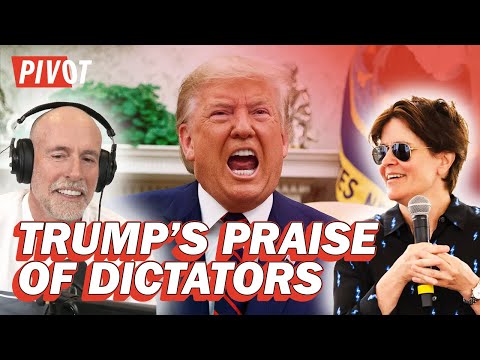
The Dangers of Donald Trump's Dictator Praise | Pivot
Kara Swisher (host), Ruth Ben-Ghiat (guest), Scott Galloway (host)
In this episode of Pivot, featuring Kara Swisher and Ruth Ben-Ghiat, The Dangers of Donald Trump's Dictator Praise | Pivot explores trump’s Dictator Praise as Re‑Education: A Democracy Danger Warning Historian Ruth Ben-Ghiat argues that Donald Trump’s violent imagery and praise of dictators form a deliberate, long-running “re-education” strategy to normalize political violence and authoritarian leadership models in the U.S.
Trump’s Dictator Praise as Re‑Education: A Democracy Danger Warning
Historian Ruth Ben-Ghiat argues that Donald Trump’s violent imagery and praise of dictators form a deliberate, long-running “re-education” strategy to normalize political violence and authoritarian leadership models in the U.S.
She connects Trump’s behavior to a century-long pattern of strongmen—Mussolini, Hitler, Erdoğan, Modi—who use modern media, personality cults, and emotional manipulation to build direct, unmediated bonds with followers.
Ben-Ghiat explains Trump’s appeal as a backlash to perceived social progress, particularly gender and racial emancipation, and situates his misogyny and “big daddy” persona within a toxic ideal of masculinity shared by many autocrats.
She warns that a second Trump term would accelerate efforts to weaken democratic institutions, weaponize law enforcement, and monetize the state, and calls for media, politicians, and the public to confront these threats more clearly and emotionally.
Key Takeaways
Trump’s violent posts are not jokes; they normalize coup-like outcomes.
Ben-Ghiat interprets the image of Biden as a bound hostage as depicting a successful overthrow of a political rival and argues that treating such imagery as humor quietly normalizes the idea of violent regime change.
Get the full analysis with uListen AI
Praising dictators is part of a long-term “re-education” of supporters.
By repeatedly celebrating leaders like Orbán, Xi, and Kim as strong and admirable, Trump is teaching his base to see authoritarianism as an attractive, legitimate model of governance rather than a threat.
Get the full analysis with uListen AI
Authoritarian strongmen exploit backlash against social and gender progress.
Moments of perceived ‘too much’ racial, gender, or social emancipation create openings for figures like Trump, who present themselves as protectors of those who feel displaced, especially conservative elites and aggrieved men.
Get the full analysis with uListen AI
Toxic masculinity and sexual aggression are features, not bugs, of strongmen.
Ben-Ghiat notes that many strongmen—from Mussolini to Gaddafi to Trump—use open misogyny and abuse as part of their ‘glamour,’ appealing to constituencies that want women’s power rolled back, as seen in the politics around Roe.
Get the full analysis with uListen AI
Modern autocrats master contemporary media to build personality cults.
Like Mussolini with newsreels, Hitler with radio, Modi with holograms, and Berlusconi with satellite TV, Trump uses Twitter and social media to create a direct, unfiltered bond that makes followers feel personally addressed and protected.
Get the full analysis with uListen AI
A second Trump term would likely intensify authoritarian capture and self‑enrichment.
She expects more aggressive use of executive power (e. ...
Get the full analysis with uListen AI
Media must abandon old ‘both sides’ habits to cover an autocratic party.
Ben-Ghiat argues that treating the GOP as a normal democratic party obscures its pro‑authoritarian orientation; she calls for better headline framing, front-and-center placement of democracy-relevant stories, and persistent probing of hypocrisy.
Get the full analysis with uListen AI
Notable Quotes
“Wake up people. This is an emergency.”
— Ruth Ben-Ghiat
“What he's been doing... you've got to re-educate people to see violence in a positive way, and even make it into something patriotic and even morally righteous.”
— Ruth Ben-Ghiat
“He was the perfect person as the anti-Obama... the male brute.”
— Ruth Ben-Ghiat
“Until we wean ourselves from this kind of toxic brute... ideal of masculinity, we're going to be susceptible to these Donald Trumps.”
— Ruth Ben-Ghiat
“He has been very clear about his intent to have an American version of fascism.”
— Ruth Ben-Ghiat
Questions Answered in This Episode
How can democratic leaders effectively counter a strongman’s emotional appeal without mimicking authoritarian tactics?
Historian Ruth Ben-Ghiat argues that Donald Trump’s violent imagery and praise of dictators form a deliberate, long-running “re-education” strategy to normalize political violence and authoritarian leadership models in the U.S.
Get the full analysis with uListen AI
What concrete signals should citizens watch for that indicate a democracy is sliding into ‘soft’ authoritarianism rather than just polarization?
She connects Trump’s behavior to a century-long pattern of strongmen—Mussolini, Hitler, Erdoğan, Modi—who use modern media, personality cults, and emotional manipulation to build direct, unmediated bonds with followers.
Get the full analysis with uListen AI
How can media organizations redesign coverage so they accurately convey the gravity of autocratic threats without normalizing or amplifying them?
Ben-Ghiat explains Trump’s appeal as a backlash to perceived social progress, particularly gender and racial emancipation, and situates his misogyny and “big daddy” persona within a toxic ideal of masculinity shared by many autocrats.
Get the full analysis with uListen AI
What strategies could help reduce the cultural allure of toxic, ‘brute force’ masculinity that makes strongmen so attractive to portions of the electorate?
She warns that a second Trump term would accelerate efforts to weaken democratic institutions, weaponize law enforcement, and monetize the state, and calls for media, politicians, and the public to confront these threats more clearly and emotionally.
Get the full analysis with uListen AI
If a second Trump term began implementing Project 2025-style changes, what institutions or state-level actors would be most critical in resisting authoritarian consolidation?
Get the full analysis with uListen AI
Transcript Preview
Ruth, uh, Ben, Bengioot is a professor of history at NYU and author of Strongmen: Mussolini to the Present. She also writes the Substack Lucid, ooh, what a good name, which focuses on abuses of power and threats to democracy. Ruth, welcome.
Thank you. I'm so glad to be here.
So we wanna talk dictators. Uh, I wanna start with something you posted on X last week after Donald Trump shared violent imagery of Joe Biden. On Truth Social, you wrote, "Wake up people. This is an emergency." Uh, a lot of people have concerns about that imagery, but what was it specifically that made you sound the alarm here? You've do- been doing it for a while, so I'm not so sure that it's the newest thing in the world for you, but, but talk about why, why that bothered you in particular of the many things that could bother you about Donald Trump.
Yeah. So i- it's about, you know, 'cause, 'cause I feel like, uh, Donald Trump has been, um, waging, and his GOP enablers have been waging a, a whole campaign to delegitimize all of our democratic institutions-
Mm-hmm.
... and in particular, uh, you know, attacking Joe Biden. This was an image which, uh, showed Joe Biden. It was a, you know, a sticker on the back of a pickup, uh, as though he were a hostage, uh, kidnapped. And if you study coups, a third of my book, Strongmen, is about coups and authoritarian takeovers.
Mm-hmm.
What is this showing? It's showing an outcome of a political situation where Biden is, has met a bad end, where he's somehow been overthrown and ended up tied up. (laughs)
Mm-hmm. Right.
And this is being, uh, you know, this is being depicted as something positive. And so it's-
Right.
... continuing the coup and it's just, it's, it's extremely dangerous, uh, for obvious reasons and I feel like this is, um, normalizing this is allowing people-
Which is the point, right?
Yeah.
I mean, you, you called it, you said Trump's repeated ev-, uh, elevation of dictators as models of leadership should be understood as part of a re-education strategy.
Yeah.
And one thing he does, is this is not new, he did that with CNN, if you remember him punching CNN.
Yep.
That, this was years ago. He, he did one that I wrote a column about when he was, you know, not just, um, you know, "Stand by and stand," whatever the heck he said. He says it a lot. It's b- it's not a new, fresh thing, but you're calling it a re-education strategy-
Yep.
... that's been ongoing, right? That it hasn't stopped, the coup, and he continues to do that. Explain why, 'cause, 'cause he says he's joking. He says he's kidding.
Yep.
He's, this is just him, that this is his brand of humor, (laughs) such that it's not funny, but still. Um, talk about the re-education part of it.
Install uListen to search the full transcript and get AI-powered insights
Get Full TranscriptGet more from every podcast
AI summaries, searchable transcripts, and fact-checking. Free forever.
Add to Chrome