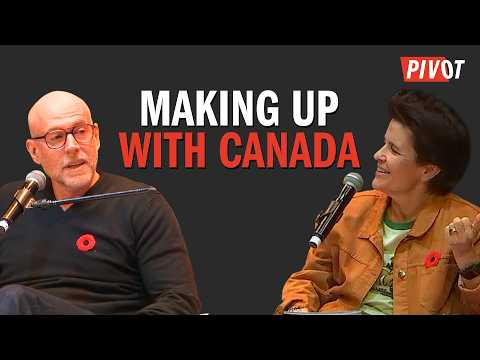
Can We Get Back Together With Canada? | Pivot
Kara Swisher (host), Narrator, Scott Galloway (host), Narrator, Narrator, Narrator, Narrator, Narrator, Narrator, Narrator
In this episode of Pivot, featuring Kara Swisher and Narrator, Can We Get Back Together With Canada? | Pivot explores tariffs, tourism, and tech: Kara and Scott reassess US–Canada ties Recorded live in Toronto, Kara Swisher and Scott Galloway use humor and sharp commentary to explore the fraying yet interdependent relationship between the US and Canada. They link US policy failures—government shutdowns, FAA underfunding, tariffs, SNAP cuts, ICE raids—to broader questions about economic vitality, safety, and national character. The conversation moves from air travel and AI’s economic and geopolitical stakes to the asymmetry of US–Canada trade and how tariffs are driving Canada to diversify away from America. They close by debating progressive politics, tourism declines, masculinity, and how AI-fueled disinformation and social media demand aggressive regulation, especially to protect young people.
Tariffs, tourism, and tech: Kara and Scott reassess US–Canada ties
Recorded live in Toronto, Kara Swisher and Scott Galloway use humor and sharp commentary to explore the fraying yet interdependent relationship between the US and Canada. They link US policy failures—government shutdowns, FAA underfunding, tariffs, SNAP cuts, ICE raids—to broader questions about economic vitality, safety, and national character. The conversation moves from air travel and AI’s economic and geopolitical stakes to the asymmetry of US–Canada trade and how tariffs are driving Canada to diversify away from America. They close by debating progressive politics, tourism declines, masculinity, and how AI-fueled disinformation and social media demand aggressive regulation, especially to protect young people.
Key Takeaways
Government-induced disruption to air travel erodes economic vitality and safety.
Flight cuts tied to US political brinkmanship hurt tourism, business, and overall productivity, while undermining decades of work that made aviation an extraordinarily safe, high-trust system.
Get the full analysis with uListen AI
AI may become a broad public good rather than a narrow corporate goldmine.
Galloway argues that, like vaccines, PCs, and airlines, AI could end up widely benefiting consumers and societies rather than allowing a small set of firms to hoard all the value—though he flags geopolitical and concentration risks.
Get the full analysis with uListen AI
US–Canada trade has long favored US shareholders, making tariffs economically irrational and politically hostile.
Because US exports to Canada tend to be higher-margin, higher-multiple goods, each dollar sold into Canada generates far more shareholder value than the resource-heavy exports Canada sends south, meaning Americans have actually been the bigger economic winners.
Get the full analysis with uListen AI
Canada’s forced diversification away from the US may strengthen its resilience and innovation.
Trump-era tariffs and unpredictability are pushing Canada to build new supply chains and trade relationships, reducing dangerous dependence on a single, volatile partner and potentially creating more room for homegrown tech ecosystems to flourish.
Get the full analysis with uListen AI
US budget choices expose a harsh value system that underfunds children while protecting older, wealthier voters.
With children making up a disproportionate share of SNAP recipients and public spending tilting toward seniors and enforcement (e. ...
Get the full analysis with uListen AI
Tourism is a higher-margin, larger employer than manufacturing, making tariff-driven tourism declines self-sabotaging.
By alienating Canadians and dampening cross-border travel, the US is damaging a sector that employs more Americans and generates more margin than the politically fetishized manufacturing industry supposedly helped by tariffs.
Get the full analysis with uListen AI
Unchecked AI and social media create a profit motive to polarize society and damage youth, demanding strong regulation.
They argue that AI-boosted platforms now financially benefit from dividing citizens and degrading mental health, especially among children, and call for age limits, school phone bans, antitrust, meaningful fines, and even criminal accountability for tech executives.
Get the full analysis with uListen AI
Notable Quotes
“If you don't think vaccines are the biggest innovation in history, your head's up your ass and I can't save you.”
— Scott Galloway
“It's as if the Trump administration said to ChatGPT, 'How can I elegantly reduce the prosperity of Americans inch by inch?'”
— Scott Galloway
“Your budget reflects your values, and we've decided we're no longer capitalism believing in winners and losers; we're about The Hunger Games.”
— Scott Galloway
“We have to absolutely get control of the technology industry and pass reasonable and important legislation around transparency, privacy, usage, safety.”
— Kara Swisher
“There is now, unfortunately, a profit incentive attached to evolving a new species of asocial, asexual youth… it's as if we have connected a profit motive into planning our own extinction.”
— Scott Galloway
Questions Answered in This Episode
How realistic is it that AI’s benefits will be broadly distributed rather than captured by a handful of dominant firms, and what policies would most influence that outcome?
Recorded live in Toronto, Kara Swisher and Scott Galloway use humor and sharp commentary to explore the fraying yet interdependent relationship between the US and Canada. ...
Get the full analysis with uListen AI
What concrete steps could Canada take to build a stronger, independent innovation ecosystem without relying so heavily on US capital and markets?
Get the full analysis with uListen AI
Given the asymmetry in US–Canada trade, what leverage—if any—does Canada actually have in pushing back against US tariffs and political volatility?
Get the full analysis with uListen AI
What specific regulatory framework for AI and social media would balance innovation with protections against disinformation and youth harm, and who should enforce it?
Get the full analysis with uListen AI
How can citizens in both countries meaningfully influence budget priorities so that children’s welfare and long-term social health are valued over short-term political gains?
Get the full analysis with uListen AI
Transcript Preview
We love Canada so much, and we (laughs) really might need to come here actually. Uh, it's feeling very Handmaid's Tale down there.
(instrumental music)
Hi, everyone. Live from the Queen Elizabeth Theatre in Toronto, this is Pivot from New York Magazine and the Vox Media Podcast Network. I'm Kara Swisher.
And I'm Scott Galloway. And where, where are we, Kara?
We're here.
Toronto! (laughs)
(cheering)
As I s- I said, this is the first stop on our seven cities in seven days tour, which should challenge our relationship quite a bit. We're spending all our time together. Um, before we start, we wanna tha- say a big thank you to our sponsors, Odoo and Upwork. Um, we're taping this show-
Or as I like to say, ka-ching.
(laughs) Okay. We're taping this show for audio and YouTube distribution, so look pretty. You will be able to hear it or watch it next week. And let's begin. Let's begin.
Okay.
We've got a lot to talk about tonight, Scott, from tariffs, to tourism, to local politics and beyond. We're gonna... we're, we're, we're making these in each city, whether we go to, uh, Boston... we're making them local. We're localizing them. That's what we're doing. So we're gonna talk a lot about Canada and things like that. We learned up on y'all.
Mm-hmm.
Um, but first, uh, how was your flight here?
My flight here?
Yeah.
I feel like you're setting me up. My flight here was fine, was great. It was a great-
Yeah, not mine.
Not yours?
Not mine, no.
See this is-
(laughs)
When she asks a question, it's not really 'cause she wants to know me. She wants me to say, "Kara, how was your flight?"
It's-
By the way, just a quick fun fact, there are more raccoons in Toronto than kids under the age of 10.
Okay, good to know.
True story. True story. 5% of Torontonians are vegan. I don't know if that's especially high or low, but-
Is it Tr- Torontonians or Torontosers?
Well, it's Toronto, but it's Torontonians, no?
Tonians, oh.
Hello!
(laughs)
Passport coming my way.
He was literally... we're in the car here, the entire time, I haven't seen him in a while, on ChatGPT having a relationship with a chatbot the whole time, and this is what he was doing. He was asking questions like this.
I'm in a relationship... I'm in a synthetic porn relationship, and I just... I'm addicted and I can't. And plus, you're like, "Nah, nah, nah, you're not doing this."
(laughs)
"Nah, nah, nah." That was sexist.
Yeah, okay. Okay, anyway, flight cancellations... mine was three hours late actually, across the US could rise 15% or even 20% if the government shutdown continues. The FAA started off by cutting around 3% of flights at select airports, including mine. Uh, we're taping this Saturday. By the time it airs, that number could be up to 10%. Here's, uh, uh, w- what do you think of this? What's going on? It's bad for every- everybody, business, tourism. I thought I almost wouldn't make it here.
Install uListen to search the full transcript and get AI-powered insights
Get Full TranscriptGet more from every podcast
AI summaries, searchable transcripts, and fact-checking. Free forever.
Add to Chrome