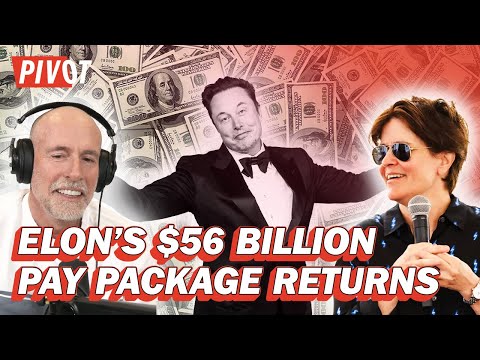
Tesla Asks Shareholders to Approve Elon Musk's Multi-Billion Payout | Pivot
Kara Swisher (host), Scott Galloway (host)
In this episode of Pivot, featuring Kara Swisher and Scott Galloway, Tesla Asks Shareholders to Approve Elon Musk's Multi-Billion Payout | Pivot explores tesla Board Backs Massive Musk Payout Amid Governance, Performance Concerns The discussion centers on Tesla’s move to reapprove Elon Musk’s multi‑billion dollar compensation package that a Delaware court struck down as unfair, and the plan to relocate the company’s corporate home from Delaware to Texas.
Tesla Board Backs Massive Musk Payout Amid Governance, Performance Concerns
The discussion centers on Tesla’s move to reapprove Elon Musk’s multi‑billion dollar compensation package that a Delaware court struck down as unfair, and the plan to relocate the company’s corporate home from Delaware to Texas.
Kara Swisher and Scott Galloway argue the board is deeply compromised and effectively captured by Musk, even as they acknowledge that the original option grant was far smaller than its current headline value due to Tesla’s past stock surge.
They highlight Tesla’s recent struggles—poor 2024 stock performance, delivery misses, layoffs, and intensifying competition—as more important than Musk’s pay headline.
Both hosts expect shareholders to reinstate the package and approve the move to Texas, but see this as emblematic of broader failures in corporate governance and overreliance on a single ‘key man’ leader.
Key Takeaways
Headline compensation numbers can mislead without understanding option valuation.
Musk’s ‘$45–56 billion’ package reflects the stock’s later surge; the economic value when options were granted was far lower, so boards and critics should evaluate pay at grant date, not just at peak market value.
Get the full analysis with uListen AI
Board independence is critical to fair executive compensation decisions.
The Delaware court’s objection centered on a board seen as socially and financially entangled with Musk, illustrating why genuinely independent directors and clean processes matter for legitimacy and shareholder protection.
Get the full analysis with uListen AI
Shareholder approval doesn’t automatically ensure sound governance.
Even with full disclosure, a shareholder vote can endorse a structurally compromised arrangement if investors are enamored with a star CEO or past returns, so governance safeguards must extend beyond simple majority votes.
Get the full analysis with uListen AI
Overreliance on a ‘key man’ leader creates structural business risk.
Tesla’s dependence on Musk for strategy, brand, and vision makes both the company and its board reluctant to challenge him, concentrating power and impeding succession planning or independent strategic course corrections.
Get the full analysis with uListen AI
Stock performance and operational metrics should outweigh personality in evaluation.
With Tesla the worst performer in the S&P year‑to‑date, missing delivery estimates and cutting 10% of its workforce, Swisher and Galloway argue analysis should focus on product competitiveness, margins, and execution rather than Musk’s persona.
Get the full analysis with uListen AI
Brand toxicity and rising competition erode early‑mover advantages.
They contend Tesla’s product feels ‘tired’ and Musk’s polarizing behavior damages consumer sentiment in a market where many strong EV alternatives now exist, diminishing the company’s once‑dominant positioning.
Get the full analysis with uListen AI
Regulatory and legal pushback can still shape future compensation structures.
Even if Musk’s package is reinstated, the Delaware decision likely signals to Tesla’s board (and others) that future grants cannot be as extreme or off‑market without attracting legal and governance challenges.
Get the full analysis with uListen AI
Notable Quotes
“This board is in his pocket... it benefits from him. They party with him.”
— Kara Swisher
“I do think it's a little unfair to look at the headline number, 'cause what we're not taking into account is the fact that the stock skyrocketed after they won the auction.”
— Scott Galloway
“The problem with this company is not that he is not paid enough. It has to do with the, you know, stop focusing on Twitter and focus on doing better cars.”
— Kara Swisher
“So far, year to date, Tesla is the worst performing stock in the S&P.”
— Scott Galloway
“He had his time... It’s a business story rather than an Elon Musk story.”
— Kara Swisher
Questions Answered in This Episode
How should investors properly value and judge large option-based CEO compensation packages when stock prices can dramatically change after grant?
The discussion centers on Tesla’s move to reapprove Elon Musk’s multi‑billion dollar compensation package that a Delaware court struck down as unfair, and the plan to relocate the company’s corporate home from Delaware to Texas.
Get the full analysis with uListen AI
What structural safeguards could make boards truly independent when a company is heavily identified with a single star founder-CEO?
Kara Swisher and Scott Galloway argue the board is deeply compromised and effectively captured by Musk, even as they acknowledge that the original option grant was far smaller than its current headline value due to Tesla’s past stock surge.
Get the full analysis with uListen AI
At what point does a CEO’s personal brand and behavior become a material liability for a consumer-facing company like Tesla?
They highlight Tesla’s recent struggles—poor 2024 stock performance, delivery misses, layoffs, and intensifying competition—as more important than Musk’s pay headline.
Get the full analysis with uListen AI
How might Tesla’s move from Delaware to Texas alter its governance, regulatory exposure, or future legal scrutiny of compensation decisions?
Both hosts expect shareholders to reinstate the package and approve the move to Texas, but see this as emblematic of broader failures in corporate governance and overreliance on a single ‘key man’ leader.
Get the full analysis with uListen AI
Given rising EV competition and softening sentiment, what concrete strategic moves would Tesla need to make to regain a durable advantage beyond Musk’s image?
Get the full analysis with uListen AI
Transcript Preview
Tesla is asking its shareholders to reinstate that multi-billion dollar compensation package for CEO Elon Musk, the one that was rejected by a Delaware judge as unfair earlier this year. The board says it still stands behind the pay package. Of course it does, 'cause they get paid. And that, uh, vote in favor at the company's annual meeting would, quote, "restore Tesla's shareholder democracy," again, but they're pulling in all the re- I can't believe First Amendment wasn't shoved in this statement. Shareholders will also be voting on Elon's plan to move Tesla's corporate home from Delaware to Texas. So it's m- moot the Delaware decision. This is what they said they were gonna do. They will do it. Uh, he'll get his money back. They'll win on this one. Tesla shareholders very much like Trump, uh, Truth Social. Although Tesla's an actual business, uh, still will bid it up no matter what he does. So they wanna pay him. Maybe he's worth it. If he d- if the stock does well, if he can turn it around and get better cars and, you know, get the p- economic prospects of Tesla doing well, he's certainly capable of it compared to Donald Trump. Uh, but, um, you know, the argument seems to be they may not have been aware of what was behind the creation of pay package, but now they are. Um, I think they will approve it. I think most people think they will. Um, I, just for people to be aware, Tesla's, uh, stock performance has been more than lackluster in 2000, uh, '24. The shares have lost 38% of their value so far. Elon's pay package was worth 56 billion in January, now it's closer to 45 billion. Um, he is the key man in this thing at this point. It probably shouldn't be. Um, and he wanted voting control back in January. Uh, he'll get that probably. It's, it's his company to do with what he wills, what he wants to. I don't know. I don't... It's capitalism. Nice to meet you. Thoughts?
I think that's right. I, I think the, uh, uh, I do think his pay package will be reinstated. And the, the thing that Aswath Damodaran, my colleague at Stern, pointed out that made a lot of sense to me is we see the headline number, 56, now 45 billion.
Mm-hmm.
And the delay, by the way, if, if he were to exercise and sell all his shares, I don't know if he was planning to do that, it's cost him 10 billion even if it's reinstated. But that's the headline number. But when they actually devised and awarded the compensation package, it was on options on stock when the stock was far below this. Meaning that if you valued his actual compensation package when the award was made, it was dramatically less-
Mm-hmm.
... than 45 billion. And as much as I hate to in any way defend or acknowledge the point, he wasn't co- he wasn't paid 45 billion. He was given options much less than that. And because the stock skyrocketed, he's, he's registered this enormous windfall. So I'm not sure it's entirely fair to say should the board be paying him 45 billion. If, if Vox gave us, uh, let's say $10 million worth of options-
Install uListen to search the full transcript and get AI-powered insights
Get Full TranscriptGet more from every podcast
AI summaries, searchable transcripts, and fact-checking. Free forever.
Add to Chrome