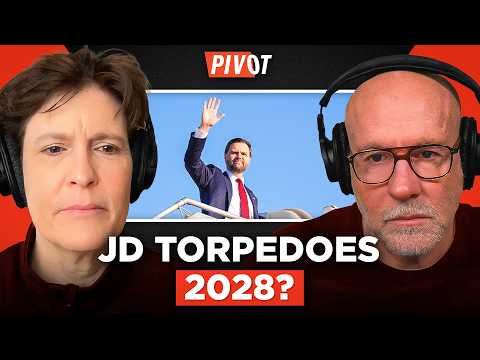
Did JD Vance Just Blow Up His 2028 Run? | Pivot
Scott Galloway (host), Kara Swisher (host)
In this episode of Pivot, featuring Scott Galloway and Kara Swisher, Did JD Vance Just Blow Up His 2028 Run? | Pivot explores vance vs Pope, Trump chaos, and AI rivalry reshape business headlines They argue markets are strangely resilient amid Iran escalation, partly because U.S. energy exposure differs from Europe’s and because wealthy stockholders are insulated from everyday price shocks like gasoline and fertilizer.
Vance vs Pope, Trump chaos, and AI rivalry reshape business headlines
They argue markets are strangely resilient amid Iran escalation, partly because U.S. energy exposure differs from Europe’s and because wealthy stockholders are insulated from everyday price shocks like gasoline and fertilizer.
They frame JD Vance’s public swipe at the Pope as politically self-defeating for a future presidential run, suggesting it alienates key religious constituencies and is an unnecessary fight.
They interpret Trump’s renewed threats toward Fed Chair Jerome Powell as either legally hollow bluster or a deliberate distraction tactic (especially from Epstein-related coverage), with Senate dynamics likely constraining outcomes.
They break down Amazon’s $11.5B Globalstar purchase as an infrastructure-and-spectrum play to build a Starlink competitor and potentially bundle connectivity into a future Prime/phone offering.
They portray Anthropic as surging on enterprise adoption while OpenAI appears to be “flailing,” criticizing OpenAI’s public memo attacking partners/rivals as poor strategy and a sign of internal or leadership strain.
Key Takeaways
Markets can rise while most households feel worse.
They argue equity indices increasingly reflect the fortunes of asset owners and tech-heavy firms, while inflationary shocks (gasoline, fertilizer) disproportionately hit lower-income consumers and global food systems.
Get the full analysis with uListen
Freedom-of-navigation chokepoints are treated as precedent-setting leverage.
Galloway supports blocking Iranian port access via Hormuz logic, warning that allowing unilateral chokepoint coercion (Hormuz, Suez, Malacca) undermines the global trade order—even if the U. ...
Get the full analysis with uListen
Picking fights with religious leaders is high-risk, low-reward politics.
They view Vance’s critique of papal commentary as a needless provocation that could alienate evangelicals/Catholics and signal excessive deference to Trump rather than independent leadership.
Get the full analysis with uListen
Trump–Powell threats look more like theater than policy.
They stress Trump likely lacks clear legal authority to remove Powell as a governor before 2028, and they interpret the flare-up as a media-cycle distraction rather than a credible governance plan.
Get the full analysis with uListen
Amazon’s satellite move is about spectrum plus vertical integration.
Buying Globalstar gives Amazon satellites and, crucially, spectrum rights—useful for consumer connectivity bundles and for Amazon’s own logistics stack (warehouses, drones, robots) that benefits from private network control.
Get the full analysis with uListen
Enterprise AI is shaping the perceived winner more than consumer buzz.
They argue Anthropic’s enterprise-heavy revenue mix creates stickier demand and fewer “free substitute” options than consumer LLMs, accelerating its IPO readiness and strengthening unit economics.
Get the full analysis with uListen
Publicly attacking partners/competitors can signal weakness for a market leader.
They criticize OpenAI for “shitposting” Microsoft/Anthropic, noting classic branding doctrine: leaders don’t validate rivals by naming them, and public spats risk enterprise trust and partner retaliation.
Get the full analysis with uListen
The merger window thesis: companies will attempt ‘unthinkable’ consolidation.
They predict more aggressive merger pitches (like United–American) because executives perceive regulators as weakened or politicized, despite obvious consumer harm and precedent like the blocked JetBlue–Spirit deal.
Get the full analysis with uListen
Seeded investment accounts can be transformative if designed to prevent early leakage.
They like the baby-bonds/“Trump accounts” concept on compounding grounds but argue the real societal payoff comes from locking funds until retirement to reduce future entitlement pressure—while acknowledging market-volatility concerns.
Get the full analysis with uListen
Notable Quotes
“I think that the US threatening to fully block the Strait of Hormuz is the right move right now.”
— Scott Galloway
“The NASDAQ and the Dow are the two most damaging metrics in the world... ’cause they give people a false sense of... prosperity and wellbeing.”
— Scott Galloway
“I think he's torpedoing his 2028 chances by picking a fight.”
— Kara Swisher
“Every time the temperature... around Epstein gets... above a certain temperature, they say, ‘Throw something out and distract everybody.’”
— Scott Galloway
“When you're the market leader... you never reference the competition.”
— Scott Galloway
Questions Answered in This Episode
What specific evidence supports the claim that blocking Hormuz-style chokepoints is an effective deterrent rather than an escalation trap?
They argue markets are strangely resilient amid Iran escalation, partly because U. ...
Get the full analysis with uListen AI
If Vance’s comments alienate Catholics, how do you weigh that against any potential gain with Trump’s base or nationalist messaging?
They frame JD Vance’s public swipe at the Pope as politically self-defeating for a future presidential run, suggesting it alienates key religious constituencies and is an unnecessary fight.
Get the full analysis with uListen AI
Legally, what mechanisms (if any) could allow a president to remove a Fed chair or governor, and what court precedents matter most here?
They interpret Trump’s renewed threats toward Fed Chair Jerome Powell as either legally hollow bluster or a deliberate distraction tactic (especially from Epstein-related coverage), with Senate dynamics likely constraining outcomes.
Get the full analysis with uListen AI
How realistic is the ‘Amazon phone + Prime Plus connectivity’ bundle, and what regulatory hurdles (FCC/spectrum, carrier rules) could slow it?
They break down Amazon’s $11. ...
Get the full analysis with uListen AI
Are Anthropic’s enterprise numbers a sign of sustainable advantage, or could they reflect short-term procurement cycles and pilot-project inflation?
They portray Anthropic as surging on enterprise adoption while OpenAI appears to be “flailing,” criticizing OpenAI’s public memo attacking partners/rivals as poor strategy and a sign of internal or leadership strain.
Get the full analysis with uListen AI
Transcript Preview
I'm sorry, Pope-- The Pope shouldn't talk about matters of theology? Isn't that exactly who should be discussing it?
I think he's torpedoing his twenty twenty-eight chances by picking a fight. [upbeat music] Hi, everyone. This is Pivot from New York Magazine and the Vox Media Podcast Network. I'm Kara Swisher.
And I'm Scott Galloway.
How's it going, Scott?
Just so well, Kara.
Let's do a rundown of the latest with Iran. President Trump says the war is very close to over again. As we tape this, Iranian officials and Pakistan's military chief are set to meet in Tehran to discuss messages exchanged by Iran and the US. Meanwhile, Iran's military has threatened shipping in the Red Sea if the US continues its blockade of Iranian ports.
Let me just piss off everybody. I think that the US threatening to fully block the Strait of Hormuz is the right move right now.
Mm-hmm. Many people do.
Because, uh, freedom of navigation for the last hundred and fifty years has been a key component of the global economy. It's a generally accepted principle that the Strait of Malacca or the Straits of Singapore, if Indonesia, Malaysia, and Singapore decide one day to exert their geopolitical power and get tens of billions of dollars, that they could block the strait. Egypt could block, uh, the Suez Canal. And so if there isn't a multilateral force that keeps this thing open, it just sets a terrible precedent. Now, how we got here, I think a lot of people have very valid arguments around, well, we broke it, now we're asking the world to fix it. But I think it's actually a good strategy to say, "Okay, if you want the straits blocked, we're gonna make them blocked for everyone, including all entry into Iranian ports," which I think is the right move. Um, what is really unusual about all of this, and I know we're gonna get to this, is that the markets are up.
Yeah, they are.
Um, which is just, uh, it, it fully seems like-
Yeah, let me-
... the markets have totally dislocated.
Yeah. The, the, the S&P-
Go ahead. I'm sorry
... is up two point eight percent at the time of this taping. Just they are going up 'cause they feel that there'll be some, some opening of the Hormuz, correct? I mean, or, or as Scott Bessent call it, the Strait of Vermouth, but go ahead.
There's a few things happening. One, [sighs] I've, I've said this for a while. I think the NASDAQ and the Dow are the two most damaging metrics in the world-
As you said, yeah
... 'cause they give people a false sense of how, of the prosperity and wellbeing in the world. And the reality is America is energy independent, and so there's actually some stocks that are up twenty to forty percent in the oil sector, so it's not a defense risk to us. There is... The markets seem to be saying that the war will at some point be resolved sooner rather than later, and that the oil flow through Hormuz will begin again. You also have this unusual situation where in the last three bi- major conflicts the US was involved in, or three exogenous shocks, the Gulf War, the Iraq War, and COVID, what ended up happening was the markets were way down. And initially, in March, at the outset of the war, the markets declined ten percent. But in each instance, there's been a rip back. In the following year, the stocks are up. So people have been buying the dip, and basically what's happened now is people buy the dip sooner, and the markets recover based on a historical pattern-
Install uListen to search the full transcript and get AI-powered insights
Get Full TranscriptGet more from every podcast
AI summaries, searchable transcripts, and fact-checking. Free forever.
Add to Chrome